Original Reality Theory
Aa
AI alignment protocol (in Portuguese)
1. Foundations and Methods of Analysis
1.1 What Is Original Reality Theory?
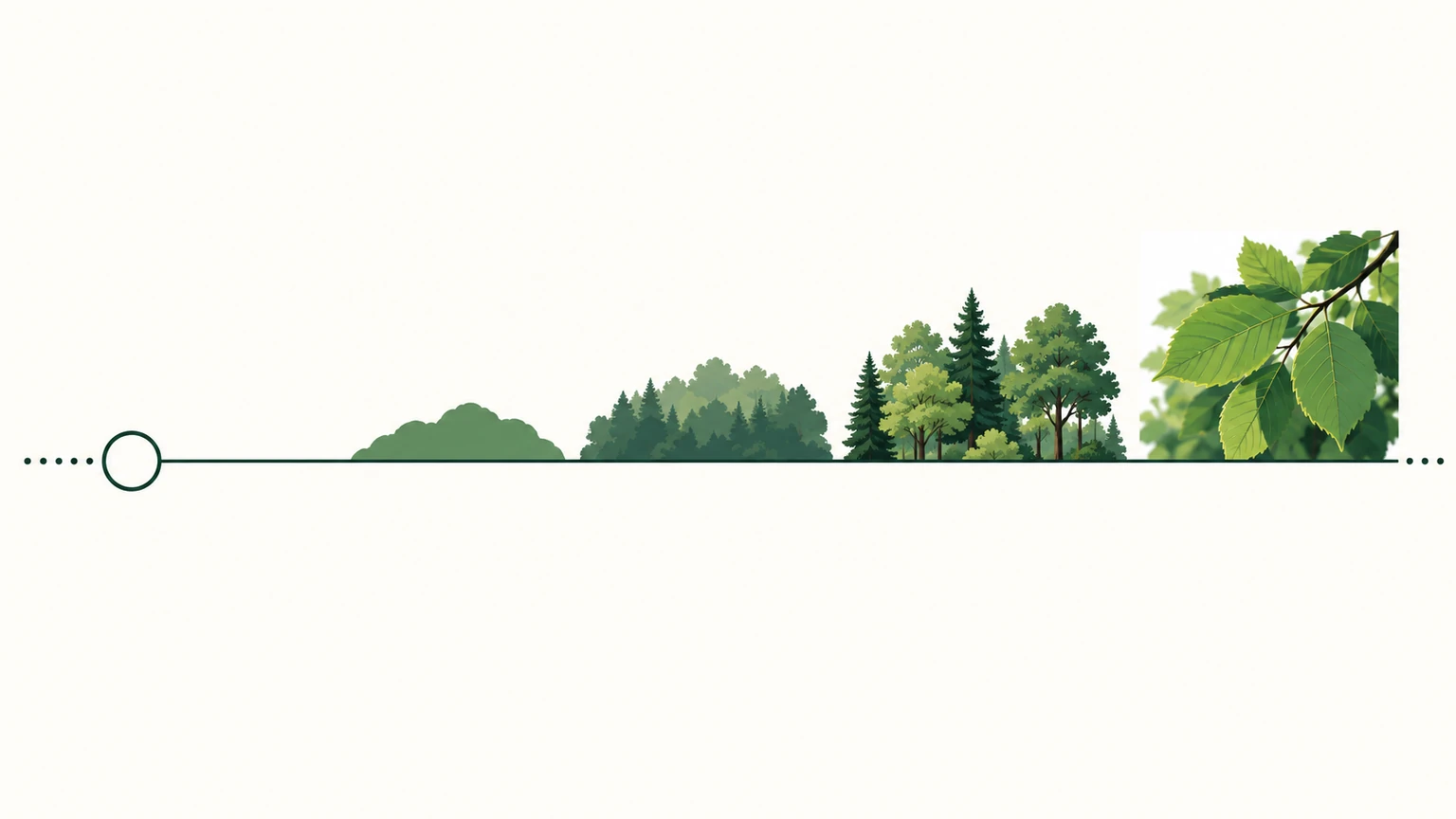
Imagine someone approaching a forest for the first time. From a distance, it is a patch of green. Closer up, the patch separates into trees, and then into trunks, branches, and leaves. One tree becomes distinguishable from another by its bark, the shape of its leaves, or its flowers, and a botanist would further distinguish species that seem identical to a layperson. The forest did not change during the walk. What increased was the number of distinctions the observer began to make and, with them, what the observer knows about the forest.
This is the movement of all knowledge. To know is to differentiate reality and combine its differences into information. Perceiving and differentiating are the same phenomenon, separable only in explanation: there is no perception without difference, because perceiving something means distinguishing it from something else. Differences make interpretation and representation possible. What was undivided becomes divided into elements that can be related and combined, and information arises from these combinations.
To abstract is to travel in the opposite direction. Make the walk in reverse: the species merge into “trees,” the trees into a “forest,” and the forest into a patch of green. At each step, differences decrease, and with them, information. To abstract is to know less at that scale.
Both movements have limits. The theoretical limit of constructing knowledge is total differentiation. The theoretical limit of abstraction is the absence of differentiation and, therefore, of information. In ORT, Original Reality is this second limit: reality without any differentiation, perspective, interpretation, or representation of it.
Original Reality therefore cannot be fully known, because knowing already means differentiating it. Even the patch of green is still a difference, since it is distinguishable from the sky and the ground. The limit lies beyond any image one can form. Everything that is perceived, interpreted, and represented constitutes a derived reality.
This distinction is itself also a derivation. “Original Reality,” “derived reality,” “differentiation,” “information,” and all of ORT’s other concepts are representations. The theory necessarily operates within a derived reality to formulate that which, at its limit, would cease to admit any formulation. Original Reality is not an object ORT intends to reach. It is a theoretical limit of abstraction.
This limit can be represented by a conceptual ruler along which the walk toward the forest extends in both directions. At one end is maximum differentiation: the growth of distinctions, concepts, interpretations, representations, and information through which a derived reality becomes progressively more complex. At the opposite end is maximum abstraction, with zero differentiation and zero information. This zero point conceptually corresponds to Original Reality. Both extremes are theoretical limits, not physical positions or points on a measurable scale, and ORT’s method always operates between them.
Summary for Reflection
- To know is to differentiate reality and combine its differences into information.
- To abstract is to remove differences and, with them, information.
- Perceiving and differentiating are the same phenomenon.
- Original Reality is the limit of the absence of differentiation and information.
- Original Reality cannot be fully known, because knowing already means differentiating.
- Everything that is perceived, interpreted, or represented is derived reality, including ORT’s concepts.
1.2 The ORT Method
Knowledge reaches each person largely already constructed. A child learns that a tree is one thing and a stone another long before knowing why, and may use these categories throughout life without retracing the path that made them possible. ORT proposes deliberately following this path in two movements: first deconstructing differentiations, then reconstructing them.
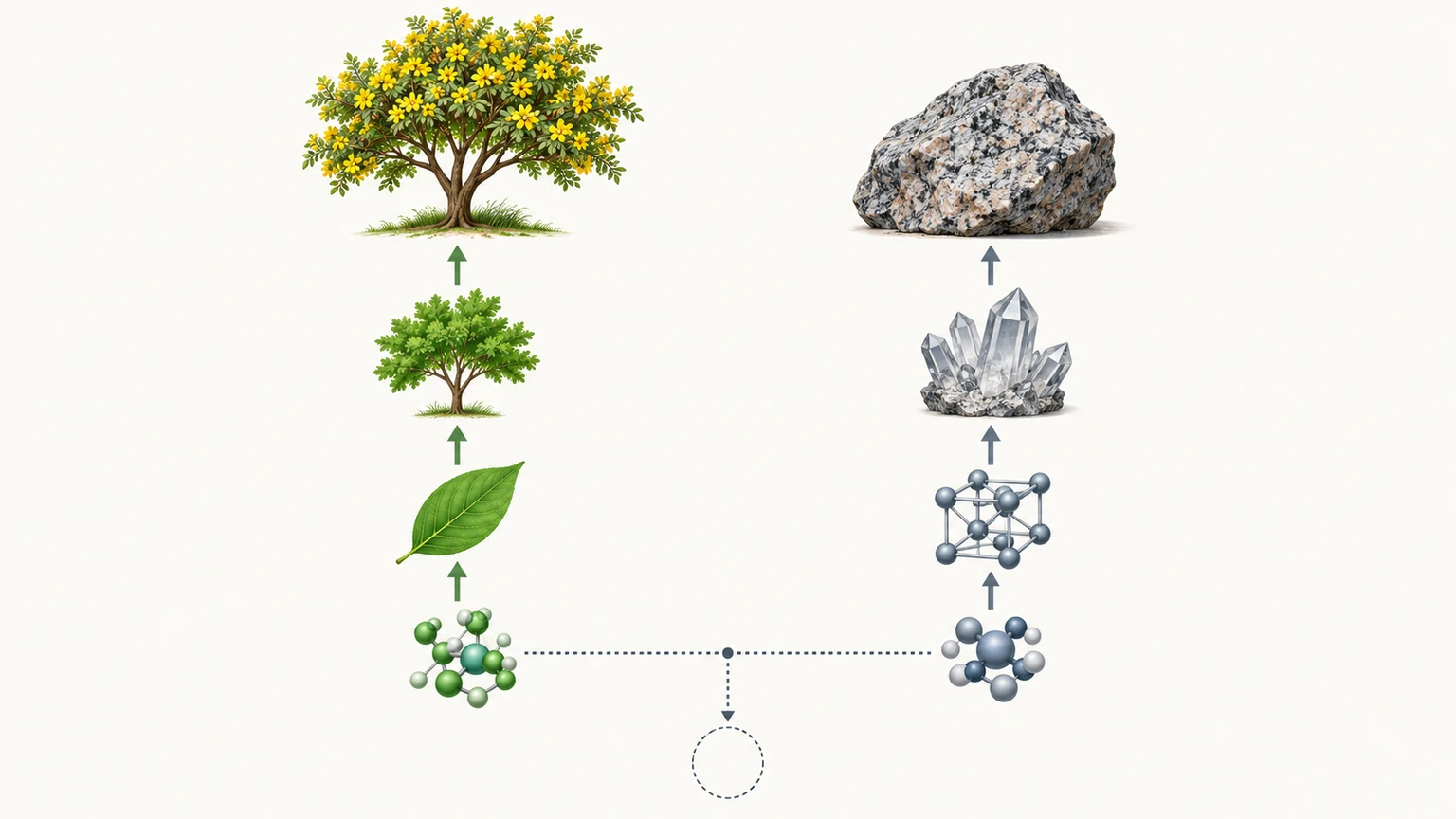
Take a tree and a stone. Deconstructing the tree, a yellow ipê becomes simply a “tree,” then a “plant,” then a “living being.” Deconstructing the stone, a block of granite becomes simply “rock,” then “geological material,” then “nonliving matter.” Now take the next step: set aside everything that still distinguishes them, the species, life, the type of rock, the way each is organized, and describe both only in terms of what constitutes them. In both, what remains is arrangements of atoms in relation: carbon, oxygen, and hydrogen in the tree; silicon, oxygen, and aluminum, among others, in the granite. Oxygen is present in both. Within this analytical frame, the distinction between living and nonliving no longer participates in the description, without the difference in organization between tree and stone ceasing to exist. This is how phenomena that appeared distinct reveal shared structures when differentiations are removed.
The movement does not stop at atoms, which are also arrangements. Abstraction continues toward the ruler’s zero limit without ever reaching it, because reaching it would mean eliminating every difference, including the one that makes it possible to formulate the method itself. The limit guides the movement, but is not a destination.
Then reconstruction begins. Moving back up, the question is: what differences must be added for tree and stone to become distinct again? The tree maintains its organization through regulated processes of exchanging matter and energy with its surroundings: it absorbs water and light, grows, and renews its leaves. Granite also exchanges heat with the environment and is slowly transformed by erosion, but it lacks the metabolic mechanisms of maintenance, regulation, and repair that the tree has. Reconstruction returns the observer to the same knowledge as before, with something more. The observer knows not only that the tree is alive and the stone is not, but which differentiations support this distinction and at what depth they disappear. This is what ORT calls increasing the structural resolution of knowledge.
The movement can be represented in two directions:
Construction → increase in differentiations → increase in possibilities for combination → increase in information → progressively more complex derived realities.
Abstraction → reduction in differentiations → reduction in possibilities for combination → reduction in information → conceptual approach to the limit of Original Reality.
ORT deliberately follows the second direction and then returns along the first, because the movement toward the limit reveals what disappears and what remains when differentiations are removed. In the figure, the tree and the stone move downward toward what they have in common and then back upward, each to its own organization.
What the method is not. Deconstructing does not mean physically taking something apart: the tree remains whole, and what changes is the resolution of the description. Nor is it reductionism. Saying that tree and stone are, at one level, arrangements of atoms does not mean the tree is “only” atoms. Reconstruction exists precisely to recover the organizations that make each arrangement what it is, at the scale at which it is. And the method does not replace inherited knowledge: it starts from that knowledge and returns to it.
ORT is thus both theory and method. The theory establishes Original Reality as the conceptual limit of the absence of differentiation and information. The method moves toward this limit through abstraction and then reverses direction, reconstructing differences. Deconstruct to identify what remains when differences disappear; reconstruct to understand how differences make possible what we call knowledge.
Summary for Reflection
- ORT’s method deconstructs differentiations and then reconstructs them.
- Abstraction reduces information at that scale and reveals what is shared.
- Reconstruction shows which differences support each concept.
- The zero limit guides the movement, but is not reached.
- The method does not replace inherited knowledge: it increases its structural resolution.
The entire theory on a single pageContinuous reading for people and AI tools.