Original Reality Theory — full text
Aa
AI alignment protocol (in Portuguese)
Introduction
Someone watches the sunset. A physicist might describe the scene as sunlight passing through a thicker layer of atmosphere, where blue light scatters more than red. A biologist might describe it as light stimulating three types of cones in the retina, and a neuroscientist as patterns of activity in the visual cortex. A poet might simply call it the end of a day. Each illuminates one aspect of the scene, and none exhausts it, because each frames the same event differently, at a particular scale and from a particular question.
Original Reality Theory (ORT) starts from this premise: different fields of knowledge represent distinct abstractions of the same reality. The question it addresses is how to relate these abstractions without erasing what is specific to each, and its answer is a conceptual framework that describes reality through fundamental principles shared by a wide range of phenomena, with the aim of expanding the analytical capacity of those who use it.

Where This Inquiry Comes From
ORT did not begin as an attempt to create an alternative to existing theories. It began with a question about human behavior, which soon led to systematic observation of the mind itself: how thoughts arise, how interpretations are constructed, how they can be changed, and how different ways of perceiving alter our understanding of the world. Over time, the ideas that emerged from this exercise were tested against knowledge produced in fields such as neuroscience, psychology, anthropology, sociology, history, physics, biology, and systems theory. The aim was never to confirm a personal intuition, but to submit it, continually, to dialogue with what is already known.
Along the way, it became clear that ORT is not alone. General Systems Theory, Complexity Theory, Cybernetics, Information Theory, and contemporary efforts to unify physics also seek to understand reality in an integrated way, and ORT has points of contact with many of them. It does not intend to replace or compete with them, and it does not start from the idea that current knowledge is wrong. On the contrary: it learns from that knowledge, uses it as a reference, and returns to it whenever a proposed relationship needs to be checked.
ORT Itself Is a Representation
Every explanation uses words, concepts, diagrams, and numbers, and none of these resources is what it represents. ORT is no exception. Its concepts, beginning with “Original Reality,” are representations constructed to make comprehensible something that, at its limit, admits no representation. The theory therefore subjects itself to the same limits it recognizes in other explanations, and the sciences remain the source of evidence about the phenomena they study.
Taken as a whole, ORT is a proposal: it should be examined for the coherence of its internal logic and tested against available knowledge, and readers are invited to do so. Within the exposition, however, the theory speaks in statements, and each concept is presented as ORT defines it.
The State of This Text
ORT’s conceptual framework is established. The work in progress is its exposition and formalization: finding words, examples, images, and mathematical formulations that allow readers with different backgrounds and perspectives to reconstruct the ideas as closely as possible to the form in which they were conceived, and rigorously demonstrating the relationships the theory establishes. The parts marked as under development are in this situation, and the text will be updated as this exposition advances. The articles and essays published on the site do not constitute a complete presentation of the theory. They are applications and reflections that draw on its concepts.
How to Read
The text proceeds in three movements. The first (section 1) presents ORT’s foundation and method. The second (section 2) does not yet present the core of the theory: it examines how we represent, communicate, and compare, and also who is reading—that is, the cognitive matrix each reader brings, how to observe it at work, why it is worth the effort to develop it, and how to examine and revise our own interpretations. These mechanisms and practices shape the reading of any explanation, including this one. The section ends with the premises that guide the rest of the journey. The third (section 3 onward) presents the theory itself, from the most abstract level to the one closest to human experience. Along the way, readers are invited to do what the theory itself proposes: understand before comparing, compare before concluding, and ask, at every step, where they are looking from and with what matrix. At the end of each section, the “Summary for Reflection” brings together the text’s central ideas in short statements. These are not sentences to memorize or conclusions to accept: they are starting points for readers to connect what they have read, reach their own conclusions, and build a new way of understanding—the second matrix discussed in section 2.5, needed both to agree and to disagree on sound grounds.
Why Not Skip Section 2
It is tempting to go straight to the theory. Section 2 seems preparatory, and in a sense it is. But ORT cannot be understood simply by adding its content to what one already knows: it calls for a different way of relating knowledge, a form of systems thinking that does not arise automatically from the reader’s previous experience, however solid that experience may be. Section 2 gives readers the tools to build this foundation. Drawing on science, it shows how we represent, communicate, and interpret, and invites readers to observe these processes within themselves as they read. Those who skip this stage tend to fit the theory into the matrix they already had: to understand it only partially, reject it for something it did not say, or, more difficult to notice, mistake familiarity with the words and examples for understanding the relationships the theory proposes. Section 2 does not ask for agreement. It offers the preparation needed to understand ORT as a whole and examine its propositions on sound grounds.
Summary for Reflection
- Different fields of knowledge represent distinct abstractions of the same reality.
- ORT proposes a conceptual framework that relates these abstractions without erasing their specific features.
- ORT began with systematic observation of the mind itself and continually submits itself to dialogue with existing knowledge.
- ORT does not replace the sciences: it learns from them and returns to them for verification.
- ORT itself is a representation and is subject to the limits it recognizes.
- Taken as a whole, ORT is a proposal; within the exposition, it speaks in statements.
- ORT’s conceptual framework is established; the work in progress is its exposition.
- The journey has three movements: the foundation and method, the reader’s preparation, and the exposition of the theory.
- Each summary is a starting point for reflection and connection, not a conclusion to memorize or accept.
- Without the preparation in section 2, the theory tends to be fitted into the matrix the reader already had.
1. Foundations and Methods of Analysis
1.1 What Is Original Reality Theory?
Imagine someone approaching a forest for the first time. From a distance, it is a patch of green. Closer up, the patch separates into trees, and then into trunks, branches, and leaves. One tree becomes distinguishable from another by its bark, the shape of its leaves, or its flowers, and a botanist would further distinguish species that seem identical to a layperson. The forest did not change during the walk. What increased was the number of distinctions the observer began to make and, with them, what the observer knows about the forest.
This is the movement of all knowledge. To know is to differentiate reality and combine its differences into information. Perceiving and differentiating are the same phenomenon, separable only in explanation: there is no perception without difference, because perceiving something means distinguishing it from something else. Differences make interpretation and representation possible. What was undivided becomes divided into elements that can be related and combined, and information arises from these combinations.
To abstract is to travel in the opposite direction. Make the walk in reverse: the species merge into “trees,” the trees into a “forest,” and the forest into a patch of green. At each step, differences decrease, and with them, information. To abstract is to know less at that scale.
Both movements have limits. The theoretical limit of constructing knowledge is total differentiation. The theoretical limit of abstraction is the absence of differentiation and, therefore, of information. In ORT, Original Reality is this second limit: reality without any differentiation, perspective, interpretation, or representation of it.
Original Reality therefore cannot be fully known, because knowing already means differentiating it. Even the patch of green is still a difference, since it is distinguishable from the sky and the ground. The limit lies beyond any image one can form. Everything that is perceived, interpreted, and represented constitutes a derived reality.
This distinction is itself also a derivation. “Original Reality,” “derived reality,” “differentiation,” “information,” and all of ORT’s other concepts are representations. The theory necessarily operates within a derived reality to formulate that which, at its limit, would cease to admit any formulation. Original Reality is not an object ORT intends to reach. It is a theoretical limit of abstraction.
This limit can be represented by a conceptual ruler along which the walk toward the forest extends in both directions. At one end is maximum differentiation: the growth of distinctions, concepts, interpretations, representations, and information through which a derived reality becomes progressively more complex. At the opposite end is maximum abstraction, with zero differentiation and zero information. This zero point conceptually corresponds to Original Reality. Both extremes are theoretical limits, not physical positions or points on a measurable scale, and ORT’s method always operates between them.

Summary for Reflection
- To know is to differentiate reality and combine its differences into information.
- To abstract is to remove differences and, with them, information.
- Perceiving and differentiating are the same phenomenon.
- Original Reality is the limit of the absence of differentiation and information.
- Original Reality cannot be fully known, because knowing already means differentiating.
- Everything that is perceived, interpreted, or represented is derived reality, including ORT’s concepts.
1.2 The ORT Method
Knowledge reaches each person largely already constructed. A child learns that a tree is one thing and a stone another long before knowing why, and may use these categories throughout life without retracing the path that made them possible. ORT proposes deliberately following this path in two movements: first deconstructing differentiations, then reconstructing them.
Take a tree and a stone. Deconstructing the tree, a yellow ipê becomes simply a “tree,” then a “plant,” then a “living being.” Deconstructing the stone, a block of granite becomes simply “rock,” then “geological material,” then “nonliving matter.” Now take the next step: set aside everything that still distinguishes them, the species, life, the type of rock, the way each is organized, and describe both only in terms of what constitutes them. In both, what remains is arrangements of atoms in relation: carbon, oxygen, and hydrogen in the tree; silicon, oxygen, and aluminum, among others, in the granite. Oxygen is present in both. Within this analytical frame, the distinction between living and nonliving no longer participates in the description, without the difference in organization between tree and stone ceasing to exist. This is how phenomena that appeared distinct reveal shared structures when differentiations are removed.
The movement does not stop at atoms, which are also arrangements. Abstraction continues toward the ruler’s zero limit without ever reaching it, because reaching it would mean eliminating every difference, including the one that makes it possible to formulate the method itself. The limit guides the movement, but is not a destination.
Then reconstruction begins. Moving back up, the question is: what differences must be added for tree and stone to become distinct again? The tree maintains its organization through regulated processes of exchanging matter and energy with its surroundings: it absorbs water and light, grows, and renews its leaves. Granite also exchanges heat with the environment and is slowly transformed by erosion, but it lacks the metabolic mechanisms of maintenance, regulation, and repair that the tree has. Reconstruction returns the observer to the same knowledge as before, with something more. The observer knows not only that the tree is alive and the stone is not, but which differentiations support this distinction and at what depth they disappear. This is what ORT calls increasing the structural resolution of knowledge.
The movement can be represented in two directions:
Construction → increase in differentiations → increase in possibilities for combination → increase in information → progressively more complex derived realities.
Abstraction → reduction in differentiations → reduction in possibilities for combination → reduction in information → conceptual approach to the limit of Original Reality.
ORT deliberately follows the second direction and then returns along the first, because the movement toward the limit reveals what disappears and what remains when differentiations are removed. In the figure, the tree and the stone move downward toward what they have in common and then back upward, each to its own organization.

What the method is not. Deconstructing does not mean physically taking something apart: the tree remains whole, and what changes is the resolution of the description. Nor is it reductionism. Saying that tree and stone are, at one level, arrangements of atoms does not mean the tree is “only” atoms. Reconstruction exists precisely to recover the organizations that make each arrangement what it is, at the scale at which it is. And the method does not replace inherited knowledge: it starts from that knowledge and returns to it.
ORT is thus both theory and method. The theory establishes Original Reality as the conceptual limit of the absence of differentiation and information. The method moves toward this limit through abstraction and then reverses direction, reconstructing differences. Deconstruct to identify what remains when differences disappear; reconstruct to understand how differences make possible what we call knowledge.
Summary for Reflection
- ORT’s method deconstructs differentiations and then reconstructs them.
- Abstraction reduces information at that scale and reveals what is shared.
- Reconstruction shows which differences support each concept.
- The zero limit guides the movement, but is not reached.
- The method does not replace inherited knowledge: it increases its structural resolution.
2. Before Explaining the Theory
Every explanation reaches the reader through words, numbers, images, and examples, and meets someone who already brings a way of seeing the world. In that encounter, a new idea is understood, distorted, or rejected, often before it is examined. So, before presenting the Theory of Original Reality, this section prepares that encounter. It does not yet teach the theory: it prepares those who will read it. And what it offers is useful far beyond the theory: reading more precisely, noticing what influences our own judgment, and disagreeing more accurately.
The journey rises like a staircase, with each step supporting the next. It begins with the instruments of any explanation: signs, which represent without ever being what they represent (2.1), and communication, in which speakers put only part of what they think into words, and listeners reconstruct that part using their own reference points (2.2). It then turns to the limits of those who seek knowledge: no one masters every specialty, and relating findings from different fields requires knowing what is being brought in from each (2.3). The exercises that follow train how we see. By changing the measuring stick and the context, the same phenomenon reveals relationships that seemed not to exist, and even a simple question, such as which is more powerful, the human brain or the Sun, no longer has an obvious answer (2.4).
Halfway up the staircase, the object of inquiry changes: it becomes the reader. Each person interprets what they read through a cognitive matrix formed over a lifetime, and this matrix both enables understanding and can distort a new idea (2.5). The next step is learning to observe it at work, in thoughts, emotions, and the body (2.6). Then comes the inevitable question of why to invest this effort, and the answer goes beyond reading: better questions at work, at home, and when facing our own problems (2.7). The final step moves from observation to metacognition: using what we have lived through as material for inquiry, examining how our own certainties took shape, and building a second way of analyzing alongside the old matrix (2.8).
At the top of the staircase, the premises (2.9) bring together the criteria by which the theory should be read. None of this asks for agreement in advance. It asks for the conditions needed to understand what ORT claims and, from there, accept, correct, or reject it on an informed basis. Scientific notes and technical developments remain accessible outside the main reading text.
2.1 The Word Is Not the Thing
The letter “A” is a graphic sign within a particular writing system. Its form can be recognized and used according to the conventions of that system.
The word “tree” is a linguistic sign. It can be used to represent a tree, but the word “tree” is not the tree. The sign is not what it represents.
Different languages and writing systems use different forms of encoding. Not all languages have writing, and not all writing systems are alphabetic.
Letters, words, numbers, images, diagrams, and other signs can participate in systems of representation. The conventions of each system allow these signs to be used and related.
A single word also brings many things together. “Tree” names plants with narrow or broad crowns, with branching limbs or a crown of leaves atop a long trunk, which botany classifies into countless species. A drawing selects only some of their features, such as the trunk and crown. And the same idea is written árvore in Portuguese, árbol in Spanish, and 树 in Chinese, a character that is not made up of letters.
Representation and what is represented are not the same thing. Distinguishing reality, representation, and code is necessary before examining how a message is produced, transmitted, and interpreted.

Summary for Reflection
- The sign is not what it represents.
- Reality, representation, and code are distinct.
- The same content can be encoded in different forms according to the conventions of each system.
2.2 Between What We Think and What Others Understand
Before presenting a theory, we need to consider what happens when we try to communicate it. A text does not directly transport the writer’s understanding into the reader’s mind. It offers words, examples, and relationships from which the reader constructs an interpretation.
The inquiry into communication presented here emerges from ORT, but does not constitute the exposition of the theory. Its role at this stage is to prepare the ground for reading: to examine how perception, interpretation, and representation participate in constructing an explanation and in another person’s understanding of it.
The starting point was a practical difficulty: producing a message whose meaning would remain invariant between sender and receiver, initially between a human being and an artificial intelligence. Adding definitions, examples, and constraints seemed a way to eliminate ambiguity. Yet each clarification relied on new terms that also needed interpretation. Precision could reduce some possible readings without eliminating all the others.
This difficulty shifted the question. Rather than first seeking a message immune to every transformation of meaning, it became necessary to investigate the process through which something is perceived, interpreted, represented, and communicated. A message reaches someone who already has experiences, references, and conditions of their own; it does not arrive at an empty starting point.
The technical project proposes examining these conditions together. An individual’s trajectory participates in how they respond, while circumstance includes the present conditions of their relationship with themselves and their environment. Perception, interpretation, and representation are separated in the explanation so that we can investigate them, without assuming that they occur as isolated stages or in a rigid sequence. The model under development must make their recursive relationships explicit.
In communicating, senders select something of what they intend to express and organize it through a code. Receivers encounter the message produced, not the totality of the relationships involved in producing it. From that message, they form their own interpretation. Representations produced by distinct individuals therefore do not possess absolute identity, as Premise 2 establishes for any two things.
This does not require treating all communication as failure. Two interpretations may correspond sufficiently for a particular purpose without being identical. For this reason, the project does not use correspondence as an absolute magnitude: we must specify the criterion by which two representations are being compared. An approximation sufficient for one purpose may be insufficient for another.
Dialogue allows this process to be revisited. A response offers new elements for interpretation, may reveal differences, and makes it possible to reformulate the message. But repeating the exchange does not, by itself, guarantee closer correspondence. Feedback may increase, reduce, or reorganize correspondence, and the model must investigate the conditions under which this happens.
An everyday scene shows all of this in a few seconds. After a presentation, a colleague says with a smile: “You did much better than I expected!” From what he was thinking, he singled out her good performance and meant to praise it. She receives the sentence through her own frames of reference and hears something else: that little had been expected of her. Neither person deliberately got it wrong. A question could resolve the misunderstanding—or deepen it.

For reading ORT, the consequence is methodological: before comparing a concept with another already familiar one, we need to understand how it is being used in the text and what relationships it seeks to express. The explanation can guide this understanding, but cannot eliminate the reader’s interpretive work. The premises that close this section return to these considerations before the exposition of the theory.
The research project linked to this section preserves the technical development of this inquiry: its modules, provisional definitions, hypotheses, proposed formalizations, and criteria for future verification. It is a work plan under development. Formalization does not constitute evidence, and hypotheses must be modified or rejected if the investigation does not support them.
Summary for Reflection
- The text does not transport the writer’s understanding: it offers elements from which readers construct their own.
- Representations produced by distinct individuals are not identical.
- The correspondence between interpretations is always relative to a criterion and a purpose.
- Dialogue allows interpretations to converge, but does not guarantee that convergence.
2.3 Nobody Knows Everything
A theory that spans different fields of knowledge faces an unavoidable difficulty before it even begins: no one can master, in depth, every specialty whose knowledge they will need to draw on.
Contemporary science has grown too vast to fit within a single mind. Physics, chemistry, biology, astronomy, neuroscience, psychology, anthropology, sociology, and many other fields branch into specialties that require years of training and, often, a lifetime of work. Even within a single discipline, specialists continually rely on findings produced by other specialists.
This is not a failure of science. It is a consequence of its development. Knowledge has grown through a division of cognitive labor: different people pursue different problems in depth, develop their own methods, test hypotheses, and produce findings that become part of a shared body of knowledge.
An integrative theory works in a different direction. Rather than delving ever deeper into a single specialty, it seeks relationships among findings from different specialties. These two operations are not equivalent and should not be confused.
Specialists increase resolution. They need to understand details that may be decisive within their domain: methods, calculations, controversies, experimental limitations, technical definitions, and the history of the problem within the field. An integrative inquiry often needs to move in the opposite direction: reduce resolution to compare structures, relationships, and findings across different domains.
Reducing resolution, however, does not mean becoming independent of the disciplines that produced those results. A conclusion used by ORT continues to belong to the field that produced it and remains limited by what that field actually allows us to state. Abstraction can remove details that are unnecessary to the question under analysis; it cannot add certainties that were absent from the original knowledge. This distinction can be summarized by a rule:
ORT may reduce resolution. It must not increase certainty.
Consider a map. To walk along a street, we need a scale at which streets, intersections, and buildings are visible. To understand the relationship between cities, that same resolution may become an obstacle: we need to pull back. In doing so, we lose details but gain relationships that were not perceptible when we were looking at a single corner. Neither scale is universally superior. The appropriate resolution depends on the question.
The question also determines which field responds. A bunch of grapes seems like a simple object. The farmer asks how to grow it; the agronomist, whether the plant is healthy; the chemist, what molecules the grapes are made of; the physicist, what atoms; the astronomer, how the elements that make them up were formed; the pastry chef, how they will taste in a tart. The grapes remain the same. What changes is the question, the analytical frame, and the representation each person constructs.

Those who relate these fields also adjust resolution to the question. We do not need to master all of population genetics to use a well-established conclusion about biological evolution, just as we do not need to reconstruct all of semiconductor physics to understand that computers depend on the physical properties of matter. But using a conclusion is not the same as mastering the entire mechanism that produced it.
This boundary matters because our own perception of knowledge can mislead us. Experiments in cognitive psychology have shown that people often believe they understand mechanisms much more deeply than they can demonstrate when required to explain them in detail. This phenomenon became known as the illusion of explanatory depth. Understanding a clear description, recognizing the terms used, or following an explanation without difficulty can produce a sense of mastery that disappears when we have to reconstruct the mechanism.
There is a related risk: processing fluency can be mistaken for learning or understanding. A fluent explanation seems more comprehensible, and technologies capable of providing immediate answers make this impression especially relevant. Today it is possible to move through physics, biology, psychology, and sociology in a few minutes, receiving a coherent explanation at each stage. The speed of the journey does not, by itself, turn this sequence into mastery of the disciplines traversed. ORT must explicitly recognize this risk.
But acknowledging the risk does not mean that every inquiry across disciplines is necessarily superficial. Scientific work itself depends on different levels of expertise and epistemic dependence. A researcher may understand findings from another specialty well enough to use them without having the expertise required to make a technical contribution to that field. No individual mind personally reconstructs the entire chain of knowledge on which it depends.
The problem, then, is not reliance on knowledge produced by others. The problem is losing sight of the limits of that reliance.
Legitimate integration requires knowing what is being brought in. It requires distinguishing a widely established finding from a disputed hypothesis, an explanation intended for teaching from a technical conclusion, an analogy from a structural equivalence, and one’s own inference from what the original discipline has actually demonstrated.
Finding similar words in different fields is not enough. “Relation,” “information,” “energy,” “organization,” and “system” can appear in many fields without meaning exactly the same thing. Similar wording may suggest a line of inquiry; it cannot serve as proof of the relationship one seeks to establish.
For this reason, interdisciplinarity is not simply juxtaposition. Placing a conclusion from physics alongside one from biology and another from sociology does not automatically produce a broader understanding. It is necessary to show what is being compared, at what level of abstraction, which properties remain relevant after resolution is reduced, and which differences must not be erased.
This care produces a movement that is not simply one of pulling back. An inquiry may begin within a specialty, use a result, increase abstraction, and compare it with results from other fields. If that comparison yields a conclusion whose validity depends on a specialized detail, it is necessary to return: increase resolution again, consult the relevant technical knowledge, and check whether the proposed relationship still holds. The movement can be represented as follows:
specialty → finding → abstraction → integration → doubt → return to the specialty → verification → renewed integration.
There is no final point at which a general inquiry becomes independent of the specialties. It continually depends on them.
This also sets a boundary of responsibility for ORT. When a proposition requires technical expertise beyond what is available, the appropriate response is not to fill the gap with rhetorical confidence. It is to acknowledge the limit, seek specialized literature, turn to calculations, experiments, data, or specialists when necessary, and keep the conclusion provisional until verification is available.
The goal of an integrative theory is not to replace physics, chemistry, biology, psychology, or any other discipline. It is to seek relationships that may remain invisible when each field is viewed in isolation and to test whether those relationships hold up when revisited in light of the specialized knowledge from which they arose.
This allows us to distinguish two different kinds of depth. There is the vertical depth of someone who delves into a specialized problem. And there is relational depth, produced when results from different fields are brought into contact and reveal structures that would not be visible within a single discipline. One does not replace the other. The second is possible only because the first exists.
Readers therefore do not need to accept in advance that ORT’s abstractions are legitimate. They can test them. They can ask whether the theory attributes something to a discipline that it has not demonstrated, erases a necessary difference to make two structures appear identical, turns an analogy into an identity, or increases certainty while reducing resolution. If that happens, abstraction has failed. The function of this method is not to shield ORT from these criticisms. It is to make them possible.
A theory that aims to cross different domains of knowledge must accept that each crossing can be retraced in the opposite direction. Integration becomes stronger not by distancing itself from the specialties, but by being able to return to them without contradicting the knowledge it used as its starting point.
Summary for Reflection
- ORT may reduce resolution. It must not increase certainty.
- The appropriate resolution depends on the question.
- An imported conclusion remains limited by the field that produced it.
- Similarity between words does not prove a relationship between phenomena.
- Integration gains strength when it returns to the specialties without contradicting them.
2.4 Change the Yardstick, Change the Answer
So far, we have worked through three important stages. First, we examined the signs, codes, and representations we use to organize and express what we perceive. Then we looked at how these representations participate in communication between people and why conveying information does not necessarily produce the same understanding in the person receiving it. Finally, we discussed the limits of our ability to understand, especially when we need to work at different levels of depth and abstraction.
Now we will bring these questions together in a practical experience. Rather than simply discussing how we represent, interpret, and understand the world, we will observe what happens when we change the criteria used to examine the same phenomenon. We will use familiar examples and scientific information to see how apparently contradictory answers can arise from different questions, even when the data being used are correct.
We will do two complementary exercises. In the first, we will calibrate our perspective by changing the criteria for comparison. In the second, we will calibrate the context by progressively expanding the set of movements and relationships we consider.
The goal is not to demonstrate that any interpretation can be correct. It is to develop the habit of recognizing the criteria, references, and limits that support our conclusions—an important preparation for the following sections, which examine readers themselves, and for the premises of Original Reality Theory.
2.4.1 Calibrating Perspective
Is it possible to observe the same phenomenon, use correct scientific information, and reach apparently contradictory conclusions? Under certain circumstances, yes. Not because science has changed its mind during the reading, but because we have changed the question, the unit of measurement, the time interval, or the scale being considered.
Before we continue, I propose an exercise. You will not need to believe any claim made by Original Reality Theory or know its concepts. We will work with results produced by science itself. The proposal is different: to notice how answers that seem self-evident may depend on criteria we do not always state.
In each comparison, try to answer the first question before reading the answer. Then notice what happens when we change the frame of reference. The phenomenon does not have to change for the conclusion to change.
The Sun and the brain: which is more powerful?
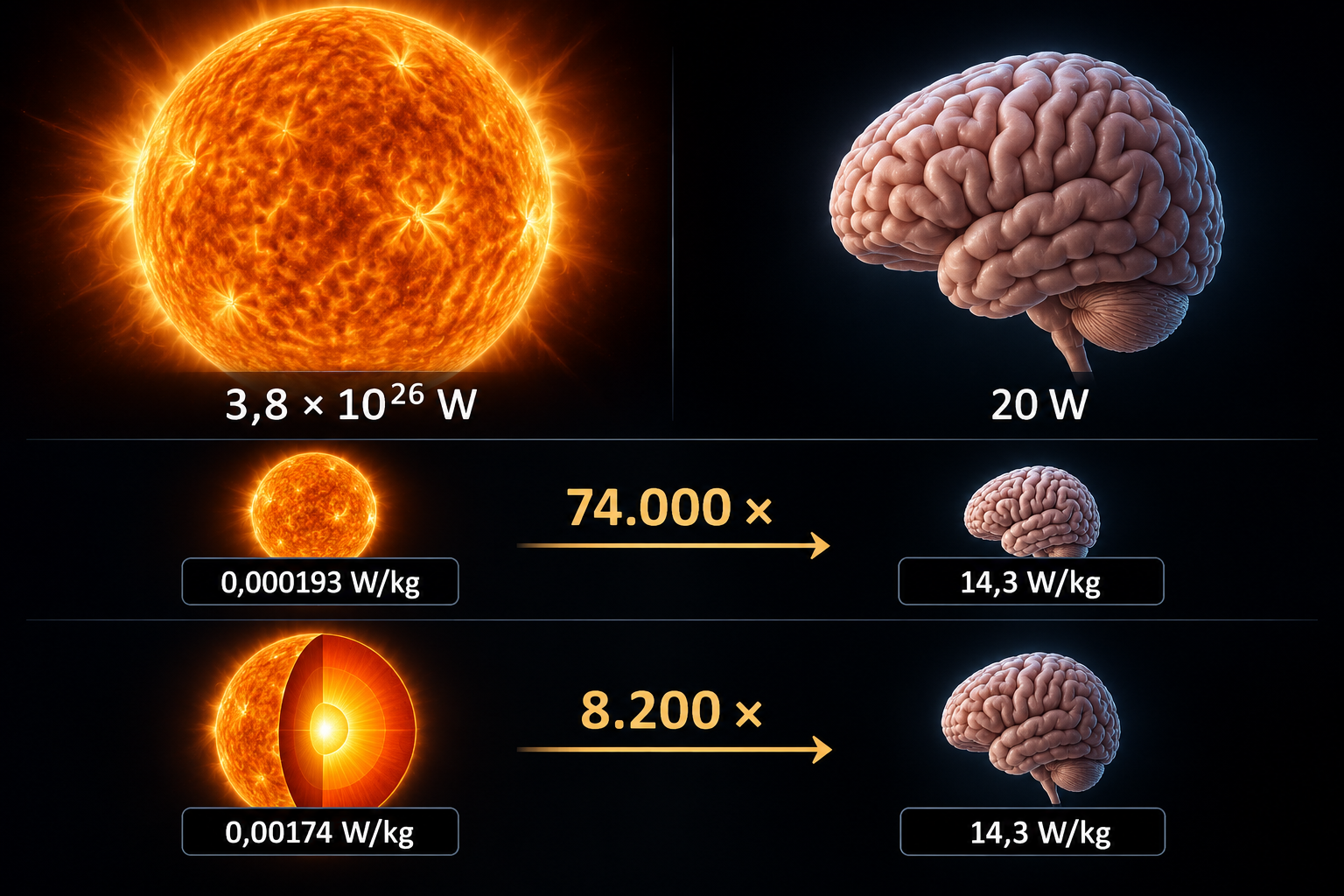
Imagine the Sun on one side and a human brain on the other. Which is more powerful? If we compare total power, the answer is the Sun, by such an enormous margin that the comparison almost seems like a joke. Its luminosity is on the order of 3.8 × 10²⁶ watts. An adult human brain uses approximately 20 watts of metabolic power. In both cases, we are measuring energy per unit of time: the energy radiated by the Sun and the energy consumed by the functioning brain. One watt equals one joule per second.
Now let us ask a different question. Instead of comparing the two complete systems, how much power corresponds to each kilogram of matter? A brain weighing approximately 1.4 kilograms uses about 14.3 watts per kilogram. The Sun’s luminosity divided by its total mass, meanwhile, corresponds to approximately 0.000193 watts per kilogram.
The result is surprising: in this comparison by mass, the brain’s metabolic rate is approximately 74,000 times greater than the Sun’s average power per kilogram. The brain has not become more powerful than the entire Sun. We have simply stopped comparing totals and started comparing averages normalized by mass.
What if we consider a small region near the center of the Sun, where energy production per kilogram is higher? The gap narrows, but it remains striking: the brain still shows approximately 8,200 times more power per kilogram.
Two answers—“the Sun” and “the brain”—can therefore both be correct, provided they answer different questions. The first concerns total power. The second concerns average power per unit of mass. If we leave out that distinction, we create a dispute between numbers that were never measuring the same thing.
Can lightning be hotter than the Sun?
Without looking at the answer, which seems hotter: the Sun or a lightning bolt? Intuition usually favors the star. Yet the air heated along the channel of an electrical discharge can reach temperatures on the order of 30,000 degrees Celsius, while the photosphere—the region we usually call the Sun’s surface—is approximately 5,500 degrees Celsius.
So is lightning hotter than the Sun? That depends on which part of the Sun we are considering. Its core reaches about 15 million degrees Celsius. The comparison changes completely when we shift our focus from the photosphere to the star’s interior.
The time conditions also change: the extreme heating of the air in a lightning bolt is brief, whereas the Sun sustains energetic processes over vastly longer timescales. Temperature, total energy, and duration are different properties. One cannot automatically stand in for the others.

A hydrogen bomb and one second of the Sun
Now think of the Tsar Bomba, the largest nuclear explosion ever detonated. The bomb weighed about 27 metric tons and released energy equivalent to 50 million metric tons of TNT. Compared with the entire Sun, that explosion seems small. But what happens if, once again, we compare energy per kilogram?
To use the same time window, imagine the bomb’s energy distributed over one second. In this calculation, each kilogram of the device would correspond to about 7.7 trillion watts. Each kilogram of the Sun, by contrast, considering its global average, corresponds to approximately 0.000193 watt. The result is even more surprising than the brain comparison: in this one-second comparison, the bomb has approximately 40 quadrillion times more power per kilogram than the Sun’s average.
The Sun still releases far more energy in total. The difference is that the bomb concentrates its release in a very brief explosion; it does not sustain that power for one second. Our one-second window serves only to make a proportional comparison. Once again, changing the question—from the total to the amount per kilogram—completely transforms the result.

Inside the human body and at the heart of a star
Think about your own body. It is made of cells, which contain molecules composed of atoms. And in the nuclei of those atoms, we find protons. Now imagine the pressure at the center of the Sun: approximately 2.5 × 10¹⁶ pascals. It seems hard to find anything more extreme. But let us leave the star for a moment and return to one of those particles we carry within us. In 2018, researchers estimated a pressure of approximately 10³⁵ pascals near the center of a proton.
That is about 4 quintillion times the pressure at the Sun’s center. Yes: a small region inside a single proton in our bodies has a pressure vastly greater than that found at the heart of the star. And the Sun itself is also made of atoms.
How can such an enormous intensity exist in something so small? The investigation revealed a distribution of pressures: near the proton’s center, there is an outward contribution; in more external regions, confining forces act inward. This organization contributes to the particle’s stability. Its enormous internal pressure therefore does not become a pressure of the same magnitude on our tissues.
In the previous examples, we compared power per kilogram. Here we are measuring a different quantity: pressure, expressed as force per unit area. But the contrast teaches a similar lesson: an object’s size does not, by itself, determine the intensity of the phenomena we find inside it. Think of a neutron star: the extremely compact remnant of a star, one of the most extreme environments known in the universe. Yet at this very moment, the protons that make up our own bodies contain internal pressures greater than those at the Sun’s center, which can even exceed values estimated inside a neutron star. The extraordinary is not only out there—it is also within us.

A cell and a star: what are we calling complex?
The Sun and a single cell are made of matter subject to the same physical laws. But look at how that matter is organized. In the Sun, extreme temperatures keep much of it in the form of plasma, with atomic nuclei and free electrons. The fusion of hydrogen into helium releases energy; radiation, plasma movements, and magnetic fields participate in the star’s dynamics.
Now reduce the scale to an E. coli bacterium: a single cell. Its DNA contains approximately 4.6 million base pairs and instructions for producing about 4,300 types of proteins. Researchers have built a model of its metabolism that includes about 2,700 chemical reactions and 1,200 different substances. These are not numbers for an entire organism. They all describe aspects of how just one cell functions.
This is where the contrast appears. In the Sun, matter participates in nuclear processes and collective plasma movements. In the cell, atoms form thousands of molecules with specific structures and functions: some accelerate reactions, others transport substances, and still others make it possible to read DNA information, build components, and repair damage. These activities are not independent; they must work in coordination for the cell to remain alive.
Therefore, if we compare the diversity of specialized molecular arrangements and the integration of regulated chemical functions, a single cell exhibits far greater functional complexity than we find in the Sun in that respect. Not because biology lies outside physics: it is matter itself, obeying the same laws, organized in radically different ways. An enormous star impresses us with its energy; a microscopic cell, with the thousands of relationships it can keep functioning at once. Size alone does not reveal the complexity of the arrangement.

2.4.2 Calibrating Context
A journey that changes shape
So far, we have changed how we compare quantities. Now we will also change how we represent a movement. Before following our airplane, however, it is worth looking at a technique that science communication has long used: changing proportions to make relationships visible that would disappear if everything were drawn to its actual scale.
Why do we change the proportions?
A familiar example is the representation of the solar system. In schoolbooks, museums, and science communication materials, the Sun and planets often appear side by side, with their sizes, distances, and positions adjusted so that each can be recognized. This exercise did not invent that approach: it is a widely used teaching choice that makes the whole system easier to understand.
Look at the two halves of the image below. In the first, we immediately recognize Mercury, Venus, Earth, Mars, and the more distant planets because their sizes and separations have been adapted. In the second, the attempt to preserve the distances more closely makes the tiny marks representing the planets much harder to see; the image therefore uses guide lines and enlarged circles to show where they are and what they look like.
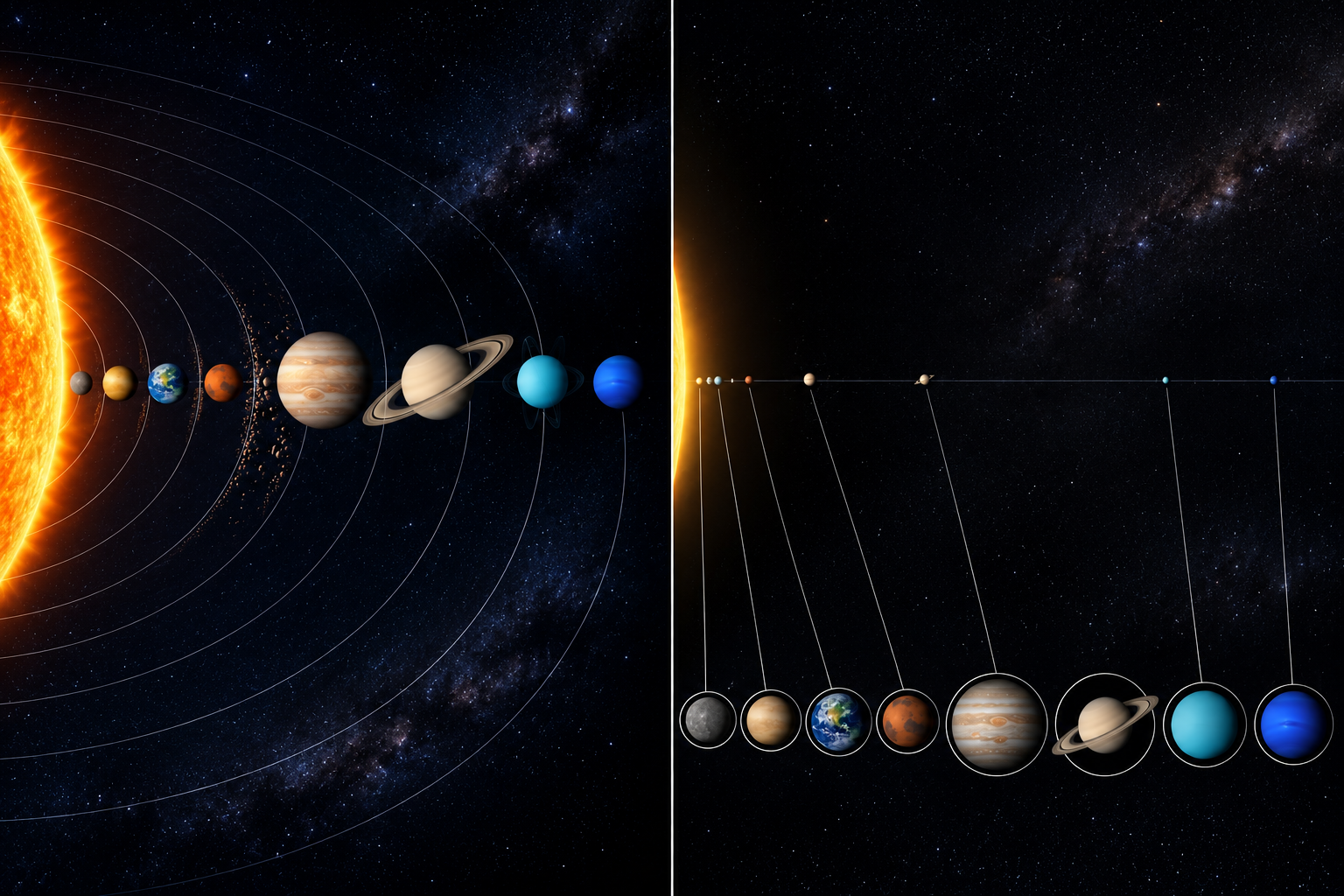
We can make the contrast more concrete with a mental image. If the Sun were an orange about 8 centimeters in diameter, Earth would be a point less than 1 millimeter across, about 8.6 meters away. Jupiter would be approximately 8 millimeters across and about 45 meters away. Neptune, less than 3 millimeters across, would be more than 250 meters away. When we try to fit everything on the same sheet of paper, preserving the distances while still showing what the planets look like becomes practically impossible.
A representation does not have to reproduce all the properties of a phenomenon at once to be useful. It does, however, need to make clear what it preserved and what it adapted. In the next images, we will do something similar: show the same journey within progressively broader frames of reference, first to understand the change in viewpoint and then to make movements perceptible that would disappear if we kept all the physical scales literal.
One journey, different frames of reference
Let us apply the same technique to an airplane’s path. Each stage is accompanied by the corresponding panel of a single journey. Read one stage at a time and look at the image immediately afterward. At the end of the exercise, Figure 7 brings all five panels together so you can compare the perspectives.
Imagine an airplane traveling for twelve hours between two distant points on Earth, which we will call A and B. For the passenger, the journey might be drawn as a simple arrow: it leaves A, moves forward, and arrives at B. In the seat, the passenger barely feels the enormous displacement. With the window shade closed and attention confined to the cabin, the cup stays on the tray table and the people seem almost motionless. All these observations can be consistent with the reference being used.

The pilot and the navigation systems need a different description. Earth is approximately spherical; on its surface, the shortest path between two points ideally follows an arc of a great circle. On certain flat maps, that arc appears as a curve that would surprise someone who imagined a straight line. A real flight, of course, also depends on winds, weather, air traffic, and operational decisions. The important point is not that the passenger is wrong and the pilot is right: it is that a simplified arrow, a route on the globe, and a line on a map are not the same representation.

Now let us change the context again. In the representation tied to Earth’s surface, airports A and B maintain approximately fixed positions. But imagine that our drawing is attached to a coordinate system that does not rotate with Earth. During a twelve-hour journey, the planet completes approximately half a turn relative to the stars. Both airports move with the surface; the airplane moves relative to them while also sharing Earth’s rotation. The path drawn in this new frame of reference no longer coincides with the arc seen on the rotating globe.

Let us widen the frame. Earth is not only rotating: it also travels in its orbit around the Sun at an average speed close to 30 kilometers per second. In twelve hours, its orbital movement amounts to a path of about 1.3 million kilometers. Both the departure and arrival airports have been carried along by that displacement. If we draw the journey in a frame of reference related to the Sun, we must include this movement. That does not mean the passenger bought a ticket to travel 1.3 million kilometers relative to the ground: the distance depends on the frame of reference adopted.

We can shift our reference even farther out. The solar system itself orbits the center of the Milky Way at a speed on the order of hundreds of kilometers per second. In twelve hours, the displacement corresponding to the solar system’s galactic motion is on the order of millions of kilometers. In this context, the airplane’s path incorporates movements that did not even appear in the earlier drawing. We cannot simply add speed or distance values as though they all pointed in the same direction; to represent the path rigorously, we must combine vector positions and velocities in a specified frame of reference.

Let us try one final mental exercise. Draw the journey once on a passenger’s sheet of paper, then on a globe, then in a frame of reference that does not rotate with Earth, then in the context of the orbit around the Sun, and finally in the context of the galaxy. In each drawing, ask: what was preserved? What began to move? Which points were considered fixed? What time and spatial scales are we working with?
Now look at all of Figure 7. The five panels show the same journey from A to B, but each broadens the context being considered. Compare them before continuing: what once seemed like a simple line now includes the movements of Earth and the solar system.

Notice the difference between the extremes: in panel 01, the arrow helps the passenger imagine the journey; in panel 05, the solar system’s movement greatly expands the context. The intermediate panels add one change at a time. In all of them, A and B indicate the departure and arrival of the same flight. Inside the cabin, the passenger remains almost motionless relative to the airplane itself.
In Figure 7, the teaching adaptation consists of simplifying the paths, enlarging the celestial bodies, and visually representing frames of reference that actually involve very different scales. The drawings are not calculated records of the airplane’s trail; they prepare us to understand what changes when the observer includes Earth’s rotation, its orbit around the Sun, and the solar system’s movement through the galaxy. In a twelve-hour flight, Earth rotates about half a turn relative to the stars, travels approximately 0.49° along its solar orbit, and covers only a tiny fraction of the galactic orbit. In the next figures, we will examine the trails and visualization factors more specifically.
The airplane made one journey. These were not five different journeys. Yet each representation selected different relationships within that same event. The purpose of calibrating context is not to declare all descriptions equivalent or equally useful. It is to recognize that even an apparently simple line can depend on movements and relationships the observer had left outside the frame.
When someone else’s explanation seems strange, it is worth asking a question before disagreeing: are we describing the same event from the same context? Sometimes disagreement begins because one person is looking only at the airplane while the other has also included the planet, the Sun, and the galaxy.
From separate movement to an integrated trail
Imagine three tiny points of light photographed over twelve hours. The blue point is at the departure airport (A); the red one is at the arrival airport (B); the white one follows the airplane. In a long-exposure photograph, each point leaves a line. Our first impulse is to draw only the white line, from A to B. But both airports are also moving: they rotate with Earth and share its movements through space.
The next image separates the perspectives to make them easier to read. Begin with the passenger and pilot panels. Then observe what happens when the viewpoint stops moving with Earth’s surface. In the last panels, blue, red, and white leave trails at the same time: we changed the frame of reference, not the journey.
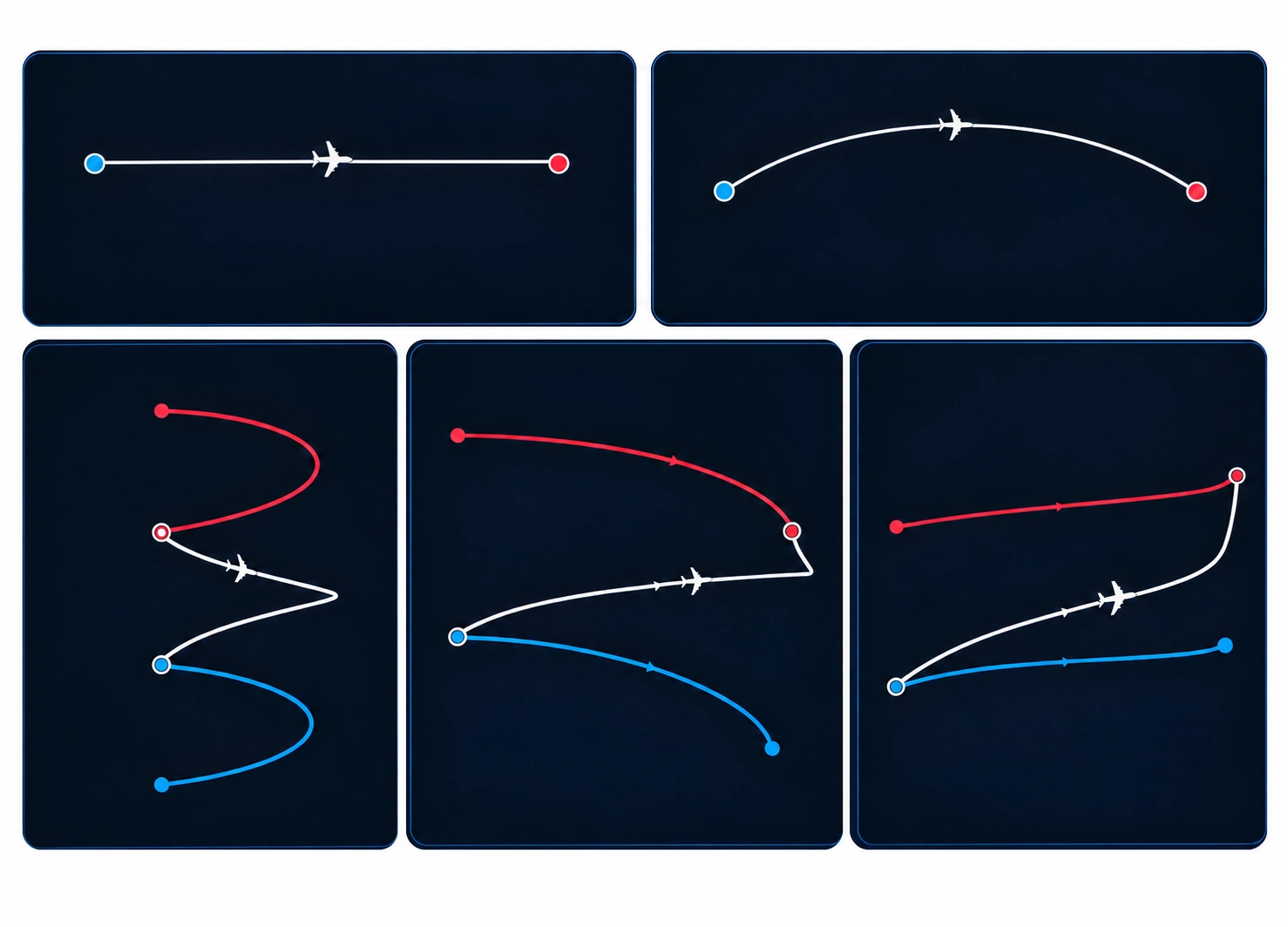
To read this image without formulas, imagine three luminous pens on a rotating sheet: the blue one is attached to airport A; the red one, to airport B; the white one moves across the sheet from A to B. Now imagine this rotating sheet being carried by another platform, which is also moving. Each pen’s line now records both its own movement and the platform’s. This is the change in reference the panels try to make visible.
Figure 8 separates the effects to make them easier to understand. In the idealized twelve-hour example, an airplane traveling at 900 km/h covers 10,800 kilometers relative to the ground; Earth rotates about 180.5° relative to the stars, while its orbital and galactic displacements are much greater. For a mathematical comparison in which the smaller movements remain visible, we can keep rotation at 1× and reduce the orbital and galactic displacements to 1/100 and 1/1000, respectively. These are visualization factors in a teaching model, not changes to actual distances or speeds.
In the next figure, we move away from separate panels. Imagine the three pens drawing at the same time on all these moving platforms. The result is presented as a single long-exposure record: blue, red, and white, each accumulating its path. To keep smaller details from disappearing in the presence of larger ones, this final image uses a new visual normalization.
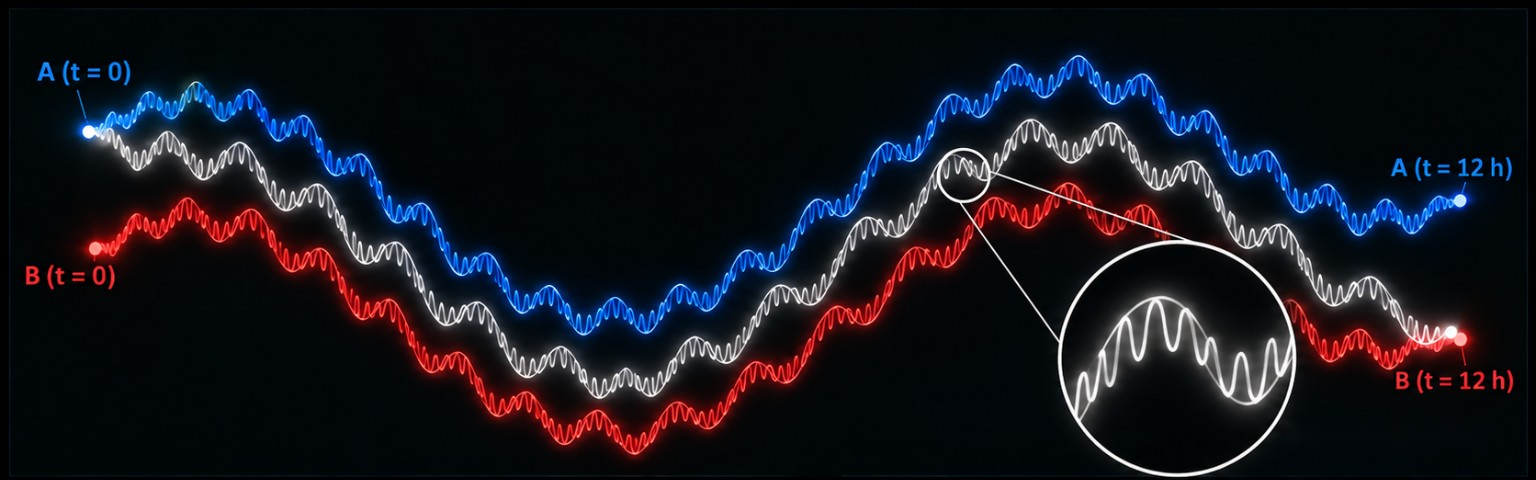
Start with the colors, not the formulas. The blue line records where the departure airport was at each moment; the red line does the same for the arrival airport; the white line follows the airplane. The airplane leaves A at the beginning and reaches B at the end, but A and B did not remain motionless during the journey. The larger curve suggests the movement of the whole; intermediate variations and small undulations appear along it, making the idea of smaller movements participating in larger ones intuitive. The magnifying lens only reveals part of the white trail; it does not show another path.
The teaching adaptation is crucial: the visual scale has been changed so that all layers remain perceptible. In Figure 9, galactic motion was used as the baseline (1×), while the orbital, rotational, and local-displacement components were represented with illustrative weights of 8×, 500×, and 900×. These are drawing coefficients, different from those in Figure 8; they do not mean that Earth or the airplane accelerated. Nor does each undulation correspond to an actual revolution: in twelve hours, Earth travels less than half a degree along its solar orbit and a tiny fraction of the galactic orbit. The composition illustrates the idea of superposition, not a literal astronomical reconstruction.
For a mathematical reading, the paths can be described by position functions over time and a vector sum of the movement components in the chosen frame of reference. The numerical details and the scope of the visualization factors are recorded in the technical notes; they need not interrupt the intuitive reading.
What changed during the comparisons and the journey?
If you returned to some answers and changed your mind, ask yourself what actually changed. Did the Sun change its mass? Did the brain start consuming more energy? Did the lightning get hotter? Did the proton gain pressure because we studied it? No. What changed were the distinctions we made: whole and part, mass and volume, energy and power, surface and core, duration and instant, physical behavior and functional organization.
Something similar happened in the airplane exercise. The passenger observes a journey from A to B; the pilot takes Earth’s curvature into account; other frames of reference add the planet’s rotation and the movements of Earth and the solar system. Even the airports, which seemed motionless, begin to leave trails. These were not five different journeys: we broadened the context, and other relationships became visible.
A comparison can be surprising and rigorous at the same time. To achieve that, we need to state the criterion, respect the units, and recognize the representation’s limits. That is why we enlarged planets in the solar system figure and adjusted scales in the airplane images: not to change the phenomena, but to see relationships that would almost disappear in a literal drawing.
This also does not mean that every perspective serves every question equally well. The Sun’s total power answers one question; power per kilogram answers another. A route drawn on Earth’s surface is useful for navigation; a broader frame of reference shows movements that route does not represent. The appropriate description depends on what we want to understand.
A physicist, astronomer, or other specialist may read these pages without finding anything new in their field. They may consider the comparisons elementary or of little use to their work. And given the question that usually guides their research, they may be right. These exercises do not seek to add technical knowledge to each discipline’s repertoire: they seek to make visible how the choice of a measuring stick, scale, or context changes the relationships we can perceive.
This distinction becomes more important as knowledge grows. A researcher can achieve great depth in one specialty without following all other fields with equal mastery, including those within the same discipline. Benjamin Jones (2009) examined the growing burden of knowledge required for innovation and its relationship to specialization; Wuchty, Jones, and Uzzi (2007) documented the expansion of teamwork in scientific production. This does not mean specialists are doomed to lose sight of the broader picture, but that building an overall view has come to require a deliberate, often collective effort.
This effort is familiar to science. The U.S. National Academies (2005) describe interdisciplinary research as the integration of information, methods, and perspectives from different fields to investigate problems that go beyond the boundaries of a single discipline. Uzzi and colleagues (2013), analyzing millions of articles, found an association between high-impact work and predominantly conventional combinations of knowledge that also incorporated unusual connections. These studies do not prove ORT or guarantee that bringing fields together will produce discoveries; they do show, however, that investigating relationships among bodies of knowledge is part of science’s own strategies.
We can imagine specialties as drawers. Each holds methods, definitions, and findings developed with great rigor. ORT seeks to open more than one at a time: not to mix their contents indiscriminately, but to investigate possible connections, patterns, and unifying perspectives among findings from different fields. Finding a similarity does not amount to demonstrating an identity; it may, however, be the beginning of a new question.
If one of these questions develops into a promising hypothesis, it will need to return to the relevant disciplines, with their methods of verification and their limits. It is within this circulation—from specialized findings to a broader map, and from that map back to new investigations—that ORT locates part of its proposal. Knowledge produced within the specialties remains the foundation; the attempt to connect it may, in turn, suggest paths for those specialties to advance.
Keep two questions in mind for the next pages: what measuring stick was used? And what was left outside the frame? When something seems obvious or absurd, first examine the comparison and context supporting it. In the first exercises, we changed the measuring stick; in the journey, we widened the frame. The Sun, the brain, and the airplane did not change because of that. Our way of observing relationships changed—and that is where a broader understanding can begin.
Summary for Reflection
- The answer about the same phenomenon changes when the comparison criterion changes.
- Every comparison requires explicit criteria, including quantity, unit, scale, interval, and frame of reference when relevant.
- Expanding the context makes visible relationships that were outside the picture.
- Different perspectives do not make all descriptions equivalent: the appropriate one depends on the question.
- A useful representation states what it preserves and what it adapts.
2.5 The Matrix You Read With
On the morning of June 10, 2000, London opened the Millennium Bridge, a new pedestrian crossing over the River Thames. Designed to look like a blade of light cutting across the river, it connected St. Paul’s Cathedral to Tate Modern, which had opened just weeks earlier in a former power station. About ninety thousand people crossed it on the first day, with as many as two thousand on it at once. Shortly after the crowd filled the walkway, something no one expected happened: the bridge began to sway from side to side. Pedestrians spread their legs to keep their balance and grabbed the handrails; some laughed, while others were frightened. Newspapers soon nicknamed it the “wobbly bridge,” and two days later it was closed.
What had gone wrong? The structure could easily support the crowd’s weight. The problem lay in a detail the calculations had missed. When we walk, our bodies sway slightly from side to side with each step. A small, almost imperceptible movement of the bridge made pedestrians adjust their steps to keep their balance. Without realizing it, hundreds of people began stepping in the same rhythm, like an audience whose applause falls into sync without anyone planning it. Those synchronized steps pushed the bridge sideways, the swaying increased, and more people fell into step. The phenomenon was neither in the structure nor in the people: it was in the relationship between them.
Now imagine three people watching this scene. A structural engineer sees a bridge without devices capable of absorbing the swaying. A physicist sees repeated movements falling into the same rhythm. A psychologist sees people unconsciously adjusting their bodies to moving ground and reacting to the fright. All three see something true. The risk lies in taking one’s own part for the whole. What each person sees first depends on the relationships they have learned to observe.
The preceding sections examined code, communication, the limits of understanding, and the calibration of how we see. We still need to examine the reader. Like the engineer, the physicist, and the psychologist, no reader comes to a text empty-handed. Each person brings a network of concepts, memories, experiences, and habitual ways of relating things, shaped by both formal study and everyday life. We will call this organization a cognitive matrix, or simply a matrix. It allows us to understand the world and act within it. And it also quietly translates every new idea into old categories before that idea has even been understood.

The scene is familiar. Three people are talking, each with a brain shown in a different color representing their cognitive matrix. The speaker’s matrix is yellow, and the message emerges from it as small yellow dots that reach both listeners. The message is the same for both. What changes is the matrix that receives it.
In the woman, with a red matrix, the dots arrive and remain mostly yellow. She smiles and agrees: her interpretation is close to what the speaker meant. In the young man, with a blue matrix, the dots also arrive yellow, but many turn green, as happens when yellow is mixed with blue. The message has combined with the relationships he already had, and his face shows puzzlement. This does not mean she is more capable than he is. The same statement has encountered two different matrices, and every reader has occupied each of these three positions.
Now remove the faces and keep only the mechanism. In the diagram, the envelope is the message, still yellow. It travels to the two matrices, red and blue, and an interpretation emerges from each. In the one that passed through the red matrix, yellow predominates, with some red dots and slight changes in tone. In the one that passed through the blue matrix, green takes over, alongside some yellow and blue dots. The diagram is not a map of the brain: it shows, in simplified form, how the matrix participates in interpreting what reaches us.

This translation of new material into old categories was observed in the laboratory almost a century ago. In 1932, the English psychologist Frederic Bartlett asked Cambridge students to read a Native American legend, “The War of the Ghosts,” and then retell it from memory. The story was unfamiliar to them: warriors arriving in canoes, ghosts fighting alongside the living, a mysterious death at dawn. When retelling it, the students did something curious. They left out what they did not understand, supplied explanations for what seemed meaningless, and replaced unfamiliar details with familiar ones: the legend’s canoes, for example, became boats. No one was lying. Memory simply reconstructed the legend using the material each person had at hand.
Later research showed that this is part of the mind’s normal functioning. Valerie Reyna and Charles Brainerd observed that we retain the gist of an experience much longer than its details: days after a conversation, we remember that a friend gave us sad news, but not the words they used. Jean Piaget, studying how children learn, described two processes. A child who knows only dogs and sees a horse for the first time might call it a “big dog”: the child fits something new into what they already know, a process Piaget called assimilation. Only when the child notices that this animal does not bark, does not behave like a dog, and has a different name do they create a new category: accommodation. The spontaneous tendency is toward the first. Over time, what remains of a reading is less the text itself than what it became in the reader’s matrix.
When something new simply will not fit, the matrix resists, sometimes at an enormous cost. In 1846, at Vienna General Hospital, the young Hungarian physician Ignaz Semmelweis faced a mystery. The maternity department had two wards. In the first, staffed by physicians and students, women died of puerperal fever, an infection following childbirth, at more than twice the rate of the second, staffed by midwives. Families knew this: some women begged not to be taken to the first ward, and some preferred to give birth in the street. In 1847, a colleague of Semmelweis died after being accidentally cut by a student’s scalpel during an autopsy, with symptoms similar to those of the mothers. Semmelweis connected the facts: physicians went straight from the autopsy rooms to examine women in labor. He ordered everyone to wash their hands with a chlorinated solution before entering the ward, and mortality, which had reached 18% in April 1847, fell to about 1% to 2% in the following months.
One might expect the discovery to have been celebrated. It was not. Much of the medical community rejected the conclusion. In the matrix of medicine at the time, diseases came from putrid vapors in the air and imbalances in the body; there was strong resistance to the idea that the hands of physicians themselves, respected men, carried death from one bed to another. Semmelweis lost his position, left Vienna, and died in 1865 without seeing his ideas accepted. A few years later, the work of Pasteur and Lister would give medicine the matrix it had lacked. Disputes within the hospital and Semmelweis’s own delay in publishing his results also played a part. But the deepest obstacle lay elsewhere: the evidence had been in front of his colleagues all along, and it was the matrix that determined what it meant.
We do not need to go back to the nineteenth century to find the same phenomenon. In 1985, researchers Ibrahim Halloun and David Hestenes tested college students before and after introductory physics courses. Many arrived with an intuitive idea about motion: an object moves only as long as something pushes it. Newtonian physics says otherwise, and the course taught this. Even so, by the end of the course, the intuitive idea remained virtually intact. The students had completed the course, but many continued to see motion through the matrix they had brought from home.
And this filter does not spare the most capable: sometimes it acts through their very competence. In 1942, psychologist Abraham Luchins gave the name Einstellung effect to the tendency of a familiar solution to prevent someone from seeing a better one. In 2008, Merim Bilalić, Peter McLeod, and Fernand Gobet brought the idea to chess. They showed experienced chess players positions offering a familiar, good sequence of moves and another that was shorter and better, and tracked their eye movements. The players said they were looking for alternatives, but their gaze kept returning to the squares involved in the solution they already knew. It was not a lack of talent: it was talent itself, trained over thousands of games, directing their gaze.
In ORT, this mechanism finds fertile ground. The theory connects descriptions from different fields and gives specific meanings to familiar words, marked with the prefix ORT-, such as ORT-life, ORT-consciousness, and ORT-interpretation. When readers encounter, further on, the claim that an atom possesses ORT-consciousness, they tend to use the word’s ordinary meaning and protest: “atoms don’t think.” And they would be right, if ORT said that. But ORT does not attribute thought to atoms: ORT-consciousness designates the capacity of an arrangement—a configuration of elements in relation, such as an atom, a cell, or a tree—to maintain itself as an arrangement. Anyone who rejects the claim on the basis of the ordinary meaning is criticizing a thesis ORT has not proposed. The same applies to someone who sees a tree and a stone described as arrangements of atoms and concludes that the theory equates an organism with a rock, or to someone who, in section 2.4, rejected the idea of the brain being more powerful than the Sun by using total power as the measure. In all these cases, a familiar interpretation is carried over into an explanation that uses a different criterion, a different analytical frame, or a different definition.
Understanding ORT therefore requires building a second cognitive matrix, capable of operating with the theory’s definitions and relationships without converting them into familiar categories. The second matrix does not erase the first. In 1995, Brazilian researcher Eduardo Mortimer proposed the conceptual profile model, according to which learning a scientific explanation does not require eliminating earlier ways of thinking: they coexist, and context determines which one to use. Astronomers know that Earth rotates, yet still say, without any embarrassment, that the Sun rises in the east. Similarly, readers can use their discipline’s matrix for its problems and ORT’s matrix for relationships that span disciplines and scales. The studies cited describe how memory, learning, and attention work; the second matrix is the requirement ORT derives from them.
This matrix is not built by rereading. In 2006, Henry Roediger and Jeffrey Karpicke showed that students who tried to recall a text without looking at it remembered much more of it days later than those who simply reread it, even though the latter felt more confident. Rereading creates a sense of mastery; recalling without looking helps retain what was studied. In ORT, this is only the beginning: beyond reconstructing, one must apply. Study can follow four steps:
- explain each concept in your own words, within the level of abstraction at which it was defined, without replacing it with a familiar term;
- relate it to phenomena at other scales and in other fields;
- apply it to a case the text did not present and check the application against scientific knowledge, without treating analogy as proof;
- return to the text after some time, reconstruct the reasoning without consulting it, and notice where the old matrix filled in gaps.
Along the way, it is worth observing your own thinking. When a claim seems obvious or absurd, the question is not just “do I agree or disagree?” but: What definition am I using? Where did my measuring stick come from? What have I left out of the picture? Am I responding to ORT or to the concept I already knew? Understanding becomes evident when readers can explain a proposition, apply it to a new example, and say what it does not allow them to conclude. Repeating the theory’s sentences shows familiarity with the text, not understanding. The next section turns this self-observation into an exercise.
None of this requires agreement. The second matrix is a condition for understanding, not for acceptance. An individual claim can be criticized by someone who has understood it; the whole, by someone who knows the network of definitions supporting it. Faced with any objection, the first question is: What was understood? If the answer describes a different thesis, the target must be clarified. If it faithfully describes the proposed thesis, the criticism must be examined, including when it reveals an error in the theory. The second matrix is not a credential of allegiance: it is what allows disagreement to address what was actually stated.
The Millennium Bridge reopened in 2002. The solution came only when the structure and the crowd were considered together: after studying pedestrian behavior, the engineers installed dampers capable of absorbing the swaying, and millions of people have crossed it since without noticing anything. None of the three perspectives was wrong; what was missing was the relationship between them. That is the invitation of the following pages: to keep the perspective each reader already has while building another alongside it, one capable of seeing the relationships. The purpose of all this effort is to expand the reader’s capacity for analysis.
Summary for Reflection
- Every reader reconstructs what they read from a cognitive matrix.
- Recognizing words is not the same as reconstructing the relationships they express.
- The matrix enables understanding and can also distort the meaning of a new proposition.
- Evidence that does not fit the matrix tends to be rejected before it is examined.
- An established matrix directs attention toward what it already knows.
- Understanding ORT requires building a second matrix capable of operating with its definitions, abstractions, and relationships.
- The second matrix coexists with the first; it does not replace it.
- The second matrix is built through reconstruction, association, abstraction, and application, not through rereading.
- A criticism addresses ORT when it examines the proposition the theory actually formulates.
- Understanding does not require agreement; it allows disagreement with what has been understood.
2.6 The Laboratory You Carry With You
In the 1970s, psychologists Richard Nisbett and Timothy Wilson set up a display in a department store in the United States. On the table were four pairs of pantyhose, arranged side by side. Passersby were invited to examine them and choose the pair of the highest quality. What they did not know was that all four pairs were identical. Even so, the choices were not distributed randomly: the pair on the right was preferred over the one on the left by a ratio of nearly four to one. Asked why, participants talked about the weave of the fabric, the elasticity, and the finish. No one mentioned position. When the researchers asked directly whether position might have influenced their choice, almost everyone denied it, some looking at the interviewer as though they suspected they were talking to a madman.
The experiment reveals two things at once. Something within us plays a part in our choices without asking consciousness for permission. And when we explain what we did, the explanation may be constructed afterward, using whatever material seems reasonable, just as Bartlett’s students reconstructed the legend. The preceding section showed that every reader interprets the world through a cognitive matrix. This section proposes observing it at work, in the one place where it is always available for examination: within ourselves. We have carried a laboratory since birth, use it at every moment, and rarely investigate it deliberately. It was there, as the Introduction recounts, that this theory began.

The first instrument in this laboratory is attention. As you read these lines, your eyes move, your breathing continues, muscles support your posture, and sensations arrive from different parts of your body. Almost none of this reaches consciousness. Try shifting your attention to one of these processes, the way your body rests against the chair, for example, and notice what happens: a sensation that was already there begins to exist for you. Your body did not start functioning when you observed it. What changed was the analytical frame: what you chose to bring into the foreground.
Do the same with your thoughts. For a few moments, follow what passes through your mind without trying to control anything. At some point, a thought will pull you away from the exercise, and only after a while will you realize that you became distracted. That moment of recognition is the experiment’s most valuable piece of evidence. Being absorbed in a thought is one thing; noticing that you are thinking is another. Psychology calls the ability to recognize explicitly what is happening in one’s own experience meta-awareness, and studies show that it frequently fails: we spend much of our time distracted without knowing it. Noticing distraction is seeing attention at work from the inside.
The laboratory becomes more revealing when emotion enters the picture. Think of a heated argument. Something the other person says sounds like a provocation, disagreement feels like an attack, and each response confirms the earlier impression. The body takes part: the voice rises, the shoulders tense, and attention narrows around what is upsetting. Hours later, once the anger has subsided, the same person recalls the conversation and discovers that some of the words no longer seem so offensive. What was said has not changed. What changed was the state from which the person interprets what was said.
Comparing these two readings of the same scene is one of the most useful experiments a person can conduct on themselves. It shows emotion acting as an engine: directing attention, favoring certain interpretations, and preparing certain responses. But the engine does not choose the route on its own. When angry, one person confronts while another falls silent; when sad, one seeks company while another withdraws. Experience, habits, and context also contribute to the outcome. Psychologist James Gross describes emotions in precisely this way: as response tendencies that attention and appraisal modify along the way.
The exercise becomes more effective with repetition and a sequence. Start with the body, which is easiest to observe; move on to thoughts; then to emotions; and finally to the relationships among them: what sensation accompanies this emotion, what thought it brings back, what response it prepares. When a situation triggers an intense reaction and you cannot observe it at the time, return to it later, in a different state, and compare the two readings. You do not need to monitor everything at every moment. Like any instrument, meta-awareness develops through use, and that use can continue throughout life.
The laboratory does not end with you. Human beings share the basic mechanisms of emotion and thought, even though each person responds in their own way. Someone who has learned to recognize how anger narrows their own attention, hardens their interpretations, and pushes them toward certain responses therefore begins to recognize the same process in others: a hardening tone, insistence on the same argument, difficulty considering an alternative. This recognition allows more than guessing what someone feels. It allows us to identify patterns and anticipate tendencies: while the anger lasts, certain responses become more likely and others less so. Recognizing this helps us choose a better moment to argue, to wait, or to listen. These are hypotheses, and must be treated as such. The pantyhose experiment showed that even our access to ourselves is incomplete, and Tal Eyal, Mary Steffel, and Nicholas Epley showed that imagining another person’s point of view is less accurate than asking them directly. The internal laboratory provides patterns and hypotheses; careful observation and conversation test and correct them.
Anyone who has observed anger reorganizing their reading of a conversation has seen the cognitive matrix working from the inside. What we learn at this small scale helps us formulate questions about larger scales, because beliefs, scientific theories, political convictions, and collective decisions are produced by human beings with the same processes of perception, emotion, and judgment. And an experiment of this kind is happening right now: reading these pages.
This experiment has two sides, and the writer’s side is no exception. The author of these pages also works with a memory that reconstructs. There are days when the words come easily and days when fatigue or a worry puts relationships out of reach that, after a night’s rest, seem simple. While revising this text, he experienced an episode that sums up the preceding section. In proposing a new example, that of a tree that does not end where its leaves end, he discovered that he had already written an entire section on the same subject some time earlier, and that he remembered neither its content nor its existence. The old text had been forgotten; its essence had not. The new formulation emerged with different words and an aligned structure, as if the same matrix had generated the reasoning twice. And he noticed this only because the written record was there for comparison: introspection alone would not have revealed it. Recognizing this process is also an exercise in meta-awareness. Sometimes the best thing to do is rest; at other times, it is to record the idea while it is available.
On the reader’s side, the text is the same for everyone; the conditions are not. One reader prefers formulas to analogies; another, images to descriptions; another, direct arguments to narratives. A word feels unfamiliar because you are accustomed to using it in a different sense. A worry, fatigue, or haste makes an explanation feel dry when, on another day, it would have sparked your interest. These conditions affect the willingness to continue, the ease of following an argument, and even how quickly an idea is accepted or rejected. It is the pantyhose experiment happening on the page: something influences judgment without announcing itself.
This is where meta-awareness takes on a direct role in reading ORT. When a passage arouses enthusiasm, impatience, distrust, or rejection, observe your reaction as well. What prompted it? The argument, the language, an unmet expectation, the memory of something you already know, or your state at that moment? Recognizing these influences does not determine who is right. It helps separate what the text states from the way you are receiving it. Once that separation has been made, the criticism that remains is more precise, and when the problem lies in the explanation rather than in the reading, it will become clearer. ORT does not ask readers to accept its propositions because they have done this exercise. It asks them also to examine the instrument with which they will examine those propositions.
The participants in the pantyhose experiment had no way of discovering, merely by looking inward, why they chose the pair on the right. An external experiment was needed to reveal what introspection could not reach. The laboratory we carry does not replace the laboratory of science: the two complement each other. One is always available and generates questions; the other tests the answers. Learning about oneself does not exhaust our knowledge of human beings, but it is one of the most accessible starting points, and the following pages are a good opportunity to begin.
Summary for Reflection
- The body and conscious experience are a field of observation that is always available.
- Observing one’s own experience changes the analytical frame of what one perceives and, sometimes, the experience itself.
- Noticing a thought does not reveal its cause.
- Emotion guides interpretation and prepares responses, but does not determine behavior on its own.
- Revisiting a situation in a different emotional state reveals the influence of the earlier state on judgment.
- Recognizing patterns in oneself provides frames of reference for identifying them in others and anticipating tendencies; observation and conversation test what is inferred.
- Observing one’s own matrix is part of preparing to examine any explanation, including ORT.
- Writers also think from a matrix, subject to the same conditions as readers.
- During reading, observing our own reaction separates what the text states from how we receive it.
2.7 The Effort That Gives Back More Than It Asks
In April 2025, the author lived in São Paulo, Brazil, and took his dog, Chico, for a walk in Praça Roosevelt almost every day. On one of these walks, he saw people experiencing homelessness opening trash bags and scattering the contents across the sidewalk, and the conclusion came almost automatically: if they have rights, they should also have obligations. It seemed fair, logical, and, above all, obvious. At home, however, the sentence began to bother him. He had observed a few minutes of those people’s lives and, without knowing anything about them, had already produced a complete explanation, measured against his own circumstances rather than theirs.
He decided to investigate. The more he looked at the same sidewalk from each participant’s position—someone sleeping there, a resident, a shopkeeper, social-service professionals, a politician—the larger the problem became: each position was understandable, and together they produced a result almost no one wanted. The question stopped being about the square and became a question about human beings. As it led him through politics, history, psychology, physics, and many other fields, it eventually led to the Theory of Original Reality. None of this was planned: in his fifty years of life, the author had never imagined studying so many fields, much less developing a theory. The full journey is told on the Origin page.
The previous sections prepared the reader to see. In 2.4, we changed our measuring scales and contexts; in 2.5, we encountered the cognitive matrix through which each person interprets the world; in 2.6, we learned to observe it in ourselves. What remains is the step that the story of the square illustrates better than any definition: sustaining a question. Recognizing one's own matrix does not, by itself, build a second one. That takes time, revisiting, making connections, and a willingness to reconsider what seemed settled. And it takes a reason. Why would anyone invest this effort?
The square already provides part of the answer. The author did not leave it with a solution for homelessness. He left knowing why solutions that address a single element often fail to reach the whole problem, and with questions capable of examining it through more relationships and fewer assumptions. That is the practical benefit of what the Introduction calls expanding the capacity for analysis: distinguishing an explanation sufficient for judging from one sufficient for understanding and acting.

The same applies at home. During an argument, a remark is taken as disrespect, and the response comes before any question about what was said, what was interpreted, and how much the day's fatigue influenced that interpretation. Someone who has learned to separate these layers is not automatically right, but can ask for clarification before responding to an assumed intention and discuss the actual problem instead of the perceived offense.
It applies at work, too. Deliveries are late, and the first explanation blames someone's lack of effort. The inquiry can continue: are requests arriving incomplete? Does the plan change midway through? Do two teams depend on information they do not share with each other? Perhaps the initial blame will prove justified. Perhaps an organizational problem will emerge that no amount of pressure would solve. In the square, at home, and at work, the movement is the same: from an immediate reaction to reconstructing the relationships that produced the situation. The result is not greater certainty. It is better questions before spending time, money, or relationships on the wrong explanation.
There is another, less visible advantage, perhaps the most personal one: dealing better with our own problems. Recurring anxiety, disproportionate irritation, or a defensive response that keeps repeating can seem to happen on their own, as if they had power over us. People who learn to observe their thoughts, emotions, and bodily signals begin to notice when these reactions arise, which interpretations sustain them, and what triggers set them off. Many are automatic responses the mind has established without our noticing. Once recognized, they can be put to the test: a different reading of the situation, a different response, new associations. With practice, certain patterns may weaken while other responses become more available. In some cases, a pattern that seemed inevitable changes when it is finally seen. Recognizing a trigger does not guarantee that the reaction will disappear, and persistent difficulties may require professional help. The benefit is not always being right or in control, but having more resources for dealing with ourselves.
Sustaining this movement is not simple, and not only because of the theory. No one reads with life on pause: there is work, family, bills, and days when attention simply is not available. There are also digital environments that offer one topic after another, chosen in part by systems that learn from our behavior. Researcher Sophie Leroy showed that, when we switch tasks, part of our attention remains attached to the previous one, and experiments with personalized recommendations show that what we click on does not always match what we would like to cultivate. The next novelty does not complete the previous question. In an inquiry, by contrast, the relationship understood today is what allows another to be examined tomorrow. Preserving this thread is a choice the stream will not make for anyone.
There is, however, good news in learning research: interest does not have to be fully formed at the outset. Suzanne Hidi and K. Ann Renninger described how interest sparked by a situation can, through engagement, become lasting interest, and Matthias Gruber and colleagues showed that curiosity supports memory for what we learn. That is how it happened in the square: the first question was small, and interest grew with each answer that opened up another question.
Three resources help maintain the thread. The first is to have a question of your own: a doubt raised by an example, a statement that seemed absurd, a relationship you want to test in your field. Someone who works in construction might ask where an arrangement ends and its context begins; someone who works with people, what changes when the event is separated from its interpretation; someone with expertise in another discipline, where the boundary lies between an interesting analogy and a demonstrable correspondence. The question does not have to agree with the author. It needs to be clear enough to guide the reading.
The second is to mark where your thinking stopped. When closing the text, three brief notes are enough: what relationship I managed to reconstruct, what remains unanswered, and which question I will start with next time. Psychologist Peter Gollwitzer showed that intentions tied to concrete situations (“when I open the text, I will start with this question”) are more readily carried out than vague intentions. Days later, the reader returns to an ongoing inquiry rather than a vague feeling of having already understood everything.
The third is to take the concepts into situations the text has not presented and look for where they stop working. Finding a contradiction is a result, not a failure: the second matrix is strengthened both by confirming a relationship and by discovering its limits. Alongside these resources comes a limit the author learned through experience: intense curiosity does not eliminate physical and mental fatigue. A deliberate pause preserves the inquiry better than exhausted persistence.
Readers do not need to finish this journey wanting to write a theory. They may discover that, when facing a conflict, they can listen to an explanation without confusing it with agreement; that, when facing a recurring problem, they can look for relationships that a single cause concealed; that, when facing an appealing claim, they ask for evidence before adopting it. They may even conclude that ORT is wrong on some point and propose a better explanation. In all these cases, they will have moved from merely following someone else's reasoning to directing their own.
On the walk with Chico, the question that changed everything was not “why do they do this?” It was a smaller, more uncomfortable question: “why was I so certain?” From there came months of inquiry, sometimes accompanied by cinematic orchestral soundtracks that helped keep the enthusiasm alive, and pauses that served as reminders of the body's limits. These pages extend the same invitation, on each reader's own scale: find a question worth your effort and learn to sustain it. The next section examines how accumulated experience can provide material for new interpretations. The premises that come afterward do not ask for allegiance: they are a shared starting point for an inquiry each reader can pursue independently.
Summary for Reflection
- A quick conclusion can seem complete precisely because it ignores what is not known.
- Broadening the question transforms the search for someone to blame into an understanding of a system.
- An explanation sufficient for judging may not be sufficient for understanding and acting.
- Recognizing an automatic response is the first step toward putting it to the test.
- Interest does not have to be fully formed at the outset: it grows through inquiry.
- Sustaining a question requires preserving the point where reasoning stopped and finding the way back.
- A contradiction found when applying a concept is a result, not a failure.
- Expanding the capacity for analysis means beginning to direct one's own inquiries.
2.8 Thinking About Your Own Thinking
What a person has already lived through can serve as a starting point for investigating what they do not yet understand. Over a lifetime, we observe other people’s behavior, test ways of acting, notice regularities, change our minds, and accumulate explanations about the world. Much of this learning happens without planning, protocols, or formal records. It remains distributed across memories, habits, expectations, and associations that form part of each person’s cognitive matrix.
This accumulated experience and knowledge need not be discarded to develop another way of reasoning. It must, however, stop serving only as the reference point from which we judge. In section 2.6, meta-awareness meant noticing what is happening in our own experience. Metacognition goes a step further: it examines our own thinking. Recognizing a thought is not enough; we need to ask how a conclusion was reached, what criteria support it, what information was left out, and whether another interpretation would better explain the situation. Psychologist John Flavell, who helped establish the concept in the late 1970s, described it as the knowledge we have of our own cognition and the monitoring of what it does during a task.
Imagine someone who has grown plants for many years. They have seen seedlings of the same species grow differently and learned, through trial and error, to connect these differences to sunlight, water, and planting location. When studying drainage and transpiration, they may recognize relationships that previously appeared as isolated episodes. But they may also discover that a problem they attributed to a lack of water was actually a root problem. New knowledge does not create earlier experiences; it offers other ways to relate them. Those experiences, in turn, help generate questions the concept alone might not suggest.

This process also requires examining where our own certainties come from. If someone concluded, from three similar situations, that a particular behavior always produces the same result, it is worth recalling the circumstances of each case. What was repeated? What was different? Were there contrary instances that did not remain in memory? What new observation would distinguish between two possible explanations? These questions do not turn a memory into an experiment. They make explicit a line of reasoning that may previously have operated without examination.
There is an important difference here between everyday experience and scientific inquiry. Both may begin with observing phenomena. In everyday life, however, observations are often incidental, selective, and reconstructed by memory. Science seeks to subject them to methods, records, comparisons, and checks that make it possible to correct individual impressions. Personal experience and knowledge are valuable for recognizing patterns and generating hypotheses; on their own, they are not enough to demonstrate the mechanisms that produced those patterns. And, as the stocking experiment showed, introspection does not fully recover the causes of our thoughts.
The exchange runs in both directions. A concept learned today can give new meaning to something experienced years ago. And an earlier experience can raise a question that did not appear in the explanation being studied. What matters is not immediately agreeing with the new interpretation, but being able to reconstruct the relationships that support it and compare them with other possibilities. In studies of learning, Michelene Chi and colleagues observed that students who generated their own explanations while studying physics examples were better at connecting the steps of a solution to the principles involved.
This work need not happen all at once or follow a rigid sequence. One way to begin is to choose an old conclusion about something we know well, recall the experiences that supported it, consider an alternative explanation, and look for what would need to be observed or consulted to decide between them. If the conclusion holds up, it gains support; if it changes, the error itself becomes a source of information. The exercise is especially fruitful when lived experience meets concepts from other fields, provided the differences between those fields are not erased.
This makes the construction of the second cognitive matrix proposed in section 2.5 more concrete. It does not replace the reference points readers already have or grant privileged access to the truth. It is an additional organization of relationships, definitions, and criteria that can be developed by examining accumulated experience, studying new knowledge, and putting interpretations to the test. ORT itself must be subjected to this process: understanding it within its definitions and then testing its propositions against what is known, including in order to disagree with them.
Summary for Reflection
- Everyday experience provides material for new questions, but does not, on its own, amount to scientific evidence.
- Metacognition allows us to examine the criteria, strategies, and limits of our own reasoning.
- An earlier experience can take on new meaning when related to another concept; that relationship needs to be examined.
- An additional cognitive matrix is built by relating, reconstructing, and testing interpretations, without erasing the previous one.
2.9 Premises for Entering the Theory
Before entering Original Reality Theory itself, some premises should remain a reference for reading. They condense principles presented earlier and establish the limits within which the following concepts should be interpreted.
Premise 1
Reality is one and indivisible. Division belongs to explanation and knowledge.
Knowing requires differentiation. To perceive, interpret, represent, compare, and relate, we need to produce distinctions. We separate objects, events, properties, scales, disciplines, and concepts because these divisions increase our ability to know and explain. This does not mean the same divisions exist in reality in the way they exist in our representations. The parts belong to the map. Reality does not need to obey the boundaries we use to explain it. What we call a tree, for example, is the core of a much broader phenomenon that includes sunlight, air, water, and soil.
Therefore, when ORT conceptually divides a phenomenon, presents an explanatory sequence, or uses different abstractions, these divisions should not automatically be turned into ontologically independent parts, stages, or events.
If knowing requires differentiating a reality that is one, what we identify as a thing also depends on the differences we can or choose to consider.
Premise 2
No two things are absolutely identical.
Two atoms can be classified as hydrogen because they sufficiently meet the criteria used in that classification. This does not require them to be absolutely identical in all their relationships, states, and histories.
The same impossibility persists through time. A thing is not absolutely identical even to itself at two different instants. It continues to interact with itself and with the context to which it belongs. Preserving an absolutely invariant identity would require, conceptually, freezing it in time and eliminating any change in its relationships.
Equality and identity used in knowledge therefore depend on the resolution and purpose of the comparison. Saying that two things are equal means that, within that analytical frame, certain differences have been disregarded.
Classification remains useful. What disappears is only the requirement that classificatory equality correspond to absolute identity.
Premise 3
Knowing and communicating require representation.
Letters, words, numbers, images, concepts, diagrams, models, and theories are forms through which perceived and interpreted differences can be encoded and related. But the sign is not what it represents.
The word tree is not a tree. A photograph of a tree is not the tree either. A concept of an atom is not an atom. A model of reality is not reality.
ORT itself is subject to this premise. Everything presented next—Original Reality, Derived Reality, Human Derived Reality, and any other concept—is a representation used to explain what the theory seeks to understand.
Representation can increase our capacity to know reality without ever becoming reality itself.
Premise 4
Communication does not directly transfer one individual’s interpretive state to another.
Senders produce a coded representation and make it available through a message. Receivers receive this representation and must interpret it. What reaches receivers is therefore not the interpretation existing in senders, but a message from which another interpretation will be constructed.
The greater the correspondence between the codes, references, experiences, and contexts available to the participants, the closer their interpretations may become. Even so, communication does not imply identity between them.
This premise also applies to ORT itself. The following text does not transfer the theory directly to readers. It makes representations available from which readers will construct their own interpretation, with the cognitive matrix they bring with them. Understanding ORT as a whole therefore requires building a second cognitive matrix, capable of operating with the theory’s definitions and relationships without replacing the previous one.
Premise 5
The cognitive matrix itself can become an object of inquiry and be reorganized when the accumulated knowledge and experience of the person interpreting are examined and related to new knowledge.
Over a lifetime, each individual accumulates observations, learning, and relationships, often outside the formal methods of science. Through meta-awareness, people notice what is happening in their own experience; through metacognition, they examine how this accumulated knowledge and experience contributes to their interpretations, relate it to new knowledge, and develop other forms of analysis without erasing the previous matrix.
Lived experience provides material for formulating questions and hypotheses, but does not, on its own, prove the mechanisms that produced it. Examining our own reasoning also does not guarantee access to all its causes or remove the need to test it against evidence.
Premise 6
ORT uses different abstractions to increase or reduce explanatory resolution without assuming that the boundaries produced by those abstractions are boundaries of reality itself.
The same applies to existing knowledge. Physics, chemistry, biology, astronomy, neuroscience, psychology, and other fields produce fundamental knowledge through their own analytical frames, scales, methods, and languages. ORT uses observations, measurements, experiments, and models produced by these fields, but does not assume that their disciplinary divisions constitute ontological divisions of reality.
An ORT concept must therefore first be understood within the abstraction at which it was formulated. One should not immediately conclude that an ORT concept “is” a particular concept from physics, biology, philosophy, or any other field merely because some correspondence exists between them. Likewise, different abstractions within ORT itself should not be merged merely because they refer to the same phenomenon.
Understanding comes before comparing.
Comparing comes before concluding equivalence, compatibility, or conflict.
Premise 7
ORT may formulate inferences from patterns found across different scales and perspectives even when a particular relationship has no established explanation within a specialized discipline. This does not turn inference into evidence.
When comparing with external knowledge, the distinction between observation, evidence, model, correspondence, compatibility, inference, hypothesis, and conflict must remain explicit.
3. The Theory
The exposition of ORT will be organized into three major abstractions: Original Reality, Derived Reality, and Human Derived Reality.
These are the three major conceptual containers of the currently defined structure. They do not represent three separate realities. They are explanatory divisions used to organize the exposition of a reality that, as established earlier, is considered one and indivisible.
All subsequent conceptual development of ORT should, in principle, be accommodated within one of these three major abstractions.
3.1 Original Reality
Original Reality corresponds to the deepest level of abstraction in Original Reality Theory.
Its purpose is not to present the entire theory immediately or to provide complete explanations for every concept. It establishes ORT’s elementary foundations.
For this reason, some concepts presented in this section may, when considered in isolation, seem excessively abstract, incomplete, or even obvious. This impression is expected.
Reality remains one and indivisible.
Division belongs exclusively to explanation.
3.1.1 Elementary Relations
Elementary Relations constitute the deepest level of abstraction within Original Reality.
3.1.1.1 Binary
Definition
The Binary Relation is the elementary abstraction through which ORT represents the first relational differentiation of ORT-energy. It establishes two conceptual positions:
1 — presence
0 — absence
These positions do not represent physical places or independent parts of reality. They represent only an abstraction created to analyze a reality that remains one and indivisible. Without this differentiation, there is no relation.
Principle
Every elementary relation presupposes two relational positions. The symbols 1 and 0 belong exclusively to the analytical model. They do not describe elements existing in reality.
Fundamental observation
The binary relation does not address quantity. It addresses only the existence of two relational positions. Quantity will be analyzed in the Inversely Proportional Relation. Meaning will be analyzed in the Antagonistic Relation. Therefore, the Binary Relation answers only the question: Where does the relation establish its two positions?
Representation
1 <------> 0
presence absence
or simply
1 ↔ 0
Relation to the Arrangement
A Unit of ORT-energy considered in isolation does not constitute an Arrangement. When two of these Units establish a relation, the first Arrangement arises. The Binary Relation corresponds to the first abstraction of this relation.
Axioms
- A1. The Binary Relation establishes two conceptual positions: presence and absence.
- A2. Positions 1 and 0 belong to the analytical model, not to reality.
- A3. The Binary Relation does not describe quantity.
- A4. The Binary Relation constitutes the first abstraction of the relation between two Units of ORT-energy.
Examples
Example 1 — Heat
If the phenomenon being analyzed is heat:
1 → presence of heat
0 → absence of heat
The Binary Relation does not yet indicate how much heat exists. It only establishes the two poles of the analysis.
Example 2 — Light
1 → presence of light
0 → absence of light
The intensity of the light is not yet being analyzed.
Example 3 — Movement
1 → presence of movement
0 → absence of movement
The speed or intensity of the movement is not yet part of this relation.
Synthesis
The Binary Relation constitutes ORT’s first abstraction of the relation between two Units of ORT-energy. It does not measure. It does not compare. It does not interpret. It only establishes the two fundamental poles on which the other elementary relations will be analyzed.
3.1.1.2 Inversely Proportional
Definition
The Inversely Proportional Relation is the abstraction through which ORT represents the distribution of ORT-energy between the two positions established by the Binary Relation. While the Binary Relation establishes only positions 1 and 0, the Inversely Proportional Relation abstracts the relative intensity present in each of these positions. It describes exclusively the distribution of the relation. It does not yet describe its meaning.
Principle
The distribution of ORT-energy between positions 1 and 0 occurs in an inversely proportional manner. The relative increase in one position necessarily corresponds to the relative decrease in the other. The sum of the distribution remains constant.
Representation
For analytical purposes, ORT represents this distribution as:
T1 + T0 = 1
where:
T1 = relative intensity of position 1.
T0 = relative intensity of position 0.
Thus:
T0 = 1 − T1
and
T1 = 1 − T0
This representation does not correspond to a specific physical measurement. It constitutes an analytical model used by ORT.
Tension difference
The difference between the two positions can be represented as:
ΔT = T1 − T0
where: ΔT represents the tension difference between the positions. This difference indicates only the relative predominance of one position over the other. It does not yet determine meaning.
Movement
The distribution between the positions should not be understood as static. It represents continuous movement. Any observed value corresponds only to an instantaneous abstraction of this dynamic. A representation such as:
T1 = 0,70
T0 = 0,30
does not describe a permanent state. It represents only a reading of the relation at a particular analytical instant.
Axioms
- A1. ORT-energy is distributed between the positions of the Binary Relation in an inversely proportional manner.
- A2. The relative increase in one position necessarily corresponds to the relative decrease in the other.
- A3. The sum of the distribution remains constant.
- A4. The tension difference represents only the relative predominance between the positions.
- A5. The Inversely Proportional Relation describes the distribution of the relation, not its meaning.
- A6. The tension at position 1 must be greater than the tension at position 0 for the relation to be maintained.
In analytical terms:
T1 > T0
While the relation is maintained, T0 cannot equal or exceed T1. Upon reaching T1 = T0, the relation ceases to sustain its dynamics.
When
ΔT = 0
there is no predominance between the positions.
Without predominance, there is no tension.
Without tension, the relation ceases to sustain its dynamics.
Consequently, the organization through which the Arrangement’s continuity can be identified is no longer sustained.
Examples
Example 1
T1 = 0,55
T0 = 0,45
ΔT = +0,10
There is a slight predominance of position 1.
Example 2
T1 = 0,70
T0 = 0,30
ΔT = +0,40
The predominance of position 1 is greater.
Example 3
T1 = 0,90
T0 = 0,10
ΔT = +0,80
The predominance of position 1 is even more intense.
Example 4
T1 = 0,51
T0 = 0,49
ΔT = +0,02
The predominance of position 1 is small, but its tension remains greater than the tension at position 0.
Fundamental observation
The values used in the examples are solely for teaching purposes. ORT does not establish that the distribution occurs in discrete levels. Between positions 0 and 1, there is a continuous gradient. The resolution used depends exclusively on the analysis performed. The following may be used:
- 10 levels;
- 100 levels;
- 1,000 levels;
- 1,000,000 levels;
- or any other convenient resolution.
The numerical representation does not change the relation. It changes only the precision of the analysis.
Synthesis
The Inversely Proportional Relation answers the question:
How is ORT-energy distributed between the two positions established by the Binary Relation?
It describes the distribution of the relation and the tension difference between its positions.
The tension at position 1 must be greater than the tension at position 0 for the relation itself to be maintained.
The meaning of this distribution does not yet belong to this abstraction.
It will be developed in the Antagonistic Relation.
3.1.1.3 Antagonistic
Definition
The Antagonistic Relation is the abstraction through which ORT represents the relational meaning of the distribution of ORT-energy between the two positions established by the Binary Relation and distributed according to the Inversely Proportional Relation. While the Binary Relation establishes the positions and the Inversely Proportional Relation establishes the distribution, the Antagonistic Relation abstracts the meaning produced by that distribution. There is no antagonism without a Binary Relation. There is no antagonism without an Inversely Proportional Relation. The three relations constitute a single dynamic abstracted from different perspectives.
Principle
Every distribution of tension establishes a relational position. This position constitutes a meaning. Meaning does not belong to the positions. It does not belong to the distribution. It emerges from the relation itself.
Representation
If:
T1 = 0,70
T0 = 0,30
there is a particular relational position. If:
T1 = 0,90
T0 = 0,10
the relational position is different. If:
T1 = 0,55
T0 = 0,45
there is also a different relational position. Each distribution corresponds to a different relational meaning.
Fundamental observation
The Antagonistic Relation establishes the meaning of the relation itself. This meaning belongs to ORT’s deepest level of abstraction and is part of the elementary structure of ORT-energy.
Axioms
- A1. Every distribution of tension establishes a relational position.
- A2. Every relational position has a meaning.
- A3. Meaning belongs to the relation.
- A4. Meaning remains in the relation, but ORT-interpretation varies according to the perspective of the interpreting Arrangement.
Examples
Example 1 — Heat
Consider heat as the phenomenon being analyzed.
T1 = 0,60
T0 = 0,40
This distribution has a particular relational meaning. Different Arrangements may classify the same heat intensity as:
- cold;
- warm;
- hot;
- very hot.
The meaning of the relation remains. ORT-interpretation varies.
Example 2 — Light
Consider light as the phenomenon being analyzed.
T1 = 0,80
T0 = 0,20
This distribution has a particular relational meaning. Different Arrangements may classify the same light intensity as:
- weak;
- moderate;
- intense.
The meaning of the relation remains. ORT-interpretation varies.
Example 3 — Movement
Consider movement as the phenomenon being analyzed.
T1 = 0,80
T0 = 0,20
This distribution has a particular relational meaning. Different Arrangements may classify the same movement as:
- slow;
- fast.
These classifications belong to the Arrangement. Not to the relation.
Example 4 — Color
Consider a gradient between light and dark.
T1 = 0,80
T0 = 0,20
The relation occupies a particular position in this gradient. Human language may call it:
- gray;
- graphite;
- almost black;
- black.
These words do not belong to the relation. They belong to the classification produced by the human Arrangement.
Example 5 — Force
Consider force as the phenomenon being analyzed.
T1 = 0,80
T0 = 0,20
This distribution has a particular relational meaning. As in the previous examples, human language can name regions of the gradient. For a more detailed classification, we can use, for example, ten labels:
- extremely weak;
- very weak;
- weak;
- slightly weak;
- moderate;
- slightly strong;
- strong;
- very strong;
- extremely strong;
- exceptionally strong.
These labels do not establish ten natural levels or equal intervals. We can name more regions of the gradient according to the needs and purpose of the analysis.
Again: the meaning of the relation remains. The classification depends on the Arrangement.
The gradient
As presented in the Inversely Proportional Relation, the gradient is continuous. Its division into levels depends on the resolution adopted in the analysis.
In the Antagonistic Relation, this same gradient is considered in terms of relational meaning. It is not another gradient, but the same relation analyzed through another abstraction.
Human language creates names for only some regions of this gradient. Thus:
- "cold"
- "warm"
- "hot"
- "very hot"
do not represent fundamental states of reality. They represent classifications produced by the human Arrangement for particular regions of a continuous gradient. The same occurs with:
- light;
- movement;
- colors;
- force;
- and virtually any other phenomenon.
Synthesis
The Antagonistic Relation answers the question: What relational meaning emerges from the distribution of ORT-energy? It does not answer: What does this meaning represent for a particular Arrangement?
3.1.1.3.1 Resistance
Definition
Resistance is the property through which the same tension difference does not necessarily produce the same response in different Arrangements. It belongs to the elementary structure of ORT-energy. It is not a property exclusive to biological, human, or conscious Arrangements. Every relation has resistance.
Principle
An Arrangement’s response depends on the resistance it manifests in the relation considered.
Representation
If:
T1 = 0,60
T0 = 0,40
the Arrangement’s response varies according to the resistance it manifests in the relation considered, even when this distribution remains unchanged.
Structural relation
The tension difference represents the potential of the relation.
However, this potential does not directly determine the response.
The response emerges from the relation between the tension difference and the state of the Arrangement.
ORT represents this relation structurally as:
Resp = f(ΔT, Sᵢ(t))
where:
- Resp = the Arrangement’s response;
- ΔT = tension difference;
- Sᵢ(t) = state of the Arrangement.
As defined earlier in the theory:
Sᵢ(t) = F(Cᵢ(t), Kᵢ(t))
where:
- Cᵢ(t) = statistical configuration;
- Kᵢ(t) = circumstance.
Resistance does not appear as an independent variable.
It emerges from the Arrangement’s own state.
Consequently, the same tension difference can produce different responses when the states considered are different.
Fundamental observation
Resistance does not appear as an independent variable because it constitutes a manifestation of the Arrangement’s own state.
Axioms
- A1. Every relation has resistance.
- A2. Resistance belongs to the elementary structure of the relation.
- A3. The same tension difference does not necessarily imply the same response.
- A4. Resistance manifests in any Arrangement.
Examples
Example 1 — Heat
T1 = 0,80
T0 = 0,20
For the same temperature difference, the response varies according to the Arrangement.
Example 2 — Light
T1 = 0,80
T0 = 0,20
For the same light intensity, the response varies according to the Arrangement’s state.
Example 3 — Movement
T1 = 0,80
T0 = 0,20
For the same movement, the response varies according to the resistance the Arrangement manifests in the relation established.
Example 4 — Color
T1 = 0,80
T0 = 0,20
For the same distribution, the classification varies according to the resistance the Arrangement manifests in the relation established.
Example 5 — Force
T1 = 0,80
T0 = 0,20
For the same intensity, the response varies according to the resistance the Arrangement manifests in the relation considered.
Example 6 — Communication and Resistance
This example considers a human Arrangement: a reader who, while reading Original Reality Theory (ORT), encounters a statement they initially disagree with.
At that moment, their resistance to the information is high, and they offer a criticism to the author.
For the numerical illustration at the end, consider an initial distribution of T1 = 0,90 and T0 = 0,10, corresponding to ΔT = 0,80. These values are illustrative: they represent the distribution and the tension difference, without measuring the reader’s resistance.
In the situation described, both parties communicate authentically.
The author responds to the criticism by clearly restating the reasoning, concerns, and feelings the reader expressed. The response demonstrates an accurate understanding of the perspective presented.
The reader may recognize their own reasoning in the author’s response. When they perceive that the sender has understood and expressed what they were trying to communicate, that recognition can foster a sense of a shared perspective.
That perceived similarity can foster alignment between sender and receiver. When the reader recognizes this alignment, resistance tends to decrease and the channel of communication tends to open further, encouraging their willingness to hear and examine what the author presents.
The author then acknowledges the effort behind the criticism, makes its value explicit, and shows how it contributes to the development of the theory.
If the reader perceives that their contribution has been understood and valued, this recognition may further reduce resistance and increase their receptiveness within the relation.
The example therefore considers a possible sequence of two changes: first, alignment encouraged by demonstrated understanding; then, recognition of the value of the criticism and of the person who offered it.
In this possible new state, the reader encounters information that was already published and that they previously rejected. The information remains exactly the same, but may now be examined with less resistance.
The content originally presented has not changed. The interactions may change the reader’s state and the resistance they manifest in the relation, making a different response to the same content more likely.
Even in authentic communication, the recognition described does not follow automatically from the sender’s conduct. Depending on their state, the reader may perceive, in the first stage, the restatement of their criticism as a show of understanding meant to win their trust; in the second, the acknowledgment of their contribution as condescension or self-serving praise. Under these conditions, they may give greater weight to their own criticism and show even greater resistance.
The author’s response forms part of the circumstances of the relation, but its effects also depend on the reader’s statistical configuration and state. Influence does not imply control over the response.
The example illustrates that an Arrangement’s response does not depend solely on the relation’s tension difference. It also depends on the Arrangement’s state, from which the resistance manifested in that context emerges.
The mathematical relations below revisit the three moments of this possible sequence.
Mathematical representation of the example
In this representation, i identifies the reader, and t, t+1, and t+2 order the moments of the analysis without fixing the duration of the intervals.
Initial state. This refers to the moment of high resistance before the author’s response:
Sᵢ(t+0) = F(Cᵢ(t+0), Kᵢ(t+0))
After understanding is demonstrated. This refers to the alignment recognized by the reader in the example. The interaction forms part of the circumstance and, to the extent that it is internalized, the statistical configuration:
Sᵢ(t+1) = F(Cᵢ(t+1), Kᵢ(t+1))
After recognition. This refers to the stage at which the reader perceives that their contribution is valued:
Sᵢ(t+2) = F(Cᵢ(t+2), Kᵢ(t+2))
Complete relation. The sequence of the states considered is represented as:
Sᵢ(t) → Sᵢ(t+1) → Sᵢ(t+2)
The arrows indicate the succession of the stages described. At the final moment considered, the response is represented as:
Resp = f(ΔT, Sᵢ(t+2))
Substituting the previously defined expression for the state gives:
Resp = f(ΔT, F(Cᵢ(t+2), Kᵢ(t+2)))
The expression brings together the tension difference, statistical configuration, and circumstance as structural determinants of the response. Resistance remains a manifestation of the state. These relations do not impose a single direction on changes in resistance. Quantifying that change or calculating the response requires specifying the functions involved.
Illustrative summary of the stages in the example
T1 and T0 represent the relative intensities at logical positions 1 and 0; these positions do not identify the author and the reader. ΔT represents the difference between those intensities, as defined earlier:
T1 + T0 = 1
ΔT = T1 − T0
The sequence below depicts an illustrative scenario in which the tension difference also decreases over the course of the interactions described. The pairs preserve T1 > T0 and are associated with the three moments in the example:
Initial moment
T1 = 0,90 T0 = 0,10
ΔT = 0,80
↓
After perceived alignment
T1 = 0,70 T0 = 0,30
ΔT = 0,40
↓
After recognition of the contribution
T1 = 0,60 T0 = 0,40
ΔT = 0,20
↓
Reexamination of the content in state Sᵢ(t+2)
In this illustrative scenario, when the content is reexamined after recognition, ΔT = 0,20 is the tension difference used in the expression for the response presented above.
The values of T1 and T0 were chosen solely to illustrate the sequence; they do not result from measurement or a calculation of the communication process. The values of ΔT come only from subtracting the chosen numbers. The illustration does not calculate the reader’s response.
A decrease in ΔT is not equivalent to a decrease in resistance and does not, by itself, demonstrate one. In the scenario where it occurs, the reduction in resistance belongs to the dynamics of the reader’s state. It is not assigned a numerical measure in this representation, and acknowledging the criticism does not automatically determine the illustrative values shown.
Synthesis
Resistance belongs to the fundamental structure of Elementary Relations.
3.1.2 Arrangements
An Arrangement is a configuration of Units of ORT-energy in relation, distinguishable at a given scale of analysis.
An atom constitutes an Arrangement. So does a molecule. The same applies to a cell, a tree, a human being, a planet, or a galaxy. In each case, an analytical frame is established that allows observation of a particular organization and the relations that sustain it.
This requires an important distinction: an Arrangement is not a literal division of reality.
When a tree is distinguished from the soil, the air, and the other organisms around it, reality does not divide at that point. An analytical boundary is established that allows a particular configuration to be identified as a “tree.” That boundary allows its structure to be studied, its growth to be measured, its relations to be observed, and its transformations to be followed. But it belongs to the analysis.
An Arrangement is therefore always relative to the analytical frame established at a given scale of analysis.
A tree can be analyzed as a single Arrangement. At a higher resolution, it is possible to distinguish its trunk, leaves, and roots; then tissues, cells, molecules, and atoms. At a lower resolution, that same tree can appear as part of a forest, which in turn can be treated as another Arrangement within a larger ecosystem.
These different descriptions require nothing to be added to or removed from reality. Only the scale and the analytical frame change.
The same happens with a human being. Analyzing a person as an Arrangement allows their behavior as an organism to be studied. It also allows observation of the organs, tissues, cells, molecules, and atoms that participate in their constitution. At another scale, that same individual can be analyzed as part of a family, a city, a society, or a species.
Thus, Arrangements can participate in the constitution of other Arrangements without necessarily losing their own continuity.
Atoms can participate in molecules; molecules in cells; cells in tissues; tissues in organs; organs in organisms. When a new layer of organization appears, behaviors can emerge that are not found in the constituent Arrangements considered in isolation. Even so, the new scale does not automatically erase the earlier ones.
This ability to shift the analysis between scales also helps avoid another confusion: two Arrangements classified as the same do not have to be absolutely identical.
Science can classify two atoms as atoms of the same element. Two trees can belong to the same species. Two objects can come off the same production line. In each case, “the same” means that there is sufficient correspondence for a particular purpose and resolution. At a higher resolution, other differences can appear.
An Arrangement should therefore not be understood as an isolated piece that exists independently of everything around it. It is a distinguishable configuration in relation, considered within a particular analytical frame, scale, and purpose.
This organization is analyzed along three dimensions:
form, function, and meaning.
Form concerns how the Arrangement is configured.
Function, what that configuration does within a particular set of relations.
And meaning, what it represents to another Arrangement in the interaction, according to that Arrangement’s ORT-perception and ORT-interpretation.
In summary:
An Arrangement is a distinguishable configuration at a given scale of analysis. The boundary that distinguishes it belongs to the analysis; reality remains one.
3.1.2.1 Analytical Frame, Scale, and Time
An analytical frame, scale, and time are the conditions under which an Arrangement is considered: what becomes the focus, at what level of organization or resolution, and at what moment or over what interval.
These conditions jointly guide the analysis. Distinguishing them is part of the explanation; it does not imply independent parts in reality.
They prepare the questions about form, function, and meaning: how the Arrangement is configured, what its configuration does, and what it represents to another Arrangement in the interaction.
3.1.2.1.1 Analytical Frame
The analytical frame defines the focus of analysis. Distinguishing a tree from the soil, air, and surroundings makes it possible to study it, but that boundary belongs to the analysis; its relations continue within one indivisible reality.
Identifying a particular configuration as a tree establishes what will be examined in the foreground. The soil, air, and other organisms continue to participate in its relations even when the description does not examine them in the same detail.
The focus can shift from the tree to a branch or a leaf. It can also expand to a forest. In each case, the analytical frame changes: what is distinguished in order to focus the analysis.
A leaf chosen as the focus does not become independent of its branch, tree, or environment. The frame makes it possible to examine its organization and relations without turning the analytical boundary into a literal separation.
The configuration and its relations do not begin to exist because they have been selected. What is established is the boundary within which they are considered in the analysis.
3.1.2.1.2 Scale
Scale defines the level of organization or resolution considered within a particular analytical frame.
Keeping a leaf as the focus, the analysis can examine its visible configuration, the tissues that participate in its organization, the cells within those tissues, the molecules that constitute the cells, or the atoms that participate in those molecules.
The focus remains the leaf, but the level at which its organization is examined changes. If the analysis shifts its focus to a particular cell, a different analytical frame is also established.
Frame and scale can change together, but they are not equivalent. Selecting a leaf rather than the tree changes the focus; examining the leaf’s cellular organization changes the level of analysis. Examining its color or texture, in turn, does not necessarily change the scale: these can be different aspects considered at the same resolution.
At a broader scale, the tree can be examined through the relations that constitute a forest, and the forest through the relations of an ecosystem. In this case, the change in organizational level accompanies an expansion of the analytical frame.
These different descriptions require nothing to be added to or removed from reality. What changes are the analytical conditions under which its organization is distinguished. Higher resolution can also reveal differences between Arrangements classified as the same in a less detailed description.
3.1.2.1.3 Time
Time situates the analysis at a moment or over an interval: relations and transformations continue. Recognizing an Arrangement’s continuity does not mean asserting that its configuration has remained absolutely identical.
A tree analyzed at a particular moment has a configuration situated in time. Over an interval, its growth, the loss and formation of leaves, and other transformations can be observed. Even when changes are not perceptible at the scale being considered, internal and external interactions continue.
The same applies to a human organism. Cell renewal and the other relations that participate in its constitution do not stop while its continuity is recognized. Identifying the organism over time does not imply absolute identity between its successive configurations.
Considering an instant is an analytical device; it does not freeze reality. In ORT’s formulation, an Arrangement does not remain absolutely identical to itself from one moment to the next, because its relations are continuous and participate in its transformation.
A moment situates a description; an interval allows transformations to be followed. In either case, the analytical frame and scale need to remain explicit, since a change barely perceptible at one resolution can become distinguishable at another.
Frame, scale, and time thus situate the analysis without literally dividing the phenomenon: which configuration becomes the focus, at what level its organization is examined, and to what moment or interval the description refers. Reality remains one and indivisible.
3.1.2.2 Form, Function, and Meaning
As discussed in the preceding section, the analytical frame, scale, and time situate the Arrangement for analysis. An Arrangement considered under these conditions can be analyzed along different relational dimensions without implying the existence of corresponding independent parts.
Three relational dimensions make it possible to examine both an Arrangement’s configuration and its relations with other Arrangements: form, function, and meaning. Distinguishing them is part of explaining one indivisible phenomenon.
Form
Form is the configuration that makes an Arrangement distinguishable within a particular analytical frame, moment, and scale.
It is not limited to an object’s visual outline. A molecule, a cell, an organism, or a galaxy has a form even when its distinguishing features cannot be reduced to an outward appearance. Form includes the organization of relations that allows a particular configuration to be recognized as that Arrangement.
Form therefore does not mean immobility. An Arrangement can remain distinguishable as it moves, exchanges matter or energy, changes parts of its configuration, or reorganizes itself. What matters is the preservation of sufficient organization for the Arrangement’s continuity to remain identifiable at that scale and over that interval of analysis.
A tree offers a simple example. Its form is not merely the shape of its crown or the outline of its trunk. Roots, tissues, cells, and countless internal relations participate in the configuration that makes it distinguishable as a tree. It grows, loses leaves, produces new ones, undergoes changes, and can still preserve continuity as an Arrangement.
Form, then, is the configuration through which an Arrangement becomes distinguishable within a particular analytical frame, moment, and scale.
Function
Function is what an Arrangement does through its configuration and relations, under the conditions and over the interval of analysis being considered.
A form, considered within a particular analytical frame, moment, and scale, can participate in different functions depending on the relations established, and a similar function can be performed by Arrangements with different forms. Function should therefore not be confused with purpose.
To say that something has a particular function does not necessarily mean that it was created or designed, or that it exists, “in order to” fulfill an objective. It means observing what that configuration does within a particular set of relations.
A root can participate in absorbing water and minerals, supporting the plant, and interacting with soil microorganisms. A heart participates in blood circulation. A bridge makes it possible to cross a physical gap. In each case, function becomes apparent when the Arrangement’s configuration is considered in operation and in relation.
Functions can also emerge that belong to none of the constituent parts in isolation. A cell carries out processes that none of its components performs alone. An organism exhibits behaviors that do not belong to any single cell in isolation. The organization of relations among Arrangements can produce behaviors specific to the new scale being considered.
Function, then, is what an Arrangement’s configuration does within a particular set of relations, over the interval being considered.
Meaning
Two senses of meaning must be distinguished: the meaning that belongs to the relation, introduced in Elementary Relations, and the meaning that belongs to the Arrangement interacting with another Arrangement. This dimension of analysis considers the second sense.
The meaning that belongs to the relation remains within it. What one Arrangement represents to another, however, depends on the latter’s ORT-perception and ORT-interpretation, according to its state at each moment of the relation being considered.
These processes presuppose ORT-consciousness: the Arrangement’s capacity to temporarily maintain its integrity and respond to its surroundings. ORT-perception is the perception of differences in this interaction; ORT-interpretation is the reaction to those differences. Without ORT-consciousness, there is neither ORT-perception nor ORT-interpretation.
The prefix ORT- indicates that these terms are not restricted to human or conscious experience. An atom does not judge or deliberately assign meaning to another: it interacts and reacts to differences according to its own constitution. It is in this interaction that meaning for the Arrangement takes shape.
The same temperature can be irrelevant to one material, alter the behavior of another, and make an organism’s continuity impossible. The same light can participate in a plant’s photosynthesis, trigger a visual response in an animal, or produce no relevant effect on another Arrangement considered at that scale.
Nothing needed to change in the difference initially considered. What changed was the Arrangement with which it entered into relation.
In the human case, the same word, image, sound, or event takes on different meanings for different people—and even for the same person at different times. This variation depends on the human Arrangement’s ORT-perception and ORT-interpretation, but these processes are not restricted to it.
In this second sense, meaning is not an absolute property carried in isolation by what is perceived. It is what one Arrangement represents to another in the interaction, according to the latter’s ORT-perception and ORT-interpretation.
Form, function, and meaning thus allow three different questions about the Arrangement being considered:
How is it configured? — form.
What does that configuration do? — function.
What does it represent to another Arrangement in the interaction? — meaning.
The three questions distinguish relational dimensions in the explanation while continuing to address the same indivisible reality.
3.1.2.3 Structure of Form
3.1.2.3.1 Unit
3.1.2.3.2 Flow
3.1.2.3.3 Opposition
3.1.2.3.4 Arrangement
3.1.2.4 Structure of Function
3.1.2.4.1 Unit
3.1.2.4.2 Flow
3.1.2.4.3 Connection
3.1.2.4.4 Cooperation
3.1.2.4.5 Emergent Behavior
3.1.2.5 Structure of Meaning
3.1.2.6 Properties
3.1.2.6.1 Form Code
3.1.2.6.2 Self-regulation
3.1.2.6.3 Diversification
3.1.2.6.4 Interaction
3.1.2.6.5 Correspondence
3.2 Derived Reality
3.3 Human Derived Reality
ORT Glossary
The ORT- prefix. When a word is preceded by ORT-, it should be understood according to its specific meaning in Original Reality Theory, rather than automatically through everyday usage or the meaning assigned in another field of knowledge. ORT-life is not synonymous with biological life, just as ORT-consciousness is not synonymous with human consciousness. The prefix preserves this distinction even in passages quoted out of context. In Portuguese, the corresponding prefix is TRO-.
This provisional glossary brings together definitions and syntheses of formulations distributed throughout ORT’s development documents. Entries will be revised as the exposition progresses. Where the documentation does not yet establish a complete definition, the entry itself indicates its provisional status. These concepts belong to the theory’s explanatory vocabulary; inclusion does not, by itself, constitute scientific verification.
Abstraction. An explanatory perspective distinguishing an aspect of reality. Divisions into units, relations, scales, and concepts belong to analysis; they do not fragment reality, which remains one.
Arrangement. A configuration of ORT-energy distinguishable at a particular analytical scale. A pair already constitutes an arrangement; atoms, molecules, organisms, and stars can be considered arrangements from different perspectives. Form, function, and meaning are properties in the explanatory map, not separate pieces of reality.
Self-regulation. The dynamics through which an arrangement maintains or reorganizes itself within its conditions of continuity. It involves tension, resistance, response, and a viability range. This provisional synthesis combines elements associated with the term in the documents, without assuming intention or guaranteed equilibrium.
Circumstance. Internal and external conditions present in an arrangement’s relations. They combine with its statistical configuration to constitute its state; they are not limited to external stimuli.
Classification. A grouping produced according to correspondences sufficient for a particular resolution and analytical purpose. A category can be useful without establishing absolute identity among its members.
Complexification. An increase in organizational layers and relational possibilities. It can produce emergent behaviors without erasing constituent arrangements. Greater complexification does not mean greater importance or ontological superiority.
Communication. A process in which the sender encodes a representation and the message participates in a new experience for the receiver. The receiver produces meaning according to its own state; it does not directly receive the sender’s concepts, experience, or complete state.
Statistical configuration. The configuration constituted by an arrangement’s trajectory up to a given instant. Previous experiences can reinforce, weaken, or reorganize response tendencies. It is neither a simple count nor a complete, retrievable archive of all past events. Response also depends on present circumstances.
Correspondence. A relation established by the analyzing arrangement according to its structure, state, scale, resolution, context, and purpose. Correspondence is neither absolute identity nor a property independent of the perspective establishing it.
Structural or dynamic correspondence. Recognition of organizational or dynamic patterns recurring across different scales and phenomena, without asserting physical identity between them. The terminology and its distinction from other forms of correspondence remain under review.
Disorganization. Loss of the organization through which the continuity of a particular arrangement could be recognized. Its constituent arrangements may continue to exist and participate in other relations. A provisional synthesis of passages on reorganization and discontinuity.
Determination and change. In the latest working formulation, response is determined by the conditions existing at that instant, which are continuously updated. An event changes the arrangement and the conditions of future responses: determination remains, but its determinants change. Probabilities in human descriptions do not, by themselves, mean that the theory adopts fundamental randomness.
Differentiation. A distinction allowing relations to be analyzed, differences to be perceived, and information to be produced. It belongs to the explanatory perspective; it does not turn a unified reality into independent realities.
Relational distance. Mediation associated with the complexification of Derived Reality in relation to Original Reality. It does not designate spatial distance, inferiority, error, or lower value. A later formulation also describes it as logical or representational distance.
Diversification. A term associated with arrangements’ possibilities for transformation and the variability of their limits, relative to structure, state, context, scale, and time. Provisional entry: the documents develop this condition but do not yet establish a complete standalone definition of diversification.
Emergence. The appearance of behaviors specific to a new organizational scale, dependent on cooperation among constituent arrangements and not attributable to any one of them in isolation. It means neither emergence from nothing nor elimination of previous layers.
State. The effective configuration of an arrangement at a particular instant, combining its statistical configuration and present circumstances. The expression “statistical configuration + circumstances” indicates this combination; it requires neither numerical addition nor independence between the components.
Viability Range of the Arrangement. The range of conditions, relations, and pressures within which an arrangement can preserve its continuity, reorganizing when necessary without losing the minimum organization that maintains it as that arrangement. The range can vary with its structure, statistical configuration, state, and relations.
Flow. Movement and transformation considered in the relations of ORT-energy and arrangements. The historical formulation describes it as movement of energy between arrangements; later texts discuss continuous flow and reorganization. This synthesis remains under review to clarify the term’s scope.
Form. An aspect of an arrangement’s organization addressed by the explanatory sequence Unit–Flow–Opposition–Arrangement. It is a property in the explanatory map, inseparable from the reality also analyzed through function and meaning. The entry will be refined as this sequence is developed.
Function. An arrangement’s behavior considered in its relations and at a particular scale. The documents associate its explanation with the sequence Unit–Flow–Connection–Cooperation–Emergence. It does not imply conscious purpose. A provisional synthesis, without matching this sequence term by term to the explanation of form.
Interaction. A relation through which arrangements affect and are affected, directly or indirectly. One arrangement can change another that, in turn, changes a third, without direct interaction between the first and third and without assuming intention.
Human metaconsciousness. The human capacity to direct attention toward observing one’s own thought, emotions, sensations, automatic patterns, and responses. Focus can alternate between cognitive and bodily processes. It is not synonymous with ORT-consciousness.
Multiperspectivity. Broadening analysis through different perspectives, scales, and analytical frames. It allows investigation of relations relevant to other arrangements without claiming to literally occupy their structure or acquire their complete experience.
Opposition. A term in the explanation of form through Unit–Flow–Opposition–Arrangement. The documents relate it to antagonism and examples of opposing forces. Its precise meaning and relationship to elementary relations still need development; no automatic equivalence with a particular physical force is adopted here.
Pair. Two units considered in relation. In ORT’s path of abstraction, the pair makes it possible to distinguish the first arrangement, the first Derived Reality, and ORT-consciousness. It is an explanatory boundary, not an assertion of an already demonstrated physical chronology.
Pressure. Events and relations acting on an arrangement that can affect its continuity. Analysis considers quantity, intensity, and time, including duration, frequency, and the interval available for reorganization. It is not reduced to a static quantity or exclusively to pressure as a physical quantity.
Derived Reality. Reality according to the relations possible for a particular arrangement, given its structure and state. It is neither a separate second reality nor synonymous with illusion. A representation’s reality as an event in an arrangement does not guarantee its correspondence with an external phenomenon.
Human Derived Reality. Derived Reality considered at the human scale, conditioned by sensory, physiological, and cognitive limits, trajectory, state, language, and culture. It includes individual and shared representations; sharing does not turn them into absolute representations.
Original Reality. The theoretical limit of maximum abstraction, without privileging a particular perspective or introducing differentiations. In this page’s current formulation, it corresponds to the limit of zero differentiation and zero information. The documents also approach it through the unit of ORT-energy; this connection remains under development, without confusing theoretical representation with complete access to reality.
Resistance. The way an arrangement’s structure and state condition the absorption of pressures, change, and continuity. It emerges from the state and is not synonymous with rigidity: it may involve adaptation and reorganization. Both the incoming load and the time available to respond are considered.
Response. Contextual behavior emerging from an arrangement’s relations in its present state. It participates in new experiences and updates the conditions of future responses; it does not require conscious decision.
Meaning. What is produced or attributed in a relation according to an arrangement’s structure and state. The same phenomenon can acquire different meanings for different arrangements. It is a property of the explanatory map, not something transferred intact through communication.
Tension. A term used to analyze relations of support, difference, and transformation in arrangements. The documents present it both as structural tension and as a distribution considered at an instant. Its definition and the connection between these uses remain provisional; identity with a single physical quantity is not assumed.
ORT-consciousness. The capacity for provisional maintenance of an arrangement’s structural and functional organization, preserving differentiation and continuity in relations. It involves ORT-perceiving relevant differences, ORT-interpreting them, and responding. It replaces the historical expression “functional consciousness”; it implies neither sensations, reflection, nor human consciousness. The discontinuity of one arrangement does not necessarily eliminate the ORT-consciousness of constituent arrangements that continue to exist.
ORT-energy. The theoretical elementary foundation adopted by ORT for what exists. It corresponds neither exclusively to energy as a physical quantity nor to a particular form of manifestation. Differences are analyzed through relations, arrangements, scales, and configurations of this foundation.
ORT-experience. Relations and events participating in an arrangement’s trajectory that can change its response conditions. It is reduced neither to conscious experience nor to retrievable memory; its contribution to the arrangement’s constitution is addressed through statistical configuration.
ORT-interpretation. Relational processing of what has been ORT-perceived according to an arrangement’s structure and present state. It does not require human thought or cognition. Its distinction from perception is analytical and does not assume temporally isolated stages.
ORT-perception. The process through which differences become relevant according to an arrangement’s structure and state. It is not exclusively equivalent to human sensory perception and does not mean capturing everything that exists.
ORT-representation. In the author’s clarification concerning nonhuman arrangements, it relates to the response or the operational basis of response in internal relations and relations with the environment. It requires neither a sentence, a mental image, nor conscious classification. This entry remains under development, particularly regarding the distinction between representation, interpretation, and response.
ORT-life. The presence of movement, including internal movement, without being limited to biological life. In this theory-specific sense, a stone has ORT-life; the expression does not classify it as a living organism. The prefix should accompany the term to preserve this distinction even when the sentence is read in isolation.
Unit of ORT-energy. The operational elementary limit adopted by the theory in its path of abstraction. It does not necessarily designate an atom, quark, or known particle and is not a physical unit of measurement. Calling an atom a “unit” in examples may indicate only the chosen explanatory scale.
4. Applications
This section will bring together applications of Original Reality Theory as a tool for analyzing concrete problems and situations.
Technical development
5.1 Communication Between Sender and Receiver — related to section 2.2
5.1.1 Motivation and origin of the project
This project arose from a practical problem of communication.
The initial attempt was to construct a message precise enough for its meaning to remain invariant when transmitted between a sender and a receiver—initially, between a human being and an artificial intelligence.
At first, the objective seemed achievable by increasing precision.
A definition could be accompanied by other definitions, restrictions, examples, counterexamples, formulas, and semantic tests intended to reduce competing interpretations.
However, a recurring problem arose during the very process of constructing these definitions.
Each term added to eliminate an ambiguity introduced new possibilities for interpretation.
A word used by the sender did not reach the receiver accompanied by the experience, associations, and internal relationships that determined its meaning for the person using it.
The receiver received the code, not the internal structure that gave rise to it.
Thus, an attempt to make a message semantically invariant produced a regress:
Definition
→ identification of ambiguity
→ new definition
→ new interpretive possibilities
→ new restrictions
→ new interpretive possibilities
The problem proved deeper when it became clear that no message produced in the present can anticipate all the categories, concepts, expressions, and interpretations that may arise in the future.
Even a definition capable of excluding all currently known ambiguities would remain exposed to new semantic possibilities subsequently produced by human creativity, philosophy, science, technology, cultural transformation, and the evolution of language itself.
A future concept that does not yet exist cannot be explicitly excluded by a message produced today.
This led to a reformulation of the problem.
Perhaps the objective of rigorous communication cannot be:
eliminating every possibility of semantic drift.
Perhaps it is first necessary to understand:
why drift arises;
at which stages it arises;
how perception, interpretation, and representation participate in it;
how a representation is transformed into a message;
how the message is reconstructed by another individual;
and how successive feedback cycles can alter the correspondence between what is intended to be communicated and what the receiver reconstructs.
This project emerged from that change in the problem.
Its initial objective is not to construct a perfect language.
Its objective is to construct a formal model of the process that precedes, produces, and follows communication.
5.1.2 Fundamental problem
A simplified model of communication could be written as:
Sender → Message → Receiver
This project begins with the hypothesis that this representation omits fundamental processes.
Before a message exists, there are processes of perception, interpretation, and representation.
The message requires selection and encoding.
After transmission, the message must once again be perceived, interpreted, and represented by the receiver.
Moreover, sender and receiver have singular trajectories.
Consequently, what participates in the production of the message in the sender is not absolutely identical to what participates in its reconstruction in the receiver.
The general problem becomes:
How do singular individual trajectories participate in the transformation of events into perceptions, interpretations, and representations and, subsequently, in the transformation of part of those representations into messages that will be perceived, interpreted, and reconstructed by another individual?
5.1.3 Nature of the work
The project will initially be developed as a modular theoretical-formal model.
At this stage, it is not a single empirical experiment.
Each module must combine three explicitly separate elements:
Scientific evidence
Results, mechanisms, and relationships supported by the available scientific literature.
Hypothesis
A proposition that the model intends to examine and that must not be presented as fact merely because it has a mathematical formalization.
Formalization
A mathematical or logical representation created to make variables, relationships, dependencies, and consequences explicit.
Formalization will not be treated as evidence.
An equation can represent a hypothesis without demonstrating that the hypothesis corresponds empirically to the phenomenon.
5.1.4 Fundamental methodological rule
The reality under study will not be presumed to be divided into the same parts used in the demonstration.
Perception, interpretation, representation, state, message, and other categories will be separated because explanation requires distinctions.
Therefore:
The order belongs to the demonstration. The modeled dynamics are continuous, recursive, and interdependent.
The numbering of the modules does not mean that the phenomenon operates as a rigid sequence.
When relationships such as:
Perception → Interpretation → Representation
are used, the arrow must initially be understood as a tool for explanatory decomposition.
Recursive relationships will be made explicit as each module is formalized.
5.1.5 Central hypothesis
Hypothesis of Representational Singularity
For distinct individuals (i) and (j), the following is proposed:
Rᵢ(t) ≢ Rⱼ(t)
Where:
Rᵢ(t) = representation produced by individual i at time t
Rⱼ(t) = representation produced by individual j at time t
≢ = absence of absolute identity
The hypothesis states that representations produced by distinct individuals are necessarily singular.
The proposition will not be considered demonstrated at this point.
Its support must emerge progressively from the demonstrations concerning:
individual trajectory;
statistical configuration;
circumstance;
state;
perception;
interpretation;
representation;
encoding;
message;
and reconstruction.
At the end, it will be necessary to verify whether the adopted premises and evidence actually support:
Rᵢ(t) ≢ Rⱼ(t)
If they do not, the hypothesis must be modified or rejected.
5.1.6 Correspondence will not be treated as an absolute magnitude
Expressions such as:
“much correspondence”;
“little correspondence”;
“large difference”;
“small difference”;
will not be used as though they had an absolute meaning.
All correspondence must be associated with a criterion or purpose.
Formally:
Cor(X,Y | Q)
Where:
Cor = correspondence
X and Y = elements being compared
Q = criterion or purpose of the comparison
Thus, two representations may have sufficient correspondence according to Q₁ and insufficient correspondence according to Q₂.
Correspondence does not mean identity.
5.1.7 General architecture
Development will be divided into modules.
Each module will provide the elements needed by the next.
Module 0 — Transgenerational continuity of information
Module 1 — Statistical configuration, circumstance, and state
Module 2 — Perception
Module 3 — Interpretation
Module 4 — Representation
Module 5 — Encoding and message
Module 6 — Communication between sender and receiver
Module 7 — Drift and correspondence
Module 8 — Feedback
5.1.8 Module 0 — Transgenerational continuity of information
Question
With what antecedent conditions does a human individual begin their trajectory?
Objective
To demonstrate that an individual does not begin their informational existence from zero.
Scientific basis to investigate
Biological inheritance;
prenatal development;
language;
social learning;
cultural transmission;
accumulated knowledge;
education;
social practices;
informational continuity across generations.
Minimal proposition
The individual begins their trajectory within conditions that precede their individual existence.
Generations do not simply copy an informational base.
There is:
transmission;
selection;
transformation;
loss;
recombination;
and production of information.
Module 0 establishes the antecedent conditions.
It does not need to participate directly in every subsequent equation.
5.1.9 Module 1 — Statistical configuration, circumstance, and state
This module establishes dynamic variables that will accompany all subsequent demonstrations.
They do not constitute isolated stages preceding perception.
They participate in perception, interpretation, and representation and are simultaneously updated by the dynamics of experience.
5.1.9.1 Statistical configuration
Provisional definition:
Statistical configuration is the internalized history of previous interactions and experiences that probabilistically conditions future responses.
Provisional symbol:
Cᵢ(t)
Statistical configuration:
is not a simple count of experiences;
is not static;
is trajectory-dependent;
can be continuously updated;
and participates in the individual's subsequent responses.
An initial abstract representation may take the form:
Cᵢ(t+1) = U(Cᵢ(t), Xₜ, ...)
The function U must be developed later.
5.1.9.2 Circumstance
Provisional definition:
Circumstance is the set of current conditions of the individual's relationships with themselves and with the environment, at the time under consideration. The environment includes other individuals.
Provisional symbol:
Kᵢ(t)
The individual's relationship with themselves includes present conditions such as:
pain;
hunger;
fatigue;
emotions;
sensations;
physiological conditions;
and other relevant internal conditions.
The individual–environment relationship includes:
physical conditions;
stimuli;
objects;
social context;
other individuals;
and other elements present in the relationship at that moment.
The distinction between internal and external will be used as an explanatory device, not necessarily as an absolute boundary of the phenomenon.
5.1.9.3 State
The state represents the individual's effective configuration at the time under consideration.
An initial formalization will be:
Sᵢ(t) = F(Cᵢ(t), Kᵢ(t))
Where:
Sᵢ(t) = state
Cᵢ(t) = statistical configuration
Kᵢ(t) = circumstance
F = functional relationship to be specified later
The state participates in subsequent operations.
Those operations also participate in updating the state.
Therefore, the general dynamics must allow:
Sₜ → processesₜ → Sₜ₊₁
without assuming a simple linear chain.
Recursive dependence
Statistical configuration, circumstance, and state cannot be fully understood without perception, interpretation, and representation.
Likewise, perception, interpretation, and representation cannot be understood without statistical configuration, circumstance, and state.
This circularity does not constitute a logical error in the model.
It represents a recursive property of the phenomenon.
The modules will be separated only to make these dynamics explainable.
5.1.10 Module 2 — Perception
Question
How do differences available in an event become differences perceived by a particular individual?
Objective
To construct a scientifically supported definition of perception that can subsequently participate in the formalizations of interpretation and representation.
Scientific basis
Sensory systems;
psychophysics;
attention;
salience;
interoception;
perceptual processing;
physiological limits;
selection of information;
predictive processing, when relevant and supported.
Initial variables
Xₜ = event or set of available conditions
Sᵢ(t) = individual's state
Pᵢ(t) = perception
An initial representation may take the form:
Pᵢ(t) = F_P(Xₜ, Sᵢ(t))
This formula will not be considered definitive before the scientific analysis.
Rule
Perception will be treated as dynamic and updatable.
It participates in recursive relationships with subsequent processes.
Recursiveness is adopted here as an assumption of the model, not as an already demonstrated conclusion. The scientific research in this module must investigate how to represent this recursiveness and examine the support for this assumption, which may be revised if the investigation does not support it.
5.1.11 Module 3 — Interpretation
Question
How is what has been perceived processed in a singular way by a particular individual?
Dependencies
This module will use concepts already formalized:
statistical configuration;
circumstance;
state;
perception.
Initial formalization
Iᵢ(t) = F_I(Pᵢ(t), Sᵢ(t))
Where:
Iᵢ(t) = interpretation.
The formula will subsequently be refined to represent recursive relationships.
Objective
To define:
what will be called interpretation;
how interpretation differs from perception;
how it depends on trajectory and state;
how it participates in subsequent updating;
and how it relates to representation.
5.1.12 Module 4 — Representation
Question
What is a representation, and how does it emerge from the dynamics involving perception, interpretation, and state?
Objective
To produce a sufficiently precise definition of representation so that it can subsequently be used in the formalization of communication.
Initial formalization
Rᵢ(t) = F_R(Iᵢ(t), Sᵢ(t))
This relationship is provisional.
The research must examine how perception, interpretation, and representation relate recursively according to contemporary scientific knowledge.
Required result
To define:
representation;
representational singularity;
representational updating;
the relationship between representation and statistical configuration;
and the limits of what can be scientifically inferred about internal representations.
5.1.13 Module 5 — Encoding and message
Question
How is part of a representation transformed into a communicable message?
Elements
R_E = sender's representation
Q_E = content selected for communication
Γ_E = encoding operation
L = code used
M = message
Initial structure:
R_E → Q_E → Γ_E → M
Hypothesis
Encoding is transformation.
Therefore:
Q_E ≢ M
The message is neither the representation nor the representational content that gave rise to it.
Topics
language;
symbols;
semantics;
pragmatics;
compression;
selection;
multimodal communication;
mathematics as code;
images;
gestures;
sound.
5.1.14 Module 6 — Communication between sender and receiver
Only at this point will the complete model of communication be constructed.
All elements used must have been defined previously.
Sender
State
→ Perception
→ Interpretation
→ Representation
→ Selection
→ Encoding
→ Message
Receiver
Message
→ Perception
→ Interpretation
→ Representation
The complete mathematical representation must incorporate the recursiveness established in the preceding modules.
Proposition to examine
The representation reconstructed by the receiver does not have absolute identity with what the sender sought to communicate.
This proposition must follow from the preceding formalizations, rather than simply being declared.
5.1.15 Module 7 — Drift and correspondence
Objective
To formalize the differences produced during communication without resorting to absolute qualifications such as:
much;
little;
large;
small.
Drift
Provisional symbol:
δ(X,Y | Q)
Drift must be defined according to a particular criterion Q.
Correspondence
Cor(X,Y | Q)
Where:
Q = criterion or purpose of the comparison.
The relationship between drift and correspondence will be formalized only after both concepts have been defined.
5.1.16 Module 8 — Feedback
Question
How do successive cycles of communication alter representations and correspondence between participants?
Initial structure:
E → M₁ → D
D → M₂ → E
E → M₃ → D
...
Each cycle constitutes a new event for the participants and can therefore update:
statistical configuration;
circumstance;
state;
perception;
interpretation;
representation;
and subsequent messages.
Hypothesis
Feedback does not guarantee an increase in correspondence.
It can:
increase it;
reduce it;
or reorganize it.
Therefore, we will not assume:
Corₙ₊₁ > Corₙ
as a rule.
The behavior must be analyzed as a function of the process.
5.1.17 Required structure of each module
Each module must have the same methodological architecture.
5.1.17.1 Specific question
What exactly does the module intend to explain?
5.1.17.2 Definitions
All necessary technical terms.
5.1.17.3 Current state of science
What has empirical support?
What remains controversial?
What competing models exist?
5.1.17.4 Model assumptions
What needs to be assumed for the formalization to be constructed?
5.1.17.5 Hypothesis or hypotheses
Which propositions will be examined?
5.1.17.6 Variables and symbols
Each variable must have a single, stable meaning.
5.1.17.7 Mathematical formalization
Representation of the proposed relationships.
5.1.17.8 Derivations
What follows logically from the formalization?
5.1.17.9 Examples
Applications intended to make the model understandable.
5.1.17.10 Counterexamples and adversarial tests
Explicit attempts to find situations that contradict the model or expose ambiguities in it.
5.1.17.11 Testability
What observations would be compatible with the model?
What observations could contradict it?
5.1.17.12 Limitations
What conclusions does the module not allow?
5.1.17.13 Exportable result
Which definitions, variables, equations, and conclusions become available to the next module?
5.1.18 Central symbol registry
A single symbol registry will be maintained throughout the project.
Initial example:
i = individual
t = time under consideration
Cᵢ(t) = statistical configuration
Kᵢ(t) = circumstance
Sᵢ(t) = state
Xₜ = event or available conditions
Pᵢ(t) = perception
Iᵢ(t) = interpretation
Rᵢ(t) = representation
Q_E = content selected for communication
M = message
δ = drift according to a specified criterion
Cor(X,Y | Q) = correspondence according to criterion Q
No symbol may change its meaning throughout the model.
Notes for Development
Research and revision material organized by theory section. Notes are separate from the main text; incorporating them requires the author’s explicit decision.
1 Foundations and Methods of Analysis
There are no notes for this section yet.
1.1 What Is Original Reality Theory?
There are no notes for this section yet.
1.2 The ORT Method
N0001 — The Intuitive Origin of the Elementary Relations
- Suggested internal location
- Deconstruction and Reconstruction
- Type
- Conceptual and Methodological Record
- Status
- Pending
- Origin
Investigation into the intuitive origin of ORT’s Elementary Relations —
The three Elementary Relations of Original Reality Theory—Binary, Inversely Proportional, and Antagonistic—were formulated as conceptual representations of a mechanism the author had previously perceived in a deeply intuitive way.
The initial perception did not emerge as an equation, a definition, or an organized sequence of propositions.
It was an abstract association among relations that the author recognized but could not yet express satisfactorily in conceptual language.
After successive exercises in observation, association, abstraction, and reconstruction, the three relations provided the explanatory representation that made it possible to organize that initial perception.
However, the resulting representation does not necessarily mean that all the explanatory possibilities of that intuition have been exhausted.
The current investigation seeks to return to the principles that made this formulation possible.
To do so, the author examines physical phenomena, mathematical constructions, logical operations, and different fields of knowledge, seeking to reconstruct relations that may help deepen understanding and improve the explanatory precision of the three Elementary Relations.
The aim is not to replace the existing formulation, but to develop increasingly clear and complete ways of representing it.
A person may intuitively recognize a relation between two phenomena without being able to explain it immediately.
They know they have perceived a correspondence but do not yet have the concepts, words, or organization needed to communicate it.
Only after successive attempts do they manage to produce a representation.
The representation is the result of this process of elaboration, but it should not be confused with the full set of relations involved in its origin.
This example helps explain why ORT uses deconstruction and reconstruction as tools for inquiry.
Supplement the presentation of ORT’s method by showing how the author uses it to investigate the Elementary Relations.
Note history
- — Added at the author’s request in the first definitive batch, with pending status. Portuguese content preserved and English translated; not incorporated into the main text.
N0002 — Reconstruction and Correspondence Across Fields of Knowledge
- Suggested internal location
- Reconstruction and Correspondence Across Fields of Knowledge
- Type
- Line of Conceptual Inquiry
- Status
- Pending
- Origin
Comparative investigation of the intuitions that gave rise to ORT, binary arithmetic, and logical algebra —
One of the author’s lines of inquiry involves examining intellectual constructions developed by different thinkers, seeking to understand the relational principles that made their formulation possible.
The central interest lies not only in the equations, mathematical structures, or technical solutions developed.
These constructions serve as starting points for investigating the intuitive process that made it possible to conceive them.
From ORT’s perspective, each human arrangement has its own constitution, trajectory, statistical configuration, and state.
For this reason, different individuals produce distinct interpretations and representations.
However, all these arrangements participate in the same reality, which ORT considers one and indivisible.
The hypothesis under investigation is that different intellectual constructions may reveal structural correspondences because they emerge from shared fundamental relations, even though they are developed by distinct arrangements.
Gottfried Wilhelm Leibniz developed a systematic formulation of binary arithmetic.
George Boole developed an algebra capable of representing and mathematically operating on logical relations.
The author of ORT formulated the Binary, Inversely Proportional, and Antagonistic relations as abstractions of a mechanism previously perceived intuitively.
These three bodies of work have different aims, contexts, and formulations.
The proposed investigation does not seek to claim that they represent the same theory.
The exercise consists of starting with the resulting formulations, deconstructing them, and investigating the principles that allow their respective lines of reasoning to be reconstructed.
It seeks to understand, for example, which relations make it possible to represent quantities through positions, express conditions through algebraic operations, and interpret a relational distribution through different abstractions.
The interest lies in the correspondences that may emerge among the processes of constructing representations.
From ORT’s perspective, such correspondences can be investigated as possible manifestations of a shared relational matrix.
Develop an application of ORT’s method to the historical investigation of mathematical and scientific constructions.
Editorial note: This note presents the aim and hypothesis of the comparative investigation, not a completed demonstration of this correspondence. A detailed historical and mathematical study will be prepared in a later batch.
References for this note: R-N0002
Note history
- — Added at the author’s request in the first definitive batch, with pending status. Portuguese content preserved and English translated; not incorporated into the main text.
2 Before Explaining the Theory
There are no notes for this section yet.
2.1 The Word Is Not the Thing
N0029 — From Electrical Variation to Machine Language
- Type
- Example of Representation and Encoding
- Status
- Pending
- Origin
Investigation into electricity, bits, and machine language. —
The investigation began with a seemingly simple question: how do the zeros and ones used by computers relate to electricity?
Answering it required distinguishing different levels of representation.
An electronic circuit has physical properties and states, such as voltages, currents, and charge distributions.
A digital circuit can use certain voltage levels to represent logical values such as zero and one.
These values can be combined into binary sequences.
However, a binary sequence does not necessarily have a single meaning.
Its meaning depends on the rules and structure of the system that uses it.
Example — The Sequence 10010000
The binary sequence:
10010000
corresponds to the decimal number 144.
In the x86 processor architecture, the corresponding byte, 90 in hexadecimal, can represent a NOP instruction, which performs no functional operation on the program's data.
However, the same sequence can also be interpreted as numerical data, depending on the context.
The bit sequence alone does not determine whether we are dealing with a number, an instruction, or another representation.
That interpretation depends on the system's organization and rules.
The Fundamental Distinction
We can examine four levels:
Physical phenomenon: electrical states of the circuit.
Logical representation: distinctions used as zero and one.
Encoding: organization of bits according to certain rules.
Operational interpretation: behavior performed by the system when using that encoding.
These levels are not physically separate realities. They are analytical frames that help us understand how the whole operates.
The Intuitive Association
A representation should not be confused with what it represents.
Electricity does not literally contain the characters zero and one.
Circuits have physical states that are used to implement a logical organization.
Likewise, a machine instruction is not an entity independent of the material organization that enables its processing.
Potential Use in ORT
This example may help explain the difference between phenomenon, sign, code, representation, and interpretation.
It also demonstrates that a classification depends on the criteria and operations of the system that establishes it.
The connection with ORT is methodological and explanatory: bits should not be directly equated with the two conceptual positions of the Binary Relation.
References for this note: R-N0029
Note history
- — Added according to the fifth batch supplied by the author, with the requested permanent identifier and pending status. Portuguese preserved, English translated, and linked by item ID. Not incorporated into the main text.
N0030 — Sound and Images: Representation Is Not Reproduction of the Original Phenomenon
- Type
- Physical and Technological Example
- Status
- Pending
- Origin
Investigation into sensors, encoding, decoding, and interfaces. —
During the investigation into processing systems, the author emphasized an important distinction:
The representation of a phenomenon is not the originally observed phenomenon itself.
This distinction can be demonstrated through the recording and playback of sounds and images.
Example 1 — Sound Recording and Playback
A person speaks into a microphone.
Speech produces pressure variations in the air.
The microphone responds to these variations by producing a corresponding electrical signal, according to its physical characteristics.
In a digital system, this signal can be conditioned, sampled, quantized, and represented numerically.
The data can be stored, transmitted, or processed.
During playback, the equipment uses these data to control a device such as a loudspeaker.
The loudspeaker produces new mechanical vibrations that generate new pressure waves in the air.
The resulting acoustic phenomenon is not materially the same wave that reached the microphone.
It is a new phenomenon, produced according to a representation of the earlier one.
Example 2 — Capturing and Displaying an Image
A digital camera receives light from the scene being observed.
Its sensor responds to the incident radiation by producing signals related to the amount of light received and, depending on its organization, to the light's spectral characteristics.
The signals are converted and processed to form a digital representation of the image.
A screen uses this representation to control its light-emitting elements.
The light emitted by the screen does not consist of the same photons that previously reached the camera sensor.
The system constructs a new physical manifestation based on the representation it produced.
The Intuitive Association
Technological processing does not necessarily transport the original phenomenon from one place to another.
It establishes correspondences between different physical manifestations through mechanisms of transduction, encoding, and representation.
These correspondences have limits.
The quality of the representation depends on acquisition capabilities, resolution, processing criteria, and the properties of the output device.
Connection with ORT
The comparison allows us to examine why representation and reality should not be confused.
The system does not need to transport the original phenomenon in its entirety to produce a representation that allows certain features of it to be recognized.
ORT can use this example to clarify how interpretations and representations are produced in relations between arrangements, preserving the premise that reality remains one and indivisible.
References for this note: R-N0030
Note history
- — Added according to the fifth batch supplied by the author, with the requested permanent identifier and pending status. Portuguese preserved, English translated, and linked by item ID. Not incorporated into the main text.
2.2 Between What We Think and What Others Understand
There are no notes for this section yet.
Return to 2.2 Between What We Think and What Others Understand
2.3 Nobody Knows Everything
N0004 — Intuition, Terminology, and Interdisciplinary Collaboration
- Type
- Methodological and Interdisciplinary Example
- Status
- Pending
- Origin
Investigation into physics, electricity, temperature, radiation, and computing —
An investigation that seeks to establish relations among different scientific fields encounters a recurring difficulty: the ability to perceive or intuit a particular relation does not imply mastery of the specialized terminology needed to describe it correctly.
The author may intuitively recognize a mechanism and, in trying to explain it, use the closest word available in his repertoire at that moment.
That word may be useful as an initial approximation, but it does not necessarily correspond to the appropriate technical concept.
Interdisciplinary inquiry therefore requires distinguishing the relation one is trying to express from the terminology provisionally used to describe it.
During the investigation, the author used the word friction while trying to explain intuitively how energy from solar radiation could increase the microscopic agitation of matter.
The expression conveyed an association among physical interaction, energy transfer, and particle motion.
However, the scientific explanation required a different mechanism.
Absorbed radiation can transfer energy to electronic states, vibrational states, and other degrees of freedom in matter. The redistribution of this energy can raise its temperature.
There is no need to assume mechanical friction between particles to explain heating through the absorption of radiation.
The scientific correction made the explanation more precise without eliminating the initial relation that prompted the question.
Initially, it may seem intuitive that an increase in temperature always increases electrical resistance because it intensifies atomic agitation.
This behavior is common in metals, where vibrations of the crystal lattice contribute to the scattering of conduction electrons.
However, some semiconductors and NTC thermistors have resistance that decreases as temperature rises.
Scientific investigation therefore adds conditions that were not evident in the first intuitive association.
The result is a more precise representation, capable of distinguishing the general principle from the particular properties of the materials examined.
ORT seeks to integrate knowledge from different fields, but this does not require its author to fully master every scientific specialty.
The contribution of the specialties is to provide concepts, mechanisms, evidence, and limits that allow the relations under investigation to be formulated more precisely.
In this process, artificial intelligence can serve as a tool for research, organization, comparison, and terminology checking, provided its explanations are critically examined and checked against appropriate sources.
Collaboration makes it possible to correct representations without assuming that every terminological inadequacy corresponds to an error in the relation being intuitively investigated.
However, it also makes it possible to identify situations in which the initial association itself needs to be modified in light of scientific knowledge.
Enrich the section on the limits of specialization by demonstrating the value of cooperation among integrative inquiry, specialized scientific knowledge, and technological research tools.
Editorial note: The scientific examples must be accompanied by specific references at a later stage, before any incorporation into the main text.
Note history
- — Added at the author’s request in the first definitive batch, with pending status. Portuguese content preserved and English translated; not incorporated into the main text.
2.4 Change the Yardstick, Change the Answer
There are no notes for this section yet.
2.4.1 Calibrating Perspective
There are no notes for this section yet.
2.4.2 Calibrating Context
There are no notes for this section yet.
2.5 The Matrix You Read With
There are no notes for this section yet.
2.6 The Laboratory You Carry With You
There are no notes for this section yet.
2.7 The Effort That Gives Back More Than It Asks
There are no notes for this section yet.
2.8 Thinking About Your Own Thinking
N0003 — Decimal and Binary Systems: Observing One’s Own Learning
- Type
- Autobiographical Example and Reconstruction Exercise
- Status
- Pending
- Origin
Investigation into the decimal and binary systems —
During an investigation into binary mathematics and computing, the author identified an elementary relation that, despite his earlier training in systems analysis, he had never clearly reconstructed intuitively.
He had used decimal numbers for decades and had previously studied binary systems, but had not consciously established the structural correspondence between the two positional systems.
The insight came when he realized that the decimal system uses powers of ten, while the binary system uses powers of two.
This was not a matter of discovering an unfamiliar mathematical fact, but of intuitively reconstructing the principle behind a representation he already knew.
The number 347 is not an arbitrary symbol for a given quantity.
It represents:
3 × 100 + 4 × 10 + 7 × 1 = 347
The positions correspond to powers of ten:
1, 10, 100, 1,000, 10,000...
Each position is worth ten times the previous one.
The binary system uses the same positional principle, replacing base ten with base two.
Its positions correspond to:
1, 2, 4, 8, 16, 32...
Each position is worth twice the previous one.
For example:
1011 in binary corresponds to:
1 × 8 + 0 × 4 + 1 × 2 + 1 × 1 = 11
The difference between the systems lies not in the principle of positional organization, but in the base used.
Understanding emerged when the author stopped treating binary numbers as sequences of symbols to memorize and began recognizing the mathematical operation that determined their formation.
This experience highlights a difference between learning to use a representation and reconstructing the principles that make it possible.
It also shows that previously acquired knowledge can take on new meaning when related to other knowledge or examined from another perspective.
The learning process itself became an object of observation.
The author was not simply learning to convert numbers. He was examining how his mind reorganized old knowledge and established previously unrecognized relations.
This observation revealed an aspect of his own cognitive functioning: understanding a ready-made explanation does not guarantee that its principles have been intuitively reconstructed.
Add a concrete example to the section on metacognition, demonstrating the difference between received knowledge, structural understanding, and intuitive reconstruction.
The example may also be reused in the future case study on binary mathematics and computing.
References for this note: R-N0003
Note history
- — Added at the author’s request in the first definitive batch, with pending status. Portuguese content preserved and English translated; not incorporated into the main text.
N0032 — Biological Memory, External Memory, and the Organization of Investigations
- Type
- Methodological Record and the Author’s Experience
- Status
- Pending
- Origin
Discussion of the organization of investigations and the creation of Notes for Development. —
During the development of ORT, the author observed a recurring difficulty.
Over months of investigation, new ideas, examples, associations, and explanations were produced in countless conversations and documents.
However, later retrieval of all this material depended on a memory capacity that did not remain constant.
Biological memory does not work like a digital archive whose entire contents can be accessed through an index.
It participates in processes of reconstruction, association, and updating, which are also conditioned by the individual's present state.
The Experience of Reorganizing the Work
The author recognized that his ability to establish associations and develop conceptual representations could be put to better use if part of the work of storing, retrieving, and organizing material were delegated to technological tools.
In this model, artificial intelligence systems can help locate information, compare documents, research scientific concepts, and organize records.
The author remains responsible for conceptual and editorial decisions.
The Solution Adopted
A section called Notes for Development was created and linked to the theory's numbered structure.
Its purpose is to collect ideas, examples, questions, and references produced during the investigations.
Each record receives a permanent identifier and remains available for later review.
This allows the author to investigate a topic freely without having to decide immediately whether the idea will be incorporated into the main text.
The material remains available for future reconstructions.
The Intuitive Association
Technology does not replace the author's interpretive activity.
It expands certain possibilities for retrieving, comparing, and organizing knowledge.
This reduces dependence on spontaneous recall when locating earlier records.
The individual can then devote a greater share of their activity to forming new associations and evaluating existing representations.
Connection with Metacognition
The investigative method itself was modified based on observation of the conditions affecting the author's cognitive functioning.
Recognizing his difficulty retrieving large volumes of information, he reorganized his work environment.
This is a concrete example of how observing one's own cognitive processes can lead to deliberate changes in learning, research, and communication strategies.
Potential Use
This note may contribute an autobiographical example of metacognition applied to organizing a sustained investigation.
It also preserves the reason the Notes for Development section was created.
Note history
- — Added according to the fifth batch supplied by the author, with the requested permanent identifier and pending status. Portuguese preserved, English translated, and linked by item ID. Not incorporated into the main text.
N0039 — Gathering, Association, Gaps, and Further Gathering: The Cognitive Path of Investigation
- Type
- Historical Record of Methodological Intuition
- Status
- Pending
- Origin
Conversation dated October 13, 2025, reinterpreted according to current ORT. —
In October 2025, the author investigated a recurring alternation in his way of producing knowledge.
At certain times, he focused on gathering information.
At others, he sought to establish associations among the available information.
During the associative exercise, gaps emerged that prompted new searches.
The path was represented as:
Gathering → Association → Identifying Gaps → Further Gathering.
This representation does not describe rigid or mandatory stages.
It is a teaching frame for a dynamic cognitive activity.
Example — The Binary System
During the recent investigation into computing, the author already knew the binary system and had studied systems analysis.
However, he realized that he had not intuitively reconstructed the relationship between the decimal and binary systems.
The association between powers of ten and powers of two allowed him to identify their shared positional principle.
This understanding led to new questions about Leibniz's intuition, Boole's logical relations, and the electronic implementation of computing.
The knowledge acquired did not end the investigation.
It produced new possibilities for association and new gaps to examine.
Connection with ORT
The example may help explain how metacognition allows investigative strategies to be recognized and reorganized.
Gathering expands the available repertoire.
Association seeks to connect that repertoire.
Perceiving gaps guides further investigations.
The relations among these activities depend on the human arrangement's structure, state, and circumstances.
Historical Preservation
The original formulation dates to 2025 and should not be automatically converted into a formal sequence of the Elementary Relations.
Its value lies in describing the cognitive path and in the possibility of comparing this earlier intuition with the current method of deconstruction and reconstruction.
Editorial note: Historical research material recovered and realigned in batch 6, pending the author’s evaluation. Recording it neither incorporates it into nor replaces the theory’s current definitions.
Note history
- — Added according to the sixth batch supplied by the author. Permanent identifier and historical origin preserved; complete Portuguese text and English translation. Not incorporated into the main text.
2.9 Premises for Entering the Theory
There are no notes for this section yet.
3 The Theory
There are no notes for this section yet.
3.1 Original Reality
There are no notes for this section yet.
3.1.1 Elementary Relations
There are no notes for this section yet.
3.1.1.1 Binary
There are no notes for this section yet.
3.1.1.2 Inversely Proportional
N0023 — The Three Elementary Relations and the Gradient Between Two Positions
- Type
- Mathematical Example and Intuitive Reconstruction
- Status
- Pending
- Origin
Comparison of binary representation, electrical gradients, and the Elementary Relations —
During the investigation into computing, the author identified a particularly useful comparison between the digital representation of two states and the gradient considered in ORT’s Elementary Relations.
In conventional digital circuits, two logic states allow information to be represented through relatively robust distinctions.
In ORT, however, positions 1 and 0 of the Binary Relation are not simply two values in a digital classification.
They establish two conceptual positions in a relation whose distribution is examined through the Inversely Proportional Relation.
Example — Distribution Between Positions
Consider a teaching representation in which the total is normalized to 100%.
We can establish:
T1 = 90%
T0 = 10%
Or:
T1 = 70%
T0 = 30%
Or again:
T1 = 50.01%
T0 = 49.99%
The examples represent distinct distributions.
In ORT’s current formulation, maintaining the relation requires position 1 to predominate over position 0. Exact equality constitutes a limit at which the difference in tension needed to sustain the relation disappears.
The Importance of Resolution
We can represent the gradient with ten, a hundred, a thousand, a million, or more divisions.
Increasing the resolution makes it possible to distinguish progressively smaller differences.
However, a change in resolution does not mean that the relation has been physically modified.
It changes the level of detail in the representation.
The Association with Electronics
A circuit can distinguish two electrical levels even when voltage varies continuously within a range.
Other circuits distinguish multiple levels.
The number of levels recognized depends on the system’s physical organization and limitations.
This comparison helped the author make explicit the difference between the gradient under consideration and the resolution adopted to represent it.
The Scope of the Analogy
ORT’s Binary Relation is not a transposition of binary mathematics.
Nor should the Inversely Proportional Relation be identified literally with the electrical voltage used by circuits.
The example demonstrates a methodological correspondence: the distinction between a relation under consideration and the resolution used to analyze it.
Possible Development
Use this association as a supporting example for the Elementary Relations, fully preserving their established definitions.
Note history
- — Added according to the fourth batch supplied by the author, with the requested identifier and pending status. Portuguese preserved and English translated. No concepts redefined and no incorporation into the main text.
3.1.1.3 Antagonistic
There are no notes for this section yet.
3.1.1.3.1 Resistance
There are no notes for this section yet.
3.1.2 Arrangements
N0022 — ORT-Consciousness and the First Relational Distinction Between an Arrangement and Its Environment
- Type
- Conceptual Clarification
- Status
- Pending
- Origin
Clarification concerning the unity of reality and ORT-consciousness —
In ORT, ORT-consciousness is not equivalent to human psychological consciousness.
It is related to an arrangement’s capacity to provisionally preserve its organization, distinguish relevant differences in relations, and respond according to its structure and state.
An arrangement’s constitution makes it possible to establish a relational distinction between its own organization and what is considered its environment.
This distinction does not imply that the arrangement is ontologically separate from reality.
Example — A Cell and Its Environment
A cell has an organization that makes it possible to recognize its continuity at a particular scale.
Its membrane participates in regulating exchanges with the environment.
The cell responds differently to chemical, osmotic, and thermal conditions, according to its structures and physiological processes.
This organization can be studied by conceptually distinguishing the cell from its environment.
However, this distinction does not mean that the cell exists independently of the relations that make its continuity possible.
Its organization continuously depends on interactions.
The First Differentiation
The author clarified that the relational recognition between arrangement and environment constitutes a fundamental differentiation in ORT’s explanatory development.
From this possibility of distinction, other differences can become relevant, allowing new relations, interpretations, and responses.
The expression "perceiving itself as something apart" should not be interpreted as requiring conscious self-reflection.
In nonhuman arrangements, it refers to the operational and relational distinction established according to their constitution.
Possible Development
Use the example to clarify the relation among ORT-consciousness, the continuity of arrangements, and conceptual differentiation, preserving reality as one and indivisible.
Note history
- — Added according to the fourth batch supplied by the author, with the requested identifier and pending status. Portuguese preserved and English translated. No concepts redefined and no incorporation into the main text.
3.1.2.1 Analytical Frame, Scale, and Time
There are no notes for this section yet.
3.1.2.1.1 Analytical Frame
N0036 — Conceptual Core: A Word Identifies an Analytical Frame, Not an Absolute Boundary
- Type
- Conceptual and Teaching Example
- Status
- Pending
The expression conceptual core was used during the investigation to distinguish the object identified through language from the broader set of relations involved in its constitution and continuity.
The initial tree example has already been developed in the material used to elaborate the theory.
This note preserves a teaching extension that uses three everyday nouns.
Example — The Dog, the Tree, and the Lake
Consider the sentence:
The dog went around the tree and jumped into the lake.
Language distinguishes three elements:
Dog, tree, and lake.
The verbs describe relations and events involving these elements.
The sentence communicates the event efficiently.
However, each noun brings together a much broader organization than its name makes explicit.
The dog depends on biological processes, food, environmental conditions, and its trajectory.
The tree participates in relations with soil, the atmosphere, water, sunlight, and other organisms.
The lake depends on geological, climatic, hydrological, and biological processes.
The dog's movement changes the water, while the water modifies the conditions of its movement.
The Intuitive Association
Nouns allow us to frame the phenomenon conceptually.
But the efficiency of language can encourage the impression that we have identified three absolutely separate realities.
The conceptual core allows us to retain the usefulness of the name without turning the analytical frame into an ontological boundary.
Connection with ORT
Reality remains one and indivisible.
The frame belongs to the analysis.
Broadening or narrowing the context allows different relations to be examined without requiring that the originally named object be discarded.
Duplication Check
Before inclusion, check the existing development of the tree and the conceptual core.
Preserve primarily the example of the dog, the tree, and the lake and its teaching use in this note.
Do not extensively repeat the text already developed about the tree.
Editorial note: Historical research material recovered and realigned in batch 6, pending the author’s evaluation. Recording it neither incorporates it into nor replaces the theory’s current definitions.
Note history
- — Added according to the sixth batch supplied by the author. Permanent identifier and historical origin preserved; complete Portuguese text and English translation. Not incorporated into the main text.
3.1.2.1.2 Scale
N0009 — The Electrical Gradient and Binary Interpretation
- Type
- Physical Example and Resolution Analogy
- Status
- Pending
- Origin
Investigation into mathematics, binary logic, and computing — Batch 2 —
Electrical voltage can vary continuously within a given range.
A digital circuit, however, can be designed to distinguish only two logic levels, represented by zero and one.
This does not mean that the electrical phenomenon has only two possible physical states.
It means that the circuit was built to classify its inputs according to specific criteria.
Example
Consider a hypothetical circuit powered at 3.3 volts.
The manufacturer might guarantee:
Up to 0.8 V: logic low.
At or above 2.0 V: logic high.
Between these limits: logical behavior not guaranteed by the specifications.
The numbers are illustrative; actual values depend on the technology and the device.
The intermediate region does not necessarily constitute a third logical state.
Nor does it mean that every individual transistor has exactly the same switching threshold.
Material properties, electrical conditions, and temperature can change the circuit’s actual behavior.
Analogy with ORT
The comparison highlights the difference between a physical quantity that allows continuous variations and the resolution of an arrangement built to distinguish them.
The circuit establishes a classification suited to its operation.
In ORT, the two positions of the Binary Relation should not be confused with the two logic levels used in computing.
The analogy serves to investigate how an arrangement’s constitution conditions the resolution with which a given relation can be represented.
Potential Use
Expand the examples in the Scale section by showing that the resolution of a reading also depends on the properties of the system used to take it.
References for this note: R-N0009
Note history
- — Added according to the second batch supplied by the author, with the requested identifier and pending status. Portuguese preserved and English translated. Not incorporated into the main text.
N0010 — Resolution, Noise, and the Physical Limits of Differentiation
- Type
- Technological Example and Investigation of Resolution Limits
- Status
- Pending
- Origin
Investigation into mathematics, binary logic, and computing — Batch 2 —
A continuous mathematical range can be subdivided into an arbitrarily large number of intervals.
But the mathematical possibility of making distinctions is not equivalent to the physical ability to identify them reliably.
In electronics, the more distinct levels are used within the same voltage range, the smaller the separation between those levels tends to be.
This increases sensitivity to noise, variations, and distortions.
A Resolution Example
Imagine a range from 0 to 1 volt.
If we divide it into uniform intervals:
| Number of levels | Approximate width of each interval |
|---|---|
| 2 | 0.5 V |
| 10 | 0.1 V |
| 1,000 | 0.001 V |
| 1 million | 0.000001 V |
| 1 billion | 0.000000001 V |
These values illustrate only the mathematical spacing of the intervals; they do not represent the guaranteed accuracy of any instrument.
The narrower the interval, the greater the need to control uncertainties and interference to distinguish the levels reliably.
Existing Technologies
PAM4 communication uses four amplitude levels to represent two bits per transmitted symbol.
Flash memory also uses multiple electrical states per cell:
SLC: two states, one bit.
MLC: four states, two bits.
TLC: eight states, three bits.
QLC: sixteen states, four bits.
In these memories, the distinction involves the cells’ charge states and threshold voltages; it is not simply a matter of measuring a constant voltage applied externally.
These technologies demonstrate that multiple physical states are already in use.
However, increasing the number of levels places greater demands on reading, writing, processing, error correction, and stability.
The Intuitive Relation Under Investigation
A quantity may allow a conceptual resolution far greater than the resolution reliably available to a particular physical system.
The instrument’s constitution plays a part in limiting the reading.
Circuit miniaturization also introduces challenges such as electrical coupling, leakage currents, and heat dissipation, although technological advances can reduce their effects.
Analogy with ORT
The inversely proportional distribution between ORT’s two conceptual positions can be examined at different analytical resolutions.
The technological comparison highlights a distinction:
The resolution used to analyze a relation should not be confused with the constitution of the relation itself.
The analogy does not turn ORT’s gradient into a literal electrical voltage gradient.
References for this note: R-N0010
Note history
- — Added according to the second batch supplied by the author, with the requested identifier and pending status. Portuguese preserved and English translated. Not incorporated into the main text.
N0018 — Temperature, Density, and Amount of Energy
- Type
- Physical Example and Comparison of Quantities
- Status
- Pending
- Origin
Investigation into rarefied gases, metals, and the solar corona —
During the investigation, an intuitive hypothesis arose: perhaps an extremely rarefied gas could not reach temperatures as high as a metal because of its small amount of matter.
The physical analysis showed that this association confused temperature with the total amount of internal energy.
Temperature and Average Energy
In the model of a monatomic ideal gas, temperature is directly related to the particles’ average translational kinetic energy.
This relationship does not require a high particle density.
A gas with few particles can have a very high temperature when the average energy associated with their motion is high.
Total Energy
Total internal energy also depends on the amount of matter and the conditions of the system.
Consequently, two systems with very different temperatures do not need to have total amounts of internal energy in the same proportion.
Example: The Solar Corona
The solar corona provides a particularly interesting example.
It consists of extremely rarefied plasma and reaches temperatures that can run into millions of degrees.
The solar photosphere, by contrast, has a temperature of approximately 5,500 °C.
The corona can have a much higher temperature despite having a much lower density.
This also helps explain why extremely high temperatures in a very rarefied plasma do not necessarily imply substantial heat transfer to an object.
The number of particles available to transport energy also matters.
The Intuitive Association
The example demonstrates the importance of identifying exactly which quantity is being compared.
Temperature, density, mass, total internal energy, and heat transfer do not represent the same property.
A comparison that initially seems contradictory may become understandable when we change the scale and criteria of analysis.
Application to ORT
The example may contribute to explaining the importance of the analytical frame and analytical resolution.
The quantity chosen to represent a phenomenon influences the relations that become evident in the analysis.
This is not about creating a physical difference through measurement, but about establishing conceptual distinctions to interpret particular relations.
References for this note: R-N0018
Note history
- — Added according to the third batch supplied by the author, with the requested identifier and pending status. Portuguese preserved and English translated. Not incorporated into the main text.
3.1.2.1.3 Time
N0037 — Time and Resolution: When the Observer Does Not Perceive Transformation
- Type
- Example of Temporal Scale and Perception
- Status
- Pending
A transformation can occur without becoming perceptible to a particular observer.
This does not mean that the phenomenon is motionless.
The ability to perceive a change depends, among other factors, on the pace of transformation, the duration of observation, and the available resolution.
Example — The Mayfly and the Apple
Imagine an organism with a very brief adult life observing an apple.
The apple undergoes continuous processes of transformation.
However, during a very short observation interval, changes associated with ripening or deterioration may be imperceptible.
The observer might represent the apple as virtually motionless or unchanged.
An observer following the same apple over several days might perceive much more evident transformations.
This difference does not require that the apple stopped changing during the first interval.
The Reverse Phenomenon
An extremely fast process may also be impossible to distinguish in its individual stages.
A camera with low temporal resolution may record very rapid movement as a blur or an indistinct continuity.
Higher-speed equipment can separate moments that previously appeared merged.
The Intuitive Association
The duration of observation and temporal resolution contribute to what becomes perceptible.
An arrangement's apparent stability does not mean an absence of transformation.
Likewise, observing a transformation is not equivalent to knowing all the relations that produced it.
Connection with ORT
The example allows the role of time in analytical frames to be developed.
An instant is a representation that allows a particular configuration to be examined.
The continuity of relations does not depend on the ability to observe all their transformations.
Editorial note: Historical research material recovered and realigned in batch 6, pending the author’s evaluation. Recording it neither incorporates it into nor replaces the theory’s current definitions.
Note history
- — Added according to the sixth batch supplied by the author. Permanent identifier and historical origin preserved; complete Portuguese text and English translation. Not incorporated into the main text.
3.1.2.2 Form, Function, and Meaning
There are no notes for this section yet.
3.1.2.3 Structure of Form
There are no notes for this section yet.
3.1.2.3.1 Unit
There are no notes for this section yet.
3.1.2.3.2 Flow
There are no notes for this section yet.
3.1.2.3.3 Opposition
There are no notes for this section yet.
3.1.2.3.4 Arrangement
There are no notes for this section yet.
3.1.2.4 Structure of Function
N0040 — Form and Function: Two Explanatory Structures That Should Not Be Confused
- Type
- Methodological Clarification and Record of Conceptual Genealogy
- Status
- Pending
During ORT's historical development, different conceptual sequences were used to investigate aspects of the organization of arrangements.
In the current structure, Form and Function are distinct explanatory dimensions.
Form seeks to explain how an arrangement is configured.
Function seeks to explain what that configuration does within a particular set of relations.
The distinction does not imply that Form and Function are separate parts of reality.
The Explanatory Structure of Form
The current plan uses:
Unit → Flow → Opposition → Arrangement.
This sequence belongs to the investigation of the arrangement's constitution and organization.
The Explanatory Structure of Function
The current plan uses:
Unit → Flow → Connection → Cooperation → Emergent Behavior.
This sequence belongs to the investigation of how the organization under consideration functions.
The Risk Identified in Historical Documents
Some earlier formulations used expressions such as Tension, Flow, and Coherence in different contexts.
The presence of similar words does not justify concluding that they represent exactly the same relations or that one sequence can be automatically merged with another.
Each formulation must be examined in light of the problem it sought to explain, its scale, its analytical frame, and its analytical dimension.
Example — A Cell
We can study a cell by considering the configuration of its constituents and the relations that allow it to be recognized as an arrangement.
We can also study the processes performed by that organization, such as exchanges of substances, energy transformation, and the maintenance of internal conditions.
These two investigations approach the same reality through different questions.
One description does not replace the other.
The Importance for Investigating the Elementary Relations
When reconstructing historical ORT concepts, we must distinguish terminological similarities from actual structural correspondences.
The goal is not to reduce all sequences to a single formula merely because they contain similar words.
The analysis seeks to identify which aspect of reality each abstraction attempted to make understandable.
Editorial Rule
Do not change or merge the current titles of the structures of Form and Function.
Preserve this note as a reference for future studies of conceptual reconstruction.
Editorial note: Historical research material recovered and realigned in batch 6, pending the author’s evaluation. Recording it neither incorporates it into nor replaces the theory’s current definitions.
Note history
- — Added according to the sixth batch supplied by the author. Permanent identifier and historical origin preserved; complete Portuguese text and English translation. Not incorporated into the main text.
3.1.2.4.1 Unit
There are no notes for this section yet.
3.1.2.4.2 Flow
There are no notes for this section yet.
3.1.2.4.3 Connection
There are no notes for this section yet.
3.1.2.4.4 Cooperation
N0012 — Transistors and Logic Gates: Physical Organization Produces Operations
- Type
- Supporting Technological Example
- Status
- Pending
- Origin
Investigation into mathematics, binary logic, and computing — Batch 2 —
A MOSFET transistor can control the conduction of current between two terminals through an electric field generated by the voltage applied to the gate.
In an enhancement-mode NMOS transistor, this voltage can form a conducting channel between source and drain.
The control gate is separated from the semiconductor by an insulating layer. It does not depend on mechanical contact between two parts.
By combining transistors, it becomes possible to build circuits that implement logical operations.
Example: The AND Operation
Consider two conditions:
A = temperature above the established limit.
B = system authorized to operate.
The output should be activated only when both are true.
This condition can be implemented by an AND gate.
Example: The OR Operation
Now consider that a device can be activated by high temperature or by a manual command.
The OR operation allows the output to be activated when at least one of these conditions is true.
Organization of Operations
Individual transistors perform specific electronic functions.
The organization of multiple components makes it possible to construct logic gates.
Combining gates makes it possible to construct circuits with more elaborate behaviors.
The River Delta Analogy
During the investigation, the author used the image of a delta with multiple channels.
The structure of the channels determines the possible paths.
Sluice gates can change which paths allow water to pass.
In a comparable way, the physical organization of the components establishes possible conduction paths, while control signals determine which paths are actually active.
The analogy does not equate electricity with water. It serves only to help visualize the relation among structure, conditions, and behavior.
Editorial Limit
This is a physical example of functional cooperation among components, not a direct demonstration of ORT’s definition of Cooperation.
Its future incorporation will depend on the conceptual development of the corresponding section.
Editorial note: The batch did not specify a reference for the transistor mechanisms in this note. Technical supporting sources should be added before any incorporation into the main text.
Note history
- — Added according to the second batch supplied by the author, with the requested identifier and pending status. Portuguese preserved and English translated. Not incorporated into the main text.
N0016 — Sensors, Transduction, and the Transformation of Information
- Suggested internal location
- Functional Organization of Components
- Type
- Technological Example of Processing
- Status
- Pending
- Origin
Investigation into sensors, communication, and information processing —
The investigation began with the perception that different technological instruments use similar mechanisms to transform physical phenomena into measurable results.
Temperature, pressure, vibration, sound, light, and speed can be used as inputs to measurement systems.
However, it is not correct to say that every sensor directly produces a code or that there is always a processor between the sensor and the output device.
The mechanisms involved need to be distinguished.
Transduction
A transducer converts a physical quantity or condition into a response of a different kind.
A thermistor exhibits changes in resistance according to temperature.
A microphone converts variations in sound pressure into an electrical signal.
A light-sensitive sensor produces an electrical response related to the incident light.
These responses do not need to be digital at their origin.
Conditioning and Digitization
In digital electronic systems, the signal produced by a sensor may undergo amplification, filtering, and other treatments.
An analog-to-digital converter can transform analog values into digital numerical representations.
Subsequent processing may apply calibrations, compensations, and mathematical operations.
Interface or Action
The result may be sent to a screen, stored, transmitted to another system, or used to control a physical action.
An automated factory provides an important example:
Sensor → Conditioning → Processing → Command → Actuator → Change in Physical Conditions.
New measurements can feed back into the process, forming a control loop.
Not every system necessarily uses all these stages.
An Example of Transformation Without Digital Computing
A liquid thermometer uses thermal expansion to move the level of a column.
A mechanical pressure gauge uses pressure-induced deformation to move a pointer.
These instruments provide representations of physical quantities without requiring digital encoding.
The Intuitive Association
The more general principle is not encoding.
It is the transformation produced by the interaction between physical conditions and an organized structure.
Encoding is one particular possibility for representation within this process.
From ORT’s perspective, the example may help examine how different arrangements have different functions because of their organization and interactions.
Editorial note: this note complements N0012 and N0013. Its specific subject is the chain of signal acquisition, transformation, and use, not the construction of logic gates or the general operation of a processor.
References for this note: R-N0016
Note history
- — Added according to the third batch supplied by the author, with the requested identifier and pending status. Portuguese preserved and English translated. Not incorporated into the main text.
3.1.2.4.5 Emergent Behavior
N0013 — Dedicated Circuits and Programmable Processors
- Type
- Technological Example of Functional Organization
- Status
- Pending
- Origin
Investigation into mathematics, binary logic, and computing — Batch 2 —
A dedicated circuit is built to perform particular functions through a specific physical organization.
A programmable processor also has a defined physical structure, but incorporates mechanisms capable of executing different sequences of instructions.
The difference is not simply the ability to change a parameter.
A program can change the sequence of operations performed, the data used, and the selected processing paths.
Example
A dedicated circuit can be built to turn on a fan when a particular condition is met.
A programmable processor can execute that same rule and, with another program, perform calculations, interpret sensors, or control different operations.
The processor does not need to be physically rebuilt every time its program changes.
Its structure already contains resources that allow operations to be selected and combined.
The Role of the Clock
In synchronous circuits, a periodic signal called a clock coordinates the moments when certain registers capture or update states.
It serves as a timing reference, comparable to a metronome.
However, a clock cycle does not necessarily correspond to a complete instruction, and not all circuits depend directly on it.
The Intuitive Association
The same organized material system can display very different behaviors depending on its internal states, inputs, and operating rules.
Its possible functions remain conditioned by the existing structure.
The river delta analogy still applies: the possible paths depend on the organization, while the routes used depend on current conditions.
Relation to ORT
The example may help explain how the organization of elements in relation allows behaviors that cannot be attributed to each component in isolation.
Computational processing should not automatically be identified with emergence in ORT’s specific sense.
Future development should clarify the intended correspondence and its limits.
References for this note: R-N0013
Note history
- — Added according to the second batch supplied by the author, with the requested identifier and pending status. Portuguese preserved and English translated. Not incorporated into the main text.
3.1.2.5 Structure of Meaning
N0024 — Relational Meaning Is Not the Interpretation Produced by the Arrangement
- Type
- Conceptual Clarification
- Status
- Pending
- Origin
Investigation into gradients, sensors, and meaning —
During the investigation, it became necessary to preserve a fundamental distinction in ORT.
The relational meaning considered in the Antagonistic Relation should not be confused with the ORT-interpretation produced by a particular arrangement.
The Antagonistic Relation represents the meaning that emerges from the relation itself.
ORT-interpretation depends on the structure and state of the arrangement participating in the interaction.
Example — The Distribution of a Relation
Consider:
T1 = 90%
T0 = 10%
This distribution establishes a particular relational position.
Now consider:
T1 = 60%
T0 = 40%
The relational position is different.
In the abstraction of the Antagonistic Relation, each distribution has its own relational meaning.
This meaning does not depend on a human being observing it or assigning a word to it.
The Role of the Arrangement
Now consider two arrangements subjected to comparable thermal conditions.
An organism may exhibit a protective physiological response.
A material may change its electrical resistance.
Another arrangement may show no relevant change at that scale.
The different responses do not necessarily mean that the relation under consideration has been modified.
They demonstrate that ORT-interpretation depends on the constitution and state of the participating arrangement.
A Photograph of a Relation
The author used the image of a photograph to explain relational meaning intuitively.
A photograph records a particular configuration at a particular instant.
Similarly, we can analytically represent the distribution of a relation at a particular moment.
However, this static representation does not eliminate the dynamics of relations.
It allows a specific configuration to be examined within a process of transformation.
Possible Development
This example may contribute to developing the Structure of Meaning section by distinguishing relational meaning, ORT-perception, ORT-interpretation, and representation.
Note history
- — Added according to the fourth batch supplied by the author, with the requested identifier and pending status. Portuguese preserved and English translated. No concepts redefined and no incorporation into the main text.
3.1.2.6 Properties
There are no notes for this section yet.
3.1.2.6.1 Form Code
There are no notes for this section yet.
3.1.2.6.2 Self-regulation
N0020 — Hysteresis and Feedback: When the Previous State Contributes to the Response
- Type
- Comparative Technical Example
- Status
- Pending
- Origin
Investigation into the Schmitt trigger, noise, and the stability of electrical states —
While studying the Schmitt trigger, the author intuitively associated its operation with a circuit breaker and with the resistance that must be overcome to move a system out of a particular state.
The initial analogy described electricity as if it acted like a kind of glue, requiring additional effort to undo the established condition.
The investigation made it possible to identify the electronic mechanism responsible for the phenomenon.
The Schmitt Trigger
A Schmitt trigger uses different thresholds for rising and falling input transitions.
Consider a hypothetical example:
When the input rises to 2.0 V, the output changes to 1.
When the input falls to 1.5 V, the output remains at 1.
Only when it falls to 1.0 V does the output return to 0.
Thus, within part of this intermediate range, the result depends on the previous state.
This behavior is called hysteresis.
The Role of Positive Feedback
In typical comparator implementations, the output contributes to determining the thresholds needed for the next change of state.
This mechanism uses positive feedback.
It is not electricity accumulated as an adhesive substance.
The behavior results from the circuit’s electronic organization.
What Is Hysteresis Used For?
Hysteresis can improve the stability of a reading in the presence of slow or noisy signals.
Without it, small fluctuations near the switching threshold could cause successive changes between zero and one.
Engineers deliberately introduce different thresholds to reduce this problem.
This also makes clear that hysteresis is not a required property of all digital circuits.
The Intuitive Association
The example reveals a situation in which the response does not depend solely on the instantaneous value of an input.
It also depends on the state the system is already in.
This condition can be examined in comparison with ORT’s interest in the relations among structure, state, circumstance, and response.
Limit of the Comparison
Electronic hysteresis should not automatically be equated with Self-Regulation in ORT.
It is a specific physical mechanism that may serve as a supporting example for examining the influence of a previous state on present behavior.
Any decision to incorporate it into the main text will depend on the development of ORT’s own definition of Self-Regulation.
References for this note: R-N0020
Note history
- — Added according to the third batch supplied by the author, with the requested identifier and pending status. Portuguese preserved and English translated. Not incorporated into the main text.
N0033 — Law of Duration: Energy Flow, Increasing Complexity, and Contextual Pressure
- Type
- Author’s Formulation under Investigation
- Status
- Pending
During the development of ORT, the author formulated a proposal called the Law of Duration, concerning the conditions that allow an arrangement to continue over time.
The investigation begins with three proposed relationships.
First Relationship — Energy Flow and Duration
Under comparable conditions, the greater the intensity of energy flow per unit of mass, the shorter the arrangement's existence in the form and function under consideration would tend to be.
Second Relationship — Increasing Complexity and Maintenance Costs
Increasing complexity can raise the energy and functional requirements for a particular arrangement's continuity.
The hypothesis investigates how this cost contributes to the possible duration of the organization under consideration.
Third Relationship — Contextual Pressure and Viability
The greater the pressure exerted by the context on an arrangement, the greater the cost of preserving its organization within its Viability Range may be.
This relationship also considers the time available for response and reorganization.
Example 1 — Stars
Very massive stars generally consume their nuclear fuel at very high rates and have shorter phases of existence than lower-mass stars.
This example allows investigation of the relationship between the intensity of energy processes and the duration of a particular stellar organization.
However, mass, composition, evolutionary stage, and specific physical mechanisms must be considered.
Example 2 — Animal Longevity
An initial association between high metabolism and a short life may seem intuitive.
However, comparisons among birds, mammals, and other animals show that longevity depends on numerous factors.
Birds and bats, for example, often have long lifespans relative to their body mass, despite metabolic characteristics that do not fit a simple rule.
Steven Austad's study, published in 1993, found slower aging in an island population of Virginia opossums historically exposed to lower predation pressure than a mainland population.
This example allows investigation of the role of context and evolutionary history.
Questions for Development
Before turning the proposal into a quantitative relationship, it will be necessary to establish:
Which type of continuity is being considered: structural, functional, or another type.
How to measure the relevant energy flow.
How to compare mass, complexity, and maintenance costs.
How to characterize contextual pressure concretely.
Which conditions must remain comparable.
Which observations would be incompatible with the proposed relationship.
Connection with ORT
The investigation seeks to relate duration, pressure, resistance, state, and the continuity of arrangements.
The proposal should not be confused with an already demonstrated universal scientific law.
Editorial note: preserve the name Law of Duration as the historical title of the author's proposal, without presenting it as an established scientific finding.
Editorial note: Historical research material recovered and realigned in batch 6, pending the author’s evaluation. Recording it neither incorporates it into nor replaces the theory’s current definitions.
References for this note: R-N0033
Note history
- — Added according to the sixth batch supplied by the author. Permanent identifier and historical origin preserved; complete Portuguese text and English translation. Not incorporated into the main text.
N0034 — The Viability Range and the Three Dimensions of Pressure
- Type
- Conceptual Example and Explanatory Development
- Status
- Pending
An Arrangement's Viability Range is the range of conditions, relations, and pressures within which the arrangement can preserve its continuity, reorganizing when necessary.
This range does not need to be fixed.
Its extent depends on the structure, statistical configuration, state, and relations involved in the arrangement's organization.
During the investigation, three relevant dimensions of pressure were distinguished.
Quantity: the number of events or pressures acting on the arrangement.
Intensity: the magnitude of each event or pressure.
Time: duration, frequency, intervals between events, and time available for reorganization.
Example — A Tree Exposed to Wind
A tree can withstand numerous moderate gusts of wind.
A single extremely intense gust can cause structural damage.
Repeated gusts can produce cumulative effects.
The interval between events also matters, since certain structures can reorganize or undergo recovery processes.
Therefore, simply counting gusts or considering only their maximum intensity is not enough.
We must examine the interaction among quantity, intensity, and time in relation to the tree's organization and state.
The Intuitive Relationship
The same pressure does not necessarily produce the same response in all arrangements or in different states of the same arrangement.
The possibility of preserving continuity depends on the conditions present in the relation under consideration.
This allows Resistance to be explained without reducing it to rigidity, mechanical opposition, or human psychological resistance.
Editorial Limit
Do not introduce a universal quantitative formula for the Viability Range based solely on these three dimensions.
The example broadens the explanation of the variables involved without exhausting their relationships.
Editorial note: Historical research material recovered and realigned in batch 6, pending the author’s evaluation. Recording it neither incorporates it into nor replaces the theory’s current definitions.
Note history
- — Added according to the sixth batch supplied by the author. Permanent identifier and historical origin preserved; complete Portuguese text and English translation. Not incorporated into the main text.
3.1.2.6.3 Diversification
There are no notes for this section yet.
3.1.2.6.4 Interaction
N0015 — Temperature, Electrical Resistance, and the Constitution of Materials
- Type
- Scientific Example
- Status
- Pending
- Origin
Investigation into temperature, atomic agitation, and electrical resistance —
The investigation began with an intuitive association among temperature, the microscopic agitation of matter, thermal expansion, and resistance to the flow of electric current.
The initial hypothesis was that, as temperature rises, atoms vibrate more intensely, causing the material to expand and hindering the organized flow of electrons.
The association contains relevant elements, but a scientific explanation requires distinguishing different physical mechanisms.
The Behavior of Metals
In metals, increasing temperature generally intensifies vibrations in the crystal structure.
These vibrations increase the scattering of the electrons responsible for electrical conduction, contributing to increased resistivity.
Thermal expansion may also occur, but it is not the main explanation for this increase in resistance.
The Behavior of Semiconductors
In various semiconductors, increasing temperature can decrease electrical resistance.
This happens because temperature can increase the availability of charge carriers, facilitating conduction.
Thus, the same type of thermal change does not necessarily produce equivalent electrical responses in different materials.
Example: The Thermistor
A thermistor uses the dependence of electrical resistance on temperature.
In NTC thermistors, increasing temperature causes resistance to decrease.
In PTC thermistors, resistance increases with temperature, according to their manufacturing and operating characteristics.
The measurement circuit uses this known relationship to calculate temperature from a measurable electrical quantity.
The Association Relevant to ORT
The example makes it possible to investigate how an arrangement’s constitution contributes to the response produced during an interaction.
Temperature alone does not determine a universal electrical response.
Behavior also depends on the material’s organization and properties.
This example may help with the future presentation of the relation among the constitution, interaction, and behavior of arrangements.
Limit of the comparison: electrical resistance mechanisms belong to materials physics and do not constitute a definition of Resistance or Interaction in ORT.
References for this note: R-N0015
Note history
- — Added according to the third batch supplied by the author, with the requested identifier and pending status. Portuguese preserved and English translated. Not incorporated into the main text.
N0017 — Radiation and Matter: Different Responses to the Same Incident Radiation
- Type
- Scientific Example
- Status
- Pending
- Origin
Investigation into photons, electrons, reflection, and the heating of materials —
The investigation began with a question about the absorption of photons by electrons in matter.
From there, everyday examples involving aluminum, iron, and glass exposed to solar radiation were examined.
Incident radiation can interact with materials in different ways, depending on their physical properties.
Possible outcomes include reflection, absorption, and transmission.
These processes can occur simultaneously in different proportions.
Aluminum Foil
A sheet of polished aluminum can reflect a large proportion of the incident visible light.
This reflection is associated with the response of the metal’s conduction electrons to the light’s electromagnetic field.
The collective response of these electrons produces the reflected wave.
We should not confuse this mechanism with the spontaneous emission of a photon by an excited atom returning to a lower-energy state.
Although both involve electromagnetic interactions, they are physically distinct processes.
Energy Absorption
When radiation is absorbed by a material, its energy can be transferred to electronic states, vibrational states, or other degrees of freedom.
The redistribution of the absorbed energy can result in heating.
Atoms of different chemical elements do not need to be present.
Even in a chemically pure metal, electrons and vibrations of the crystal structure can exchange energy.
Iron and Aluminum
A dark or oxidized surface may absorb more solar radiation than a highly polished metallic surface.
However, it is not correct to say that iron will always reach a higher temperature than aluminum.
The result depends on absorption, thermal emission, mass, heat capacity, conductivity, and environmental conditions.
Glass
Ordinary glass allows much of visible light to pass through, but behaves differently in other regions of the electromagnetic spectrum.
It may significantly absorb certain infrared bands and block part of the ultraviolet radiation.
Thus, being transparent to visible light does not mean transmitting all incident radiation.
The Intuitive Association
The investigation shows that an incident condition does not, on its own, determine the outcome of an interaction.
The material’s constitution and organization contribute to the response.
From ORT’s perspective, this example may help investigate how different arrangements respond differently to relations considered at the same scale of analysis.
Identifying different surfaces and materials constitutes an explanatory analytical frame; it does not imply a fragmentation of reality, which ORT considers one and indivisible.
References for this note: R-N0017
Note history
- — Added according to the third batch supplied by the author, with the requested identifier and pending status. Portuguese preserved and English translated. Not incorporated into the main text.
3.1.2.6.5 Correspondence
N0028 — The Singularity of Arrangements, State, and Correspondence
- Type
- Conceptual and Methodological Clarification
- Status
- Pending
- Origin
Investigation into singularity, intuition, and the reconstruction of knowledge —
ORT considers arrangements to participate in singular relational trajectories.
Two arrangements can be classified as equal according to particular criteria without that classification implying absolute identity across all their states and relations.
Correspondence depends on the scale, resolution, analytical frame, and purpose of the analysis.
Example — Two Hydrogen Atoms
Science classifies hydrogen atoms by physical properties and criteria that allow them to be recognized as belonging to the same element.
From ORT’s perspective, this classification does not require both to have absolutely identical relational histories.
The category is useful because it establishes sufficient correspondence for a particular scientific purpose.
This formulation should not be confused with a claim that physics has demonstrated measurable internal differences between all atoms classified as hydrogen.
The point is to preserve the conceptual distinction between correspondence and absolute identity.
Example — The Same Individual in Different States
An individual may examine a particular question at two different times.
At the first, they are tired, worried, or emotionally involved.
At the second, they are rested and have other associations and information available to them.
Even though they are classified as the same individual, their state has changed.
Consequently, their interpretation may also change.
The continuity of an arrangement does not mean that its state is immutable.
Reconstructing an Intuition
This principle also plays a part in the historical investigation of intellectual constructions.
The author of ORT seeks to intuitively reconstruct relations involved in the formulation of knowledge produced by other thinkers.
This reconstruction does not require reproducing those authors’ individual experiences.
The exercise itself will be carried out from the structure, trajectory, and state of the investigating arrangement.
The aim is to identify possible structural correspondences among different constructions and intuitive processes.
Relation to the Cognitive Matrix
The human cognitive matrix participates in how experiences, concepts, and information are associated.
Thus, different people may produce distinct interpretations of the same formulation.
However, this does not prevent correspondences sufficient for particular purposes from being recognized.
Possible Development
Use the example to clarify the distinction among absolute identity, classification, correspondence, and the singularity of arrangements.
Note history
- — Added according to the fourth batch supplied by the author, with the requested identifier and pending status. Portuguese preserved and English translated. No concepts redefined and no incorporation into the main text.
3.2 Derived Reality
N0021 — One, Indivisible Reality and the Origin of Conceptual Distinctions
- Type
- Conceptual Clarification and Explanatory Example
- Status
- Pending
- Origin
Discussion of information, physical phenomena, and interpretation —
ORT’s first assumption establishes that reality is one and indivisible.
This means that the divisions used to understand reality do not correspond to literal fragmentations of its constitution.
They are distinctions established by arrangements through the processes of ORT-perception, ORT-interpretation, and ORT-representation.
The ability to distinguish something does not mean that it exists as an entity absolutely separate from all other relations.
Example — The Production and Perception of a Sound
Consider a person hearing the sound produced by a musical instrument.
In everyday language, we distinguish:
The instrument that produces the sound.
The vibration produced.
The medium through which the vibration propagates.
The ear that receives it.
The individual who interprets what they heard.
This separation allows the phenomenon to be analyzed at different levels.
However, from ORT’s perspective, we are not dealing with independent realities that subsequently need to be brought together.
We are establishing conceptual analytical frames within a single reality.
We can examine only the instrument, only the propagation of the wave, or only the functioning of the ear.
The analytical frame changes the focus of the investigation, not the reality being investigated.
The Intuitive Relation
Conceptual distinction is necessary to make particular aspects of reality accessible to analysis.
But the act of distinguishing can also produce a representation in which what has been conceptually separated comes to seem absolutely independent.
ORT seeks to preserve the difference between the usefulness of classification and the unity of reality.
Possible Development
This example may help open the presentation of Derived Reality, particularly the explanation of how arrangements establish differentiations without producing ontological divisions.
Note history
- — Added according to the fourth batch supplied by the author, with the requested identifier and pending status. Portuguese preserved and English translated. No concepts redefined and no incorporation into the main text.
N0025 — Information Is Already in the Relation: Perception and Accessibility
- Type
- Conceptual Clarification and a Question for Development
- Status
- Pending
- Origin
Discussion of existing information, sensors, and the limits of interpretation —
During the investigation, the author reaffirmed a central proposition of his interpretation of ORT:
Information does not need to be created by the arrangement that perceives it. It is already present in the relations of reality.
The difficulty lies in the conditions through which a particular arrangement can establish a differentiation and produce an interpretation.
This proposition should be understood together with the assumption that reality is one and indivisible.
It does not mean that reality is fragmented into separate pieces of information, distributed like independent objects.
In ORT’s formulation, relational meaning belongs to the relation itself.
The arrangement produces its ORT-interpretation and ORT-representation according to its constitution and state.
Example — An Unperceived Sound Wave
Consider a sound wave propagating through a particular environment.
A human being may not have auditory perception of that frequency.
Another animal may respond to it.
A technological instrument may record physical characteristics of the wave and produce a numerical representation.
The fact that an individual does not perceive the phenomenon does not mean that the physical relation depends on that individual’s perception in order to occur.
What varies are the possibilities for interaction and interpretation of the arrangements involved.
An Important Distinction
From the perspective presented by the author:
The relations of reality do not depend on human readings.
Accessibility depends on the conditions of the arrangement.
ORT-interpretation depends on the arrangement’s structure and state.
Representation constitutes an elaboration corresponding to that interpretation.
These distinctions belong to the explanatory method and do not indicate a literal fragmentation of reality.
A Question for Future Development
It will be useful to clarify how the expression "the information is already there, fully formed" relates to the definition of Original Reality as the conceptual limit of the absence of differentiation and information.
The question does not need to be resolved in this note.
The aim is to preserve the author’s intuitive formulation and identify a point that may require greater explanatory precision, without assuming a contradiction or establishing a new premise.
Note history
- — Added according to the fourth batch supplied by the author, with the requested identifier and pending status. Portuguese preserved and English translated. No concepts redefined and no incorporation into the main text.
3.3 Human Derived Reality
N0026 — Sensory Accessibility and the Limits of Arrangements
- Type
- Scientific and Conceptual Example
- Status
- Pending
- Origin
Investigation into human perception, animals, and technology —
An arrangement’s constitution conditions which relations can become perceptible and how it responds to them.
At the human scale, sensory organs have specific limits.
These limits are not necessarily shared by other animals.
Example — Human and Canine Hearing
Human beings have a particular range of auditory sensitivity.
Dogs can detect higher frequencies than those normally accessible to human hearing.
This means that the same sound event can produce different responses depending on the organism under consideration.
The sound wave does not need to change for the results of the interaction to differ.
The structure of the auditory system contributes to what the organism can detect.
Another Example — Infrared Radiation
The human eye does not form images directly from much of the infrared radiation.
However, appropriate devices can detect particular bands of this radiation.
Technology can convert the captured signals into a visible image.
The instrument allows a human being to obtain a representation of something they could not perceive visually without that mediation.
Accessibility and Interpretation
Making a relation accessible does not guarantee that it will be understood.
A device can detect a variation and display numerical values.
However, what these values mean to the user depends on the concepts, references, and knowledge available within the user’s own arrangement.
Technology expands the possibilities for perception, but does not eliminate the need for interpretation.
Possible Development
Use this example to develop Human Derived Reality, highlighting its dependence on the sensory and cognitive capacities of the human arrangement.
References for this note: R-N0026
Note history
- — Added according to the fourth batch supplied by the author, with the requested identifier and pending status. Portuguese preserved and English translated. No concepts redefined and no incorporation into the main text.
N0027 — Human Readings and Instrument-Standardized Readings
- Type
- Example of Perception and Measurement
- Status
- Pending
- Origin
Discussion of thermal sensation, sensors, and standardization —
During the investigation, the author compared two ways of obtaining information about an object’s temperature.
The first was direct perception through the human body.
The second was measurement by a technological instrument.
Both involve physical interactions, but produce different representations.
Example — Touching a Heated Object
When a person touches an object, heat is transferred between their skin and the material.
Sensory receptors respond to local thermal conditions, and the nervous system participates in producing the sensation.
The experience also depends on the skin’s prior temperature, the object’s thermal properties, and the individual’s physiological conditions.
For this reason, the sensation of hot or cold is not a direct, standardized reading of the material’s absolute temperature.
Example — Thermistor
A thermistor exhibits a change in electrical resistance associated with temperature.
A circuit measures this response and can use a calibration relationship to produce a numerical value.
The reading can be standardized and comparable across instruments and observers, within the operating conditions and known uncertainties.
The Fundamental Difference
Human perception is conditioned by each individual’s constitution and state.
The instrument is also a material arrangement conditioned by its constitution, state, and environment.
However, we can design, calibrate, and verify instruments to reduce certain differences in readings.
Standardization does not eliminate mediation.
It establishes shared criteria for producing comparable results.
Association with ORT
The comparison highlights two different forms of interaction and representation.
The aim is not to classify one interpretation as ontologically superior to the other.
It is to show that results depend on the mechanisms and conditions of the arrangements taking the readings.
Possible Development
This example may help explain how scientific instruments expand and standardize particular capacities for human observation.
It may also help distinguish perception, measurement, representation, and understanding.
References for this note: R-N0027
Note history
- — Added according to the fourth batch supplied by the author, with the requested identifier and pending status. Portuguese preserved and English translated. No concepts redefined and no incorporation into the main text.
N0042 — Shifting Baselines: When the Present Becomes the Measure of the Past
- Type
- Scientific and Historical Example
- Status
- Pending
- Origin
During the investigation into time, memory, and interpretation, the human tendency to use conditions known during one's own lifetime as a reference for judging what is normal was examined.
A person may consider a particular situation permanent simply because they have never known another.
However, the span of individual experience may be much shorter than the period over which the phenomenon changes.
Example — Fish Abundance
In 1995, Daniel Pauly described the phenomenon known as shifting baseline syndrome in fisheries research.
Different generations of researchers or fishers may adopt the conditions encountered in their own experience as their initial reference point.
If the abundance of certain species has declined over several generations, a more recent generation may consider normal an environment that earlier generations would perceive as depleted.
Example — The Absence of a Bird
A child grows up in a region where a particular bird species has become rare.
To that child, the species' absence may seem a normal feature of the environment.
Their grandparents may remember that the same species was once abundant.
No individual experience, on its own, represents the phenomenon's entire trajectory.
The Intuitive Relationship
The human cognitive matrix is formed through historically situated experiences and conditions.
What a person uses as a reference may vary according to their trajectory, state, culture, and access to information.
Comparing generations broadens the time interval considered and can reveal transformations that would be invisible within an individual's observation.
Connection with ORT
The example may contribute to understanding how Human Derived Reality is conditioned by the arrangement's trajectory and the criteria through which it establishes correspondences.
It also allows connections to be drawn among state, memory, temporal framing, and interpretation.
The original scientific phenomenon was described in the context of fisheries.
Its use in other fields should be presented as an analogical extension, not as an automatic demonstration of an identical mechanism.
Editorial note: Historical research material recovered and realigned in batch 6, pending the author’s evaluation. Recording it neither incorporates it into nor replaces the theory’s current definitions.
References for this note: R-N0042
Note history
- — Added according to the sixth batch supplied by the author. Permanent identifier and historical origin preserved; complete Portuguese text and English translation. Not incorporated into the main text.
4 Applications
N0005 — The Positional Structure of Decimal and Binary Systems
- Type
- Intuitive Mathematical Reconstruction
- Status
- Pending
- Origin
Investigation into mathematics, binary logic, and computing — Batch 2 —
Decimal and binary systems may seem different when we look only at their symbols. However, both use the same mathematical principle: the value of each position is determined by a power of the chosen base.
In the decimal system, each position is worth ten times the previous one.
In the binary system, each position is worth twice the previous one.
The choice of base and symbols is conventional. But once the rules of the positional system are established, the value represented by a given sequence is no longer arbitrary.
Example 1 — Decimal
The number 347 represents:
3 × 100 + 4 × 10 + 7 × 1 = 347
The positions, from right to left, follow:
1, 10, 100, 1,000, 10,000...
Example 2 — Constructing a Binary Number from a Decimal Number
Let’s convert the decimal number 13.
First, we use the positions:
8 | 4 | 2 | 1
We ask which of these quantities need to be combined to make 13.
13 contains 8. We record 1. There are 5 left.
5 contains 4. We record 1. There is 1 left.
1 does not contain 2. We record 0.
1 contains 1. We record 1.
Result:
13 in decimal = 1101 in binary.
We check this through the inverse operation:
1 × 8 + 1 × 4 + 0 × 2 + 1 × 1 = 13
The Intuitive Relation
The binary system does not require an arbitrary table to associate decimal numbers with sequences of zeros and ones.
The positional rule itself determines the correspondence.
The important point for this investigation is recognizing a shared mathematical structure behind apparently different representations.
A Question for Future Development
Which differentiations are indispensable for constructing a positional numeral system?
What remains when we abstract away the symbols, the chosen base, and the particular operations?
Editorial Note
Note N0003 already records the author’s autobiographical experience of discovering this correspondence.
Do not duplicate that account. This note preserves the mathematical development and exercises that allow the principle to be reconstructed.
References for this note: R-N0005
Note history
- — Added according to the second batch supplied by the author, with the requested identifier and pending status. Portuguese preserved and English translated. Not incorporated into the main text.
N0006 — Leibniz: The Intuition of Representing Quantities with Two Symbols
- Type
- Historical and Mathematical Investigation
- Status
- Pending
- Origin
Investigation into mathematics, binary logic, and computing — Batch 2 —
In 1703, Gottfried Wilhelm Leibniz published his explanation of binary arithmetic, using only the symbols zero and one.
His formulation did not consist of arbitrarily assigning a code to each number.
Leibniz examined how a number system could work using a progression by factors of two rather than by factors of ten.
Numerical representation continued to follow positional rules.
Example
In the decimal system:
10 represents ten.
In the binary system:
10 represents two.
This happens because the position on the left has a different value in each system.
In decimal, it corresponds to ten units.
In binary, it corresponds to two units.
The same principle allows us to represent:
2 as 10;
4 as 100;
8 as 1000;
16 as 10000.
Each shift in position corresponds to multiplication by two.
The Focus of the Intuitive Investigation
Understanding the formula that has already been produced is not enough.
The central question is:
What relational principle makes it possible to recognize that any nonnegative integer quantity can be represented by positional combinations of just two symbols?
The investigation seeks to reconstruct this principle intellectually and examine the available historical records of Leibniz’s thinking.
Its interest for ORT lies in studying how a mathematical formulation can emerge from the identification of elementary relations and their conceptual organization.
No equivalence is assumed between Leibniz’s binary arithmetic and ORT’s Binary Relation.
Possible Future Development
Examine the original 1703 text, including Leibniz’s reasons for choosing base two and his associations with ancient Chinese representations.
References for this note: R-N0006
Note history
- — Added according to the second batch supplied by the author, with the requested identifier and pending status. Portuguese preserved and English translated. Not incorporated into the main text.
N0007 — George Boole: From Representing Quantities to Logical Relations
- Type
- Historical and Conceptual Investigation
- Status
- Pending
- Origin
Investigation into mathematics, binary logic, and computing — Batch 2 —
George Boole developed an algebra to represent logical relations mathematically.
While Leibniz investigated a way to represent quantities through a binary number system, Boole investigated how mathematical operations could express relations among classes and propositions.
The two constructions should not be confused.
Boole’s mathematics is not simply a continuation of Leibniz’s binary number table.
In his 1854 formulation, Boole used 1 to represent the universe under consideration and 0 for the empty class. Algebraic operations made it possible to represent relations among classes.
Modern Boolean logic also uses a direct interpretation in terms of true and false.
Example 1 — The AND Operation
We define:
A = the object is an apple.
B = the object is red.
The operation A AND B identifies the situation in which both conditions are true.
| A | B | A AND B |
|---|---|---|
| 0 | 0 | 0 |
| 0 | 1 | 0 |
| 1 | 0 | 0 |
| 1 | 1 | 1 |
For individual values equal to zero or one, the AND operation corresponds to multiplication:
A AND B = A × B
Example 2 — A Property That Differs from Ordinary Arithmetic
In Boolean logic:
A AND A = A
A condition combined with itself does not change its logical result.
This property is called idempotence and appears in Boole’s algebra as:
x² = x
The inclusive OR operation has a similar property:
A OR A = A
These operations must be distinguished from ordinary arithmetic addition.
In binary arithmetic:
1 + 1 = 10
In modern Boolean logic:
1 OR 1 = 1
Boole’s original notation has historical particularities: his addition operation should not automatically be identified with modern inclusive OR.
The Focus of the Intuitive Investigation
The central interest is reconstructing the conceptual transition that makes it possible to handle logical relations through mathematical operations.
What makes it possible to represent a condition with a symbol and establish rules that determine how conditions can be combined?
And which properties remain when we remove the particular examples and examine only the relations?
These questions guide the investigation without assuming that Boole formulated ORT’s relations.
References for this note: R-N0007
Note history
- — Added according to the second batch supplied by the author, with the requested identifier and pending status. Portuguese preserved and English translated. Not incorporated into the main text.
N0008 — Claude Shannon: When Logic Meets Electrical Circuits
- Type
- Historical and Technological Investigation
- Status
- Pending
- Origin
Investigation into mathematics, binary logic, and computing — Batch 2 —
In 1938, Claude Shannon published A Symbolic Analysis of Relay and Switching Circuits.
He demonstrated how relations from symbolic logic could be used to analyze and design circuits made of relays and switches.
The fundamental connection lay in the possibility of establishing correspondences between a circuit’s switching states and the values used in logical operations.
This made it possible to apply mathematical methods to electrical circuit design.
An Intuitive Example
Imagine two switches, A and B.
When they are connected in series, conduction through the path requires both to be closed.
This structure corresponds to the logical condition AND.
When they are connected in parallel, only one of the paths needs to be closed to allow conduction.
This structure corresponds to the logical condition OR.
A logical relation can therefore be implemented through a physical organization of components.
In modern electronic circuits, this implementation occurs primarily through transistor networks.
What to Investigate
Here we find a historically important transition:
A mathematical structure originally conceived to represent logical relations becomes applicable to the organization of physical circuits.
The intuitive investigation seeks to understand the recognition of this correspondence.
The interest lies not only in knowing that relays can perform logical operations, but in reconstructing the principle that makes it possible to recognize a correspondence between two organizations previously studied in different fields.
Relation to ORT’s Method
This is an example for investigating structural correspondences across distinct domains.
It does not mean that Boolean operations and electrical phenomena are identical.
It means that certain behaviors of physical systems can be represented and organized through mathematical relations that also describe logical operations.
References for this note: R-N0008
Note history
- — Added according to the second batch supplied by the author, with the requested identifier and pending status. Portuguese preserved and English translated. Not incorporated into the main text.
N0011 — Representing Complexity Through Combinations or Multiple Physical Levels
- Type
- Comparison of Methods of Representation
- Status
- Pending
- Origin
Investigation into mathematics, binary logic, and computing — Batch 2 —
During the investigation, the author identified two different ways to represent numerous information values.
One consists of directly distinguishing many levels of a physical quantity.
The other consists of using a small number of elementary states and organizing progressively larger combinations of those states.
Conventional digital computers predominantly use the second possibility.
Example 1 — Multiple Physical Levels
Imagine a device capable of directly distinguishing 1,000 voltage levels within a given range.
Each level could correspond to a distinct symbol.
The system would, however, need to reliably identify small differences between the levels.
Example 2 — Combinations of Bits
A system that distinguishes only zero and one can represent:
2 values with 1 bit.
4 values with 2 bits.
256 values with 8 bits.
65,536 values with 16 bits.
1,073,741,824 values with 30 bits.
Thus, circuits that operate with elementary two-state distinctions can construct representations with a large number of possible values.
The Intuitive Association
The author recognized a difference between two strategies:
In the first, the number of distinctions made directly on a physical quantity is increased.
In the second, a relatively simple elementary distinction is used, and representational complexity is increased by combining multiple elements.
The second strategy has proved highly useful in computing because it allows robust systems to be built from devices with few logic levels.
A Fundamental Limit
Combining bits does not mean recovering physical information that was never measured.
An analog-to-digital converter can represent a measurement with many bits, but the actual quality of the reading depends on the sensor, noise, calibration, converter accuracy, and acquisition conditions.
Nominal resolution and effective resolution may differ.
Relation to the Investigation of ORT
The comparison does not propose that ORT is a multilevel representation technology.
The interest lies in intuitively reconstructing the difference among the gradient of a relation under investigation, the criteria used to distinguish it, and the structures of representation built from those distinctions.
References for this note: R-N0011
Note history
- — Added according to the second batch supplied by the author, with the requested identifier and pending status. Portuguese preserved and English translated. Not incorporated into the main text.
N0014 — World War II and the Historical Convergence of Computing
- Type
- Historical Context
- Status
- Pending
- Origin
Investigation into mathematics, binary logic, and computing — Batch 2 —
The investigation into the origin of binary representation began with a historical recollection by the author: the existence of machines built to decipher German military communications during World War II.
This association led to the study of Alan Turing and other computing pioneers.
However, binary arithmetic long predates the war, as do the foundations of the algebra of logic.
Alan Turing and the Bombe
During World War II, Alan Turing participated in the development of methods and machines intended to analyze messages encrypted by the German Enigma.
The British Bombe was a specialized electromechanical machine, developed from earlier work by Polish cryptanalysts and further improved through Gordon Welchman’s contribution.
It helped discover the settings needed to decipher messages.
It was not a general-purpose electronic computer.
Colossus
Colossus was developed primarily by engineer Tommy Flowers, with the participation of a team of researchers and technicians.
It entered operation in 1944 and was used to analyze messages encrypted by the German Lorenz system.
It was an electronic digital computer, programmable within specific limits, but not a general-purpose stored-program computer.
Konrad Zuse
In 1941, Konrad Zuse introduced the Z3, a programmable electromechanical machine that used binary arithmetic.
It represents another important milestone in the history of computing.
The Central Question
Modern computing did not arise from a single discovery or a single inventor.
It resulted from the convergence of mathematical, logical, physical, and technological developments and practical needs.
ORT’s investigation can use this history to reconstruct how initially distinct constructions came to exhibit functional correspondences.
The aim is to examine the principles and associations that made these convergences possible, without assuming that they all arose from a single intellectual trajectory.
References for this note: R-N0014
Note history
- — Added according to the second batch supplied by the author, with the requested identifier and pending status. Portuguese preserved and English translated. Not incorporated into the main text.
N0019 — The Clock as a Temporal Organizer of Operations
- Type
- Example of Temporal Organization
- Status
- Pending
- Origin
Investigation into electricity, transistors, and processor operation —
The investigation into machine language led to a need to understand how a processor’s clock works.
The author’s intuitive association was that of a music teacher marking regular beats while a student plays different numbers of notes within those intervals.
This comparison corresponds to the operation of a metronome.
The Electronic Clock
An oscillator circuit produces a periodic electrical signal.
This signal can be distributed to digital components that need to operate according to a shared timing reference.
In synchronous circuits, certain registers capture information at defined moments, often at clock transitions.
Between these moments, signals can propagate through logic networks.
Example
A 3 GHz clock has three billion cycles per second.
The period of one cycle is approximately:
0.333 nanoseconds.
This does not mean that three billion complete instructions are necessarily executed per second.
The number of instructions actually processed also depends on the architecture and the operations performed.
The Musical Analogy
A metronome establishes a timing reference.
A musician may play one note per beat, several notes within a beat, or one note lasting several beats.
The metronome does not perform the music. It helps coordinate timing.
Similarly, the clock does not need to control each transistor individually.
It coordinates the moments when certain elements of the system update, while the organization of the circuits determines how signals are processed.
The Relevant Association
A circuit’s physical structure alone does not explain its behavior over time.
Signal propagation, current conditions, and the synchronization mechanisms used also need to be considered.
The example may contribute to an investigation of the relations among structure, function, and temporal organization.
Editorial Note
Note N0013 already introduced the role of the clock in programmable processors.
This note preserves the intuitive metronome association and develops the distinction among rhythm, processing, and synchronization.
Keep both only if their contents remain complementary, without unnecessary duplication.
References for this note: R-N0019
Note history
- — Added according to the third batch supplied by the author, with the requested identifier and pending status. Portuguese preserved and English translated. Not incorporated into the main text.
N0031 — How Elementary Logical Operations Produce Organized Behavior
- Type
- Practical Exercise in Logical Reconstruction
- Status
- Pending
- Origin
Investigation into Boolean algebra, transistors, and algorithms. —
During the study of Boolean algebra, an important question arose:
How can elementary operations such as AND, OR, and NOT be combined to produce more elaborate behavior?
The answer can be demonstrated through a simple example of equipment control.
Example — Automatic Fan Control
Consider three conditions:
A = the temperature is above the established threshold.
B = the manual activation button is on.
C = a safety lockout is in effect.
We want the fan to run when the temperature is high or when manual activation is on, but only if no safety lockout is in effect.
The rule is:
Output = (A OR B) AND (NOT C)
Let us deconstruct this expression.
First Operation — OR
The operation A OR B produces a true result when at least one of the two conditions is present.
Therefore:
If the temperature is high, the first condition can be satisfied.
If the manual button is on, it can also be satisfied.
If both are off, the result will be false.
Second Operation — NOT
The operation NOT C reverses the value of the lockout condition.
When a lockout is in effect, NOT C produces zero.
When no lockout is in effect, NOT C produces one.
Third Operation — AND
The output of the OR operation is combined with the output of the NOT operation through an AND operation.
The fan will only be activated when both final conditions are true.
Complete Table
| A | B | C | Result |
|---|---|---|---|
| 0 | 0 | 0 | 0 |
| 0 | 0 | 1 | 0 |
| 0 | 1 | 0 | 1 |
| 0 | 1 | 1 | 0 |
| 1 | 0 | 0 | 1 |
| 1 | 0 | 1 | 0 |
| 1 | 1 | 0 | 1 |
| 1 | 1 | 1 | 0 |
From Expression to Circuit
This relation can be implemented by dedicated electronic circuits.
Logic gates receive signals corresponding to the conditions and produce results according to their organization.
We can also implement the same rule on a programmable processor.
In that case, the program determines the operations to be performed, using the physical resources available in the processor.
The Intuitive Association
Relatively simple operations can be organized into structures capable of producing more elaborate behavior.
The organization of the operations matters as much as their individual properties.
The existence of a set of logic gates does not, by itself, determine which complete function will be performed.
The function depends on the connections, the organization of the components, and the conditions present.
Connection with ORT
The example can be used to investigate the relationship between structural organization, function, and behavior.
However, it does not demonstrate that Boolean algebra is equivalent to ORT's Elementary Relations.
The aim is to reconstruct intuitively how certain properties of organized elements can contribute to behaviors that do not appear in each component in isolation.
Potential Future Development
The note can serve as an introductory exercise for the historical and conceptual study of Boole.
A diagram with three inputs and three operations would make it easier to understand, especially on mobile devices.
References for this note: R-N0031
Note history
- — Added according to the fifth batch supplied by the author, with the requested permanent identifier and pending status. Portuguese preserved, English translated, and linked by item ID. Not incorporated into the main text.
N0038 — Dynamic Systems: Flows, Accumulations, Delays, and Feedback
- Type
- Example of Systems Reconstruction
- Status
- Pending
Recognizing that different elements are related is only the beginning of understanding a dynamic system.
We must investigate what changes over time, which conditions accumulate effects, and how the results of one interaction can contribute to subsequent interactions.
Example 1 — The Bathtub
Imagine a bathtub receiving water from a faucet and losing water through a drain.
The water level depends on the difference between inflow and outflow over time.
If more water enters than leaves, the stored amount increases.
If more water leaves than enters, it decreases.
If the two flows are equal, the stored amount can remain constant during that interval.
This example distinguishes:
Inflows and outflows.
Accumulated quantity.
Transformation over time.
The accumulated quantity is not the same as the instantaneous flow.
Example 2 — Feedback in a Conflict
Two people may interpret each other's defensive responses as threats.
The first intensifies their defensive reaction.
The second interprets that reaction as confirmation of danger and intensifies their response as well.
The result may successively reinforce the conditions that fuel the conflict.
Neither person needs to explicitly want escalation for their interactions to help produce it.
The Intuitive Association
A static description identifies parts or conditions.
A dynamic description seeks to identify how relations are updated, accumulate effects, and modify subsequent conditions.
Feedback can intensify differences or contribute to stability, depending on the system's organization.
Connection with ORT
The example can help reconstruct functions, temporal relations, and behaviors produced by organizations of arrangements.
The concepts of stocks, flows, and feedback belong to system dynamics and should not be automatically identified with ORT's Elementary Relations.
Editorial note: Historical research material recovered and realigned in batch 6, pending the author’s evaluation. Recording it neither incorporates it into nor replaces the theory’s current definitions.
References for this note: R-N0038
Note history
- — Added according to the sixth batch supplied by the author. Permanent identifier and historical origin preserved; complete Portuguese text and English translation. Not incorporated into the main text.
N0041 — Systems Education: Teaching Relations, Not Just Classifications
- Type
- Proposed Educational Application
- Status
- Pending
One application investigated through ORT's method is the development of teaching approaches that encourage understanding of the relations involved in the constitution and transformation of phenomena.
The goal is not to abandon traditional concepts or classifications.
It is to use them as starting points for questions that broaden understanding.
Example — Learning the Concept of a Tree
A child learns to identify a tree.
The child recognizes its trunk, branches, leaves, and other characteristics.
This knowledge is useful, but it can be expanded.
The child can be encouraged to investigate:
Where does the matter involved in the tree's growth come from?
What relations does it have with the atmosphere?
How does it use water and light?
What other organisms contribute to its continuity?
How does it modify its environment, and how is it modified by that environment?
What changes when we observe the tree over weeks, years, or decades?
The word tree continues to function as a practical identification.
But it no longer confines the investigation to the tree's outline.
From Classification to Understanding Processes
The method can be applied across different fields.
In history, understanding an event requires examining conditions, decisions, processes, and consequences, not just memorizing dates.
In the natural sciences, students can study transformations, flows, and interdependencies.
In mathematics, they can reconstruct principles before merely applying formulas.
Scientific Foundation
Research in science education shows that certain systems thinking skills can be developed through guided activities.
A 2005 study by Ben-Zvi Assaraf and Orion investigated students participating in a curriculum about the water cycle and found progress in different components of systems understanding.
This does not demonstrate that teaching ORT automatically produces the same effects.
Proposed Application
The educational hypothesis is that practices of reconstructing relations may help develop readers who are better able to examine problems at different scales.
The effectiveness of a specific educational proposal must be investigated using its own criteria.
Successful learning cannot depend on the student agreeing with the theory.
Editorial note: Historical research material recovered and realigned in batch 6, pending the author’s evaluation. Recording it neither incorporates it into nor replaces the theory’s current definitions.
References for this note: R-N0041
Note history
- — Added according to the sixth batch supplied by the author. Permanent identifier and historical origin preserved; complete Portuguese text and English translation. Not incorporated into the main text.
5.1 Communication Between Sender and Receiver — related to section 2.2
There are no notes for this section yet.
Return to 5.1 Communication Between Sender and Receiver — related to section 2.2
5.1.1 Motivation and origin of the project
There are no notes for this section yet.
5.1.2 Fundamental problem
There are no notes for this section yet.
5.1.3 Nature of the work
There are no notes for this section yet.
5.1.4 Fundamental methodological rule
There are no notes for this section yet.
5.1.5 Central hypothesis
There are no notes for this section yet.
5.1.6 Correspondence will not be treated as an absolute magnitude
There are no notes for this section yet.
Return to 5.1.6 Correspondence will not be treated as an absolute magnitude
5.1.7 General architecture
There are no notes for this section yet.
5.1.8 Module 0 — Transgenerational continuity of information
There are no notes for this section yet.
Return to 5.1.8 Module 0 — Transgenerational continuity of information
5.1.9 Module 1 — Statistical configuration, circumstance, and state
There are no notes for this section yet.
Return to 5.1.9 Module 1 — Statistical configuration, circumstance, and state
5.1.9.1 Statistical configuration
N0035 — Statistical Configuration: Previous Experiences and Future Responses
- Type
- Example of Conceptual Reconstruction
- Status
- Pending
In ORT's current formulation, statistical configuration refers to the configuration formed by an arrangement's trajectory up to a particular instant.
It contributes to the conditions through which new relations are perceived, interpreted, and responded to.
It should not be confused with a simple count of experiences.
Nor is it a complete, retrievable archive of all previous events.
Example — A Child and Spiders
Consider a child who learns from their mother that spiders are dangerous.
This experience may contribute to the formation of a fear response.
Later, the child encounters spiders under different circumstances without suffering negative consequences.
These experiences may contribute to reorganizing the child's response tendencies.
In a highly simplified teaching representation, we could record one initial experience of being taught about a threat and three subsequent experiences without negative consequences.
However, this numerical ratio does not mechanically determine the outcome.
One very intense experience may have different effects from several less significant experiences.
The present state, the interpretation of events, the context, and other relations contribute to the process.
Required Alignment with the Current Formulation
Older documents sometimes treated statistical configuration, circumstance, and state as parallel elements.
The current formulation must take precedence:
State = the articulation of statistical configuration with present circumstances.
The expression is conceptual, not an arithmetic sum.
State refers to the arrangement's actual configuration at the instant under consideration.
A new experience can update its statistical configuration and contribute to the conditions for future responses.
The Intuitive Relationship
The arrangement's past contributes to how it responds in the present.
But the present also contributes to transforming future conditions.
This relationship can be studied through human examples without restricting ORT's concepts to psychological behavior.
Potential Development
Use the child's experience to clarify statistical configuration, state, and the updating of response tendencies.
Editorial note: Historical research material recovered and realigned in batch 6, pending the author’s evaluation. Recording it neither incorporates it into nor replaces the theory’s current definitions.
Note history
- — Added according to the sixth batch supplied by the author. Permanent identifier and historical origin preserved; complete Portuguese text and English translation. Not incorporated into the main text.
5.1.9.2 Circumstance
There are no notes for this section yet.
5.1.9.3 State
There are no notes for this section yet.
5.1.10 Module 2 — Perception
There are no notes for this section yet.
5.1.11 Module 3 — Interpretation
There are no notes for this section yet.
5.1.12 Module 4 — Representation
There are no notes for this section yet.
5.1.13 Module 5 — Encoding and message
There are no notes for this section yet.
5.1.14 Module 6 — Communication between sender and receiver
There are no notes for this section yet.
Return to 5.1.14 Module 6 — Communication between sender and receiver
5.1.15 Module 7 — Drift and correspondence
There are no notes for this section yet.
5.1.16 Module 8 — Feedback
There are no notes for this section yet.
5.1.17 Required structure of each module
There are no notes for this section yet.
5.1.17.1 Specific question
There are no notes for this section yet.
5.1.17.2 Definitions
There are no notes for this section yet.
5.1.17.3 Current state of science
There are no notes for this section yet.
5.1.17.4 Model assumptions
There are no notes for this section yet.
5.1.17.5 Hypothesis or hypotheses
There are no notes for this section yet.
5.1.17.6 Variables and symbols
There are no notes for this section yet.
5.1.17.7 Mathematical formalization
There are no notes for this section yet.
5.1.17.8 Derivations
There are no notes for this section yet.
5.1.17.9 Examples
There are no notes for this section yet.
5.1.17.10 Counterexamples and adversarial tests
There are no notes for this section yet.
5.1.17.11 Testability
There are no notes for this section yet.
5.1.17.12 Limitations
There are no notes for this section yet.
5.1.17.13 Exportable result
There are no notes for this section yet.
5.1.18 Central symbol registry
There are no notes for this section yet.
Note References
These sources belong to the development notes and are not automatically added to the theory’s scientific references.
R-N0002
Leibniz, G. W. (1703). Explication de l’arithmétique binaire.
Historical text on positional representation with zero and one, including the decomposition of 13 into 8, 4, and 1. It supports the mathematical and historical investigation; it does not demonstrate equivalence with ORT’s relations. The translation URL from the first batch returned 404; in the second batch, the author supplied this transcription of the original text.
Verified (2026-10-30): Transcription consulted: base-two progression, positions, and the example 1101 = 13. The existing bibliographic record was reused.
Related notes: N0002 — Reconstruction and Correspondence Across Fields of Knowledge · N0005 — The Positional Structure of Decimal and Binary Systems · N0006 — Leibniz: The Intuition of Representing Quantities with Two Symbols
Stanford Encyclopedia of Philosophy. George Boole.
Historical and conceptual study of Boole’s algebra of logic. It contextualizes the application of algebraic methods to logic; it does not demonstrate the hypothesis of a shared relational matrix proposed in this investigation. The entry also distinguishes Boole’s original partial addition from modern inclusive OR.
Verified (2026-10-30): Entry consulted: it describes the application of symbolic algebra to logic and the works of 1847 and 1854. Verification is limited to this historical context.
Related notes: N0002 — Reconstruction and Correspondence Across Fields of Knowledge · N0007 — George Boole: From Representing Quantities to Logical Relations
R-N0003
This reference supports general aspects of metacognition; it does not provide scientific verification of the autobiographical experience described. Access through the DOI was blocked by robots.txt on October 30, 2026; the content was not checked during this addition.
Reference not yet verified.
Related notes: N0003 — Decimal and Binary Systems: Observing One’s Own Learning
R-N0005
R-N0006
R-N0007
R-N0008
Reference supplied for the association between symbolic logic and electromechanical circuits. The DOI could not be accessed during this addition; verification of this publication remains pending. It does not demonstrate identity between the circuits and ORT’s relations.
Reference not yet verified.
Related notes: N0008 — Claude Shannon: When Logic Meets Electrical Circuits
R-N0009
Texas Instruments (1996). SN54/74HCT CMOS Logic Family Applications and Restrictions. SCLA011.
Technical document on logic levels, noise margins, and signal recognition. It supports the distinction between a physical quantity and logical classification. The note’s 3.3 V example is hypothetical: this source does not validate it as a specification for an HCT device powered at 3.3 V.
Verified (2026-10-30): Input limits VIL/VIH and HCT family restrictions checked; scope limited to the electronics example.
Related notes: N0009 — The Electrical Gradient and Binary Interpretation
R-N0010
Keysight Technologies. Pulse Amplitude Modulation — PAM4.
Presents four amplitude levels, two bits per symbol, and increased sensitivity to noise. Supports the technological example, not the ORT analogy.
Verified (2026-10-30): PAM4’s four levels and signal-integrity challenges checked.
Related notes: N0010 — Resolution, Noise, and the Physical Limits of Differentiation
Micron Technology. QLC NAND Flash Memory.
Industry page on QLC NAND products. The number of bits per cell is documented in the companion source Choosing the right NAND in the same reference set.
Verified (2026-10-30): QLC memory overview checked; this page was not used on its own to validate all cell categories.
Related notes: N0010 — Resolution, Noise, and the Physical Limits of Differentiation
Micron Technology. Choosing the right NAND.
Introductory documentation: SLC, MLC, TLC, and QLC store 1, 2, 3, and 4 bits per cell, respectively. The 2, 4, 8, and 16 states follow from 2 raised to the number of bits. It also describes performance and endurance tradeoffs.
Verified (2026-10-30): SLC, MLC, TLC, and QLC sections checked; state counts are an explicit mathematical derivation.
Related notes: N0010 — Resolution, Noise, and the Physical Limits of Differentiation
R-N0011
Distinguishes nominal resolution from accuracy and describes sources of acquisition error. Supports the limits of the conversion example without supporting conclusions about ORT.
Verified (2026-10-30): The distinction between 12-bit resolution and actual system accuracy was checked.
Related notes: N0011 — Representing Complexity Through Combinations or Multiple Physical Levels
Presents noise, effective number of bits, and effective resolution in converters. Supports the distinction between nominal representation and actual reading quality.
Verified (2026-10-30): Concepts of inherent noise, quantization, and effective resolution checked.
Related notes: N0011 — Representing Complexity Through Combinations or Multiple Physical Levels
R-N0013
Cornell University (2026). Stateful Logic — CS 3410, Spring 2026.
Course material on state, registers, and clocks. Supports the description of synchronization and circuit organization; it does not demonstrate emergence in ORT’s specific sense.
Verified (2026-10-30): The Clock, Register, and Designing Larger Circuits sections checked.
Related notes: N0013 — Dedicated Circuits and Programmable Processors
R-N0014
The National Museum of Computing. The Turing-Welchman Bombe.
Provides context for the Bombe’s role in Enigma analysis, the Polish antecedents, and the contributions of Turing and Welchman. A historical source, not proof of conceptual correspondences with ORT.
Verified (2026-10-30): Description of Turing’s method and Welchman’s contribution checked, along with the Polish Bomba antecedents.
Related notes: N0014 — World War II and the Historical Convergence of Computing
The National Museum of Computing. Colossus.
Documents Tommy Flowers, operation in 1944, and the analysis of Lorenz messages. Distinguishes Colossus’s limited programmability from later stored-program computers.
Verified (2026-10-30): Lorenz purpose, start of operation, and limits of programmability checked.
Related notes: N0014 — World War II and the Historical Convergence of Computing
Provides context for Konrad Zuse’s programmable binary Z3 computer, introduced in 1941. Historical support limited to this computing milestone.
Verified (2026-10-30): Identification of the Z3 as a programmable binary computer from 1941 checked.
Related notes: N0014 — World War II and the Historical Convergence of Computing
R-N0015
OpenStax. University Physics, Volume 2 — 9.3 Resistivity and Resistance.
Supports the relationship among temperature, crystal vibrations, and the resistivity of metals. This source does not establish ORT’s own relations.
Verified (2026-10-30): The temperature-dependence section was checked: lattice vibrations, carriers in semiconductors, and the distinction between resistance and resistivity.
Related notes: N0015 — Temperature, Electrical Resistance, and the Constitution of Materials
National Institute of Standards and Technology (NIST). Mercury Thermometer Alternatives: Thermistor.
Explains thermistors and the differences between positive and negative temperature coefficients. This source does not establish ORT’s own relations.
Verified (2026-10-30): NTC/PTC responses and their dependence on sensor composition were checked.
Related notes: N0015 — Temperature, Electrical Resistance, and the Constitution of Materials · N0027 — Human Readings and Instrument-Standardized Readings
R-N0016
Analog Devices. Overview of Sensor Signal Paths.
Presents signal acquisition chains for temperature, pressure, light, and other quantities. This source does not establish ORT’s own relations.
Verified (2026-10-30): The chain of excitation, amplification, filtering, and signal acquisition was checked.
Related notes: N0016 — Sensors, Transduction, and the Transformation of Information
Analog Devices. Transducer/Sensor Excitation and Measurement Techniques.
Explains the importance of signal conditioning, electrical references, and noise control in data acquisition. This source does not establish ORT’s own relations.
Verified (2026-10-30): The need for excitation in resistive sensors and the limitations imposed by noise and wiring were checked.
Related notes: N0016 — Sensors, Transduction, and the Transformation of Information
R-N0017
OpenStax. College Physics 2e — The Electromagnetic Spectrum.
Supports the explanation of the reflection, absorption, and transmission of electromagnetic radiation. This source does not establish ORT’s own relations.
Verified (2026-10-30): The spectral context and examples of UV absorption by glass were checked; this is not a complete characterization of every material mentioned.
Related notes: N0017 — Radiation and Matter: Different Responses to the Same Incident Radiation
University of Virginia. Black Body Radiation.
Explains the response of electrons in metals to an incident electromagnetic field and its relation to reflection. Access was unavailable during this run due to a timeout; the scope indicated by the author has not yet been checked. This source does not establish ORT’s own relations.
Reference not yet verified.
Related notes: N0017 — Radiation and Matter: Different Responses to the Same Incident Radiation
OpenStax. Chemistry: Atoms First — The Bohr Model.
Presents photon absorption and transitions between atomic energy states in an introductory model. This source does not establish ORT’s own relations.
Verified (2026-10-30): Absorption and emission in atomic transitions were checked within the introductory model; it was not used as a model of collective reflection in metals.
Related notes: N0017 — Radiation and Matter: Different Responses to the Same Incident Radiation
R-N0018
OpenStax. University Physics, Volume 2 — Pressure, Temperature, and RMS Speed.
Supports the relationship between temperature and the average kinetic energy of particles in an ideal gas. This source does not establish ORT’s own relations.
Verified (2026-10-30): The expressions for average kinetic energy and total internal energy of a monatomic ideal gas were checked.
Related notes: N0018 — Temperature, Density, and Amount of Energy
Presents the temperatures of the solar photosphere and corona. This source does not establish ORT’s own relations.
Verified (2026-10-30): Approximately 5,500 °C in the photosphere and millions of degrees in the corona were checked.
Related notes: N0018 — Temperature, Density, and Amount of Energy
NASA. Cosmicopia — Sun: Earth and the Heat of the Corona.
Explains why an extremely rarefied plasma can have a high temperature without necessarily transferring a large amount of heat. This source does not establish ORT’s own relations.
Verified (2026-10-30): The Earth and the Heat of the Corona section, on low density and heat transfer, was checked; the address redirects to NASA’s institutional archive.
Related notes: N0018 — Temperature, Density, and Amount of Energy
R-N0019
IBM. What Is a Central Processing Unit (CPU)?
Presents the control unit, instruction execution, and the clock’s synchronization function. This source does not establish ORT’s own relations.
Verified (2026-10-30): Descriptions of the clock and instruction cycle were checked; scope is limited to the timing function, without equating cycles with instructions.
Related notes: N0019 — The Clock as a Temporal Organizer of Operations
All About Circuits. Edge-triggered Latches: Flip-Flops.
Explains the updating of digital states at clock-signal transitions. This source does not establish ORT’s own relations.
Verified (2026-10-30): The distinction between level-triggered and edge-triggered responses and synchronous flip-flop updates was checked.
Related notes: N0019 — The Clock as a Temporal Organizer of Operations
R-N0020
Texas Instruments. Understanding Schmitt Triggers.
Explains switching thresholds, hysteresis, and their application to noisy signals. The page provided only identification and navigation; the technical content was not retrieved during this run. Verification pending. This source does not establish ORT’s own relations.
Reference not yet verified.
Related notes: N0020 — Hysteresis and Feedback: When the Previous State Contributes to the Response
Microchip Technology. Schmitt Trigger.
Presents the role of positive feedback in creating hysteresis in a comparator. This source does not establish ORT’s own relations.
Verified (2026-10-30): Hysteresis, positive feedback, and the dependence of switching points on the output were checked.
Related notes: N0020 — Hysteresis and Feedback: When the Previous State Contributes to the Response
R-N0026
Merck Veterinary Manual. Ear Structure and Function in Dogs. April 2026 revision.
Supports the comparison of human and canine hearing abilities, particularly the perception of higher frequencies. It does not support the conceptual extension to ORT or the infrared radiation example.
Verified (2026-10-30): The April 2026 revision and the passage on dogs’ ability to hear higher frequencies were checked.
Related notes: N0026 — Sensory Accessibility and the Limits of Arrangements
R-N0027
Experimental study supplied on thermal sensation and responses when hands contact different cold materials. This context is not directly equivalent to the example of touching a heated object. Metadata were located, but the content could not be retrieved through PubMed or the DOI during this run; verification of the experimental scope remains pending.
Reference not yet verified.
Related notes: N0027 — Human Readings and Instrument-Standardized Readings
- National Institute of Standards and Technology (NIST). Mercury Thermometer Alternatives: Thermistor.
NIST. Metrological Traceability: Frequently Asked Questions and NIST Policy.
Supports the role of calibration, traceability, and uncertainty in producing comparable results. Traceability is a property of the result and requires a documented chain of calibrations; it does not, on its own, guarantee fitness for every purpose. It does not establish ORT’s formulations.
Verified (2026-10-30): The definition of traceability and its limitations concerning uncertainty and fitness for purpose were checked.
Related notes: N0027 — Human Readings and Instrument-Standardized Readings
NIST. Industrial Thermometer Calibrations.
Presents calibration practices and uncertainties for temperature instruments, including thermistors. Supports the description of comparable measurement under stated conditions and uncertainties, without eliminating instrumental mediation.
Verified (2026-10-30): Calibration uncertainty tables for thermistors and other thermometers were checked.
Related notes: N0027 — Human Readings and Instrument-Standardized Readings
R-N0029
Nisan, N.; Schocken, S. From Nand to Tetris. Project 4: Machine Language Programming.
Explains agreed-upon binary codes and their execution on the Hack platform. Supports the distinction between code and instruction; does not document the example’s x86 opcode.
Verified (2026-10-30): Checked the Background and Objective passages on machine language, assembly, and binary codes.
Related notes: N0029 — From Electrical Variation to Machine Language
Intel. XED — X86 Encoder Decoder. Documentation.
Documents x86 instruction encoding and decoding using bytes and machine mode. The hexadecimal 90/NOP example was corroborated by the NOP entry in Intel’s manual, volume 2 (https://cdrdv2-public.intel.com/671110/325383-sdm-vol-2abcd.pdf), retrieved through the search index; the complete PDF exceeded the access limit. The introductory XED page alone does not provide this table.
Verified (2026-10-30): XED page read for encoding/decoding scope. The indexed manual entry identifies NP 90 as a one-byte NOP, with an exception for the EIP register; no claim of reading the entire manual.
Related notes: N0029 — From Electrical Variation to Machine Language
R-N0030
Analog Devices. Chapter 20: Analog to Digital Conversion. Approved version, January 20, 2021.
Supports sampling, quantization, digital representation, and reconversion for output transducers, including loudspeakers. Does not establish ORT’s conceptual interpretation.
Verified (2026-10-30): Checked sections 20.1 and 20.2 on acquisition, processing, reconversion, and resolution limits.
Related notes: N0030 — Sound and Images: Representation Is Not Reproduction of the Original Phenomenon
Buckley, K. Selecting an Analog Front End for Imaging Applications. Analog Dialogue, Analog Devices.
Explains the chain from image sensor through analog conditioning, A/D conversion, and digital processing before storage, transmission, or display.
Verified (2026-10-30): Checked the introduction and the described image-acquisition chain diagram.
Related notes: N0030 — Sound and Images: Representation Is Not Reproduction of the Original Phenomenon
Analog Devices. CCD — Charge Coupled Device. Glossary of EE Terms.
Describes CCD pixels converting incoming light into measurable charge that is subsequently digitized. This CCD-specific mechanism should not be generalized to every sensor architecture.
Verified (2026-10-30): Checked the institutional definition, including A/D conversion outside the CCD.
Related notes: N0030 — Sound and Images: Representation Is Not Reproduction of the Original Phenomenon
R-N0031
Nisan, N.; Schocken, S. From Nand to Tetris. Project 1: Boolean Logic.
Presents elementary gates and the construction of logical components. Supports the exercise’s operations; the fan table was checked directly against (A OR B) AND (NOT C). Does not establish equivalence with ORT’s Elementary Relations.
Verified (2026-10-30): Checked Background, Objective, and the list of Not, And, and Or gates; all eight combinations in the exercise were calculated.
Related notes: N0031 — How Elementary Logical Operations Produce Organized Behavior
Nisan, N.; Schocken, S. From Nand to Tetris. Project 5: Computer Architecture.
Presents the organization of the ALU, RAM, CPU, and Hack platform capable of running programs. Supports the distinction between components and programmable functional organization, without establishing emergence in ORT.
Verified (2026-10-30): Checked the Hack platform’s Background, Objective, and Contract sections.
Related notes: N0031 — How Elementary Logical Operations Produce Organized Behavior
R-N0033
Relates stellar mass, fuel consumption rate, and evolutionary duration. Supports the stellar example under its specific physical conditions; does not establish a universal ORT Law of Duration.
Verified (2026-10-30): Checked the section on fuel, mass, and the lifetimes of stars of different masses.
Related notes: N0033 — Law of Duration: Energy Flow, Increasing Complexity, and Contextual Pressure
Compares island and mainland Virginia opossum populations with different predation histories. The abstract reports slower aging on specific measures; it neither isolates a universal law of pressure and duration nor establishes ORT.
Verified (2026-10-30): Abstract and metadata checked on the Wiley/ZSL publisher page; three senescence measures and a history of lower predation. No claim of reviewing the entire paper.
Related notes: N0033 — Law of Duration: Energy Flow, Increasing Complexity, and Contextual Pressure
Examines metabolism and longevity while controlling for body mass and phylogeny. The findings preclude treating a simple association between high metabolism and short life as universal; they do not establish the Law of Duration.
Verified (2026-10-30): Abstract and identification checked in the manuscript deposited in Harvard DASH; direct DOI unavailable. No correlation in eutherians and birds after controls, with differences among groups.
Related notes: N0033 — Law of Duration: Energy Flow, Increasing Complexity, and Contextual Pressure
Analyzes metabolism and longevity in birds, accounting for mass and phylogeny. The simple negative relationship disappears after these controls. Corrected the supplied identification “Speakman et al., 2009”: the same PMID corresponds to Furness and Speakman, 2008. Does not establish ORT.
Verified (2026-10-30): Authors, year, journal, DOI, and abstract checked in PubMed; a data set of over300 species.
Related notes: N0033 — Law of Duration: Energy Flow, Increasing Complexity, and Contextual Pressure
R-N0038
Presents tasks assessing stocks, flows, delays, and feedback. Supports the bathtub’s systems framing; does not test the interpersonal conflict example or equivalence with the Elementary Relations.
Verified (2026-10-30): Publisher abstract checked. Volume/copyright year2000 preserved; online publication listed as January26,2001.
Related notes: N0038 — Dynamic Systems: Flows, Accumulations, Delays, and Feedback
R-N0041
Study of about50 students in two eighth-grade classes in Israel, using a water-cycle curriculum. Reports progress in systems thinking skills; does not test ORT teaching or guarantee transfer to every field.
Verified (2026-10-30): Abstract and metadata checked on Wiley; qualitative/quantitative methods and differing progress among students.
Related notes: N0041 — Systems Education: Teaching Relations, Not Just Classifications
R-N0042
Formulates shifting baselines in fisheries research, considering generational references and historical records. The bird example is the note’s teaching extension, not an experiment reported in this publication.
Verified (2026-10-30): Original one-page text checked in the institutional VLIZ copy; direct DOI unavailable.
Related notes: N0042 — Shifting Baselines: When the Present Becomes the Measure of the Past
Empirical study of generational differences in reports by Gulf of California fishers. The authors’ article abstract was retrieved from the indexed COBI copy; PMC presented browser verification and the direct copy could not be opened. Full verification remains pending; it does not automatically establish extensions to other fields or ORT.
Reference not yet verified.
Related notes: N0042 — Shifting Baselines: When the Present Becomes the Measure of the Past
Scientific Foundations and References
This section brings together external sources and scientific, epistemological, technical, and documentary literature that support or contextualize claims used in the chapters. References are organized by the numbers and titles of the sections they relate to. The theory’s own technical development — formalizations, models, calculations, tests, and derivations — remains in the Technical development section.
1.1 — What Is Original Reality Theory?
Conceptual framework. Differentiation, information, Original Reality, and derived reality receive ORT’s own definitions here. The limit of zero differentiation and zero information is conceptual, not an observed physical state or an experimentally demonstrated result. The scale in the text is a teaching representation, not a physical measurement.
Nature of the references. The forest example illustrates changes in perceptual resolution; it is not intended as an experiment confirming ORT’s foundations. This section does not attribute proof of these definitions to an external scientific source. Any parallels with other theories must be classified as parallels, not as proof.
1.2 — The ORT Method
Conceptual framework. Deconstructing differentiations, approaching the zero limit, and reconstruction are operations defined by ORT’s method. The tree and granite example uses general facts about material composition and metabolism as illustrations; these facts do not empirically demonstrate that the conceptual limit of Original Reality exists as a physical state.
Methodological distinction. References to organization, metabolism, and matter serve to compare levels of description. The conceptual consequences of deconstruction and reconstruction must be assessed through the coherence of ORT’s definitions and, when they generate empirical hypotheses, through appropriate evidence. No specific external scientific source is presented as validating the method.
2.1 — The Word Is Not the Thing
Context. The distinction between a sign, what it refers to, and interpretation has a tradition in semiotics. This section offers introductory examples; it does not claim that semiotics proves ORT’s ontological propositions.
1. Signs, objects, and interpretation. Atkin, A. “Peirce’s Theory of Signs”. Stanford Encyclopedia of Philosophy (reference entry and its revisions). Presents the relationship between sign, object, and interpretant and helps explain why a word or representation is not the object represented. Peirce’s terminology and model are not automatically identical to ORT’s definitions.
https://plato.stanford.edu/archives/win2023/entries/peirce-semiotics/
2.2 — Between What We Think and What Others Understand
Context. The sources below contextualize language use, shared knowledge, and adjustments in understanding during communication. They do not demonstrate ORT’s own thesis concerning the absence of absolute identity between interpretive states, nor do they formalize the technical model proposed in this section.
1. Communication as joint activity. Clark, H. H. (1996). Using Language. Cambridge University Press. Examines the production and understanding of messages as coordinated actions among participants, supported by shared information, intentions, and context. Provides a scientific parallel concerning the receiver’s necessary interpretive participation; it does not imply copying a mental state.
https://doi.org/10.1017/CBO9780511620539
2. Grounding in communication. Clark, H. H.; Brennan, S. E. (1991). “Grounding in communication”, in Perspectives on Socially Shared Cognition, American Psychological Association. Describes processes through which participants negotiate understanding sufficient for a purpose and update common ground. Supports the role of feedback in dialogue without claiming that every exchange increases correspondence.
Distinction. The technical communication project mentioned in section 2.2 is ORT’s own development, still subject to formalization and testing; it remains separate from the external bibliography and accessible through the technical development link.
2.3 — Nobody Knows Everything
Context. This bibliography brings together experimental research, philosophy of knowledge, and literature on the organization of science. It supports general mechanisms and methodological limits discussed in this section; it does not, by itself, validate ORT’s specific propositions.
1. Illusion of explanatory depth. Rozenblit, L.; Keil, F. C. (2002). “The misunderstood limits of folk science: an illusion of explanatory depth”. Cognitive Science, 26(5), 521–562. Participants overestimated the depth of their understanding and revised their self-assessments when required to explain mechanisms. The finding distinguishes a feeling of understanding from the ability to explain; it does not imply that all initial understanding is false.
https://doi.org/10.1207/s15516709cog2605_1
2. Types of expertise. Collins, H.; Evans, R. (2007). Rethinking Expertise. University of Chicago Press. Distinguishes the competence to contribute technically to a specialty from the competence to discuss and reason knowledgeably about its results. This is a conceptual framework, not an experiment authorizing the abandonment of specialized methods.
https://press.uchicago.edu/ucp/books/book/chicago/R/bo5485769.html
3. Interactional expertise. Collins, H.; Evans, R. (2015). “Expertise revisited I: Interactional expertise”. Studies in History and Philosophy of Science Part A, 54, 113–123. Details the acquisition of competence through immersion in a domain’s language and practice; recognizing words does not automatically amount to mastering that competence. The link points to a version subsequently deposited by the authors.
https://arxiv.org/abs/1611.04423
4. Epistemic dependence. Hardwig, J. (1985). “Epistemic Dependence”. The Journal of Philosophy, 82(7), 335–349. Argues that knowing often depends on the evidence and work of other specialists. This is philosophical analysis, relevant to defining how an integrative theory should use third-party findings.
https://doi.org/10.2307/2026523
5. Interdisciplinary research. National Academy of Sciences; National Academy of Engineering; Institute of Medicine (2005). Facilitating Interdisciplinary Research. National Academies Press. A report on the effective integration of data, methods, concepts, and perspectives from multiple disciplines to address shared problems; it does not demonstrate any particular conceptual unification.
https://doi.org/10.17226/11153
6. Division of cognitive labor. Kitcher, P. (1990). “The Division of Cognitive Labor”. The Journal of Philosophy, 87(1), 5–22. A philosophical and model-based investigation of the distribution of effort and strategies in scientific communities; it does not experimentally establish the course of every specialization.
https://doi.org/10.2307/2026796
7. Fluency and predictions of learning. Rhodes, M. G.; Castel, A. D. (2008). “Memory predictions are influenced by perceptual information: Evidence for metacognitive illusions”. Journal of Experimental Psychology: General, 137(4), 615–625. The visual size of words influenced predictions of recall more than actual performance. The study concerns memory judgment and fluency, not the illusion of explanatory depth or AI use directly.
2.4 — Change the Yardstick, Change the Answer
Context. The measurements and values cited are findings and estimates from specific disciplines; the comparisons, frames, and normalizations are explanatory exercises. Correct data alone do not demonstrate ORT. Figures 7–9 are teaching visualization models with declared graphical factors, not literally measured astronomical trajectories.
1. Brain and Sun — quantities and regions. Clarke and Sokoloff, “Regulation of Cerebral Metabolic Rate”, in Basic Neurochemistry (NCBI Bookshelf), give an order of magnitude of 20 W for the brain; the mass adopted is 1.4 kg. NASA reports solar luminosity of about 3.828 × 10²⁶ W and mass of 1.9884 × 10³⁰ kg. The averages per unit mass are approximately 14.3 W/kg and 0.000193 W/kg, a ratio of about 74,000. For the solar region very close to the center, Bahcall’s Standard Solar Model BP2004 gives cumulative luminosity and mass fractions of 0.00027 and 0.0000298, allowing an estimate of about 0.001744 W/kg and a ratio close to 8,200. The comparison involves different mechanisms and does not describe the Sun’s entire central region.
https://www.ncbi.nlm.nih.gov/books/NBK28194/
https://nssdc.gsfc.nasa.gov/planetary/factsheet/sunfact.html
https://www.sns.ias.edu/~jnb/SNdata/Export/BP2004/bp2004stdmodel.dat
2. Lightning and Sun — temperature and duration. NOAA/National Weather Service describes air in a lightning channel reaching temperatures on the order of 30,000 °C; NASA reports approximately 5,500 °C for the solar photosphere and 15 million °C for the core. These are different regions and timescales, and temperature is not equivalent to total energy.
https://www.noaa.gov/jetstream/lightning/sound-of-thunder
https://science.nasa.gov/sun/facts/
3. Thermonuclear bomb — hypothetical normalization. The Atomic Heritage Foundation/Nuclear Museum documents the Tsar Bomba (1961), with an approximate mass of 27,000 kg and a yield of about 50 megatons of TNT; MIT contextualizes energy orders of magnitude. Using 4.184 × 10⁹ J per metric ton of TNT, total energy is approximately 2.092 × 10¹⁷ J. Hypothetically distributing it over one second and dividing by the device’s mass gives about 7.75 × 10¹² W/kg, close to 4.0 × 10¹⁶ times average solar luminosity per kilogram. One second is a mathematical window, not the explosion’s actual duration.
https://ahf.nuclearmuseum.org/ahf/history/tsar-bomba/
https://nuclearweaponsedproj.mit.edu/orders-of-magnitude/
4. Internal pressure of the proton and the solar center. Burkert, V. D.; Elouadrhiri, L.; Girod, F. X. (2018). “The pressure distribution inside the proton”. Nature, 557, 396–399. Infers, from scattering data and a model, internal pressure on the order of 10³⁵ Pa near the proton’s center, with regions of differing sign; this is not macroscopic pressure on the body. NASA estimates central solar pressure on the order of 2.477 × 10¹⁶ Pa. The order-of-magnitude ratio is about 4 × 10¹⁸, although the physical phenomena differ.
https://doi.org/10.1038/s41586-018-0060-z
5. Cell and star — a bounded comparison. NASA’s “Sun: Facts” and “Heliophysics Big Idea 3.1” describe solar plasma, fusion, energy transport, and magnetism. Alberts and colleagues, Molecular Biology of the Cell (NCBI Bookshelf), describe the bacterium E. coli K-12 with a genome of approximately 4.64 million base pairs and about 4,300 protein types. Monk et al. (2017), “iML1515, a knowledgebase that computes Escherichia coli traits”, Nature Biotechnology, present a model with 2,719 reactions and 1,192 metabolites. These numbers are model components, not processes all active simultaneously. The comparison concerns diversity of molecular organization and regulated functions, not a universal scale of complexity for every physical system.
https://science.nasa.gov/learn/heat/big-ideas/big-idea-3-1/
https://www.ncbi.nlm.nih.gov/books/NBK26866/
https://www.nature.com/articles/nbt.3956
6. Frames of reference for the journey. The National Geographic Society explains a great-circle arc on an idealized spherical surface; NASA’s Earth Fact Sheet reports rotation and orbital parameters, and JPL presents orbital description conventions. In 12 hours, Earth’s sidereal rotation is approximately half a turn, and its orbital displacement amounts to about 1.29 million km. The galactic order of magnitude depends on the frame of reference. These displacements cannot simply be added as scalar values and do not change the flight distance over the ground.
https://education.nationalgeographic.org/resource/great-circle/
https://nssdc.gsfc.nasa.gov/planetary/factsheet/earthfact.html
https://ssd.jpl.nasa.gov/orbits_doc.html
7. Figures 8 and 9 — parameters of the teaching model. The example uses 12 hours of idealized flight at 900 km/h (10,800 km, an arc of about 97.1° on a spherical Earth). The drawings adopt sidereal rotation of about 180.5° in 12 h, an order of magnitude of 29.78 km/s for Earth’s orbit, and 230 km/s as a graphical galactic parameter. In Figure 8, rotation remains at 1×, and orbital and galactic displacements are reduced to 1/100 and 1/1000; in Figure 9, galactic motion is at 1×, with illustrative weights of 8×, 500×, and 900× for the other components. The superposition is vector-based and schematic; the coefficients do not correspond to real accelerations or trajectories. The data, choices, and limitations must remain documented alongside the figures.
8. Specialization and interdisciplinarity. Jones, B. F. (2009). “The Burden of Knowledge and the ‘Death of the Renaissance Man’: Is Innovation Getting Harder?”, Review of Economic Studies, 76(1), 283–317: describes the growing knowledge required for innovation. Wuchty, S.; Jones, B. F.; Uzzi, B. (2007). “The Increasing Dominance of Teams in the Production of Knowledge”, Science, 316, 1036–1039: documents the expansion of teamwork. National Academies (2005), Facilitating Interdisciplinary Research: defines integration among methods, data, and perspectives. Uzzi, B. et al. (2013), “Atypical Combinations and Scientific Impact”, Science, 342, 468–472: finds an association between impact and combinations of conventional and unusual references. These works do not validate ORT or demonstrate that analogies between disciplines are necessarily correct.
https://doi.org/10.1111/j.1467-937X.2008.00531.x
https://doi.org/10.1126/science.1136099
https://doi.org/10.17226/11153
2.5 — The Matrix You Read With
Context. The following studies address reconstructive memory, learning, attentional biases, and retention; they also document the historical episodes used in the narrative. They offer support and parallels for the discussion of the reader. The requirement to build a second matrix is ORT’s methodological proposal, not a brain structure whose existence these studies have demonstrated.
1. Millennium Bridge. Strogatz, S. H.; Abrams, D. M.; McRobie, A.; Eckhardt, B.; Ott, E. (2005). Crowd synchrony on the Millennium Bridge. Nature, 438, 43–44. A model in which small lateral oscillations lead pedestrians to synchronize their steps with the swaying, amplifying the oscillation. The bridge, opened on June 10, 2000, was closed two days later and reopened in 2002 after dampers were installed. About ninety thousand people crossed it on opening day, with as many as two thousand on it at once. The design, by Foster + Partners, Arup, and sculptor Anthony Caro, was presented as a “blade of light” connecting St. Paul’s Cathedral to Tate Modern.
https://doi.org/10.1038/438043a
https://www.londonmuseum.org.uk/collections/london-stories/london-millennium-bridge/
2. Reconstructive memory. Bartlett, F. C. (1932). Remembering: A Study in Experimental and Social Psychology. Cambridge University Press. Tasks involving the recall and retelling of narratives reveal transformations associated with familiar schemas and frames of reference. Identifier for the later digital edition:
https://doi.org/10.1017/CBO9780511759185
3. Verbatim and gist traces. Reyna, V. F.; Brainerd, C. J. (1995). Fuzzy-trace theory: An interim synthesis. Learning and Individual Differences, 7(1), 1–75. The model distinguishes verbatim and gist representations, with different retention and use characteristics.
https://doi.org/10.1016/1041-6080(95)90031-4
4. Assimilation and accommodation. Piaget, J. (1936). La naissance de l’intelligence chez l’enfant. Neuchâtel; Paris: Delachaux et Niestlé. The distinction describes related forms of schema adaptation, not a mandatory temporal sequence.
5. Semmelweis. Best, M.; Neuhauser, D. (2004). Ignaz Semmelweis and the birth of infection control. Quality and Safety in Health Care, 13(3), 233–234. Describes the introduction of handwashing with a chlorinated solution in 1847, the decline in maternal mortality, and the rejection of his conclusions by much of the medical community at the time.
https://qualitysafety.bmj.com/content/13/3/233
6. Intuitive conceptions in physics. Halloun, I. A.; Hestenes, D. (1985). The initial knowledge state of college physics students. American Journal of Physics, 53(11), 1043–1055. Identified the strong influence of intuitive beliefs about motion and the limited change in those beliefs under conventional instruction.
https://doi.org/10.1119/1.14030
7. The Einstellung effect and expert attention. Luchins, A. S. (1942). Mechanization in problem solving: The effect of Einstellung. Psychological Monographs, 54(6). Bilalić, M.; McLeod, P.; Gobet, F. (2008). Why good thoughts block better ones: The mechanism of the pernicious Einstellung (set) effect. Cognition, 108(3), 652–661. Eye tracking showed recurring attention to features of the familiar solution, even when players were seeking a better one.
https://doi.org/10.1016/j.cognition.2008.05.005
8. Coexisting perspectives. Mortimer, E. F. (1995). Conceptual change or conceptual profile change? Science & Education, 4, 267–285. Discusses the coexistence of ways of thinking in conceptual profiles; it does not investigate ORT.
https://doi.org/10.1007/BF00486624
9. Active retrieval and retention. Roediger, H. L.; Karpicke, J. D. (2006). Test-enhanced learning: Taking memory tests improves long-term retention. Psychological Science, 17(3), 249–255. After two days or a week, those who practiced retrieval recalled more than those who reread; after five minutes, rereading had an advantage.
2.6 — The Laboratory You Carry With You
Context. The references in this section investigate the limits of introspection, attention, meta-awareness, emotion regulation, and memory accessibility. They contextualize the proposed exercises but do not, by themselves, demonstrate ORT’s definitions or foundations. The autobiographical episode is an illustrative account, not a controlled experiment.
1. Limits of introspection. Nisbett, R. E.; Wilson, T. D. (1977). Telling more than we can know: Verbal reports on mental processes. Psychological Review, 84(3), 231–259. Includes the study of identical pantyhose, in which position influenced choices without participants recognizing it, and brings together evidence that reports about the causes of one’s own judgments may be reconstructed.
https://doi.org/10.1037/0033-295X.84.3.231
2. Meta-awareness and wandering attention. Schooler, J. W.; Smallwood, J.; Christoff, K.; Handy, T. C.; Reichle, E. D.; Sayette, M. A. (2011). Meta-awareness, perceptual decoupling and the wandering mind. Trends in Cognitive Sciences, 15(7), 319–326. Examines the explicit recognition of the contents of consciousness and the fact that we do not always notice when our attention has wandered.
https://doi.org/10.1016/j.tics.2011.05.006
3. Emotions and response tendencies. Gross, J. J. (1998). The emerging field of emotion regulation: An integrative review. Review of General Psychology, 2(3), 271–299. Analyzes emotions as response tendencies and the stages at which attention, appraisal, and regulation modify emotional experience and expression.
https://doi.org/10.1037/1089-2680.2.3.271
4. Learning another person’s perspective. Eyal, T.; Steffel, M.; Epley, N. (2018). Perspective mistaking: Accurately understanding the mind of another requires getting perspective, not taking perspective. Journal of Personality and Social Psychology, 114(4), 547–571. Imagining another person’s perspective did not improve accuracy; obtaining information directly from them did.
https://doi.org/10.1037/pspa0000115
5. Fatigue and cognitive performance. Lowe, C. J.; Safati, A.; Hall, P. A. (2017). The neurocognitive consequences of sleep restriction: A meta-analytic review. Neuroscience & Biobehavioral Reviews. A meta-analysis associating sleep restriction with impairments in attention, memory, and other cognitive functions. Supports, in general terms, the observation that fatigue puts relationships out of reach that seem simple after rest; the author’s episode is an account, not an experiment.
https://doi.org/10.1016/j.neubiorev.2017.07.010
6. Memory availability and accessibility. Tulving, E.; Pearlstone, Z. (1966). Availability versus accessibility of information in memory for words. Journal of Verbal Learning and Verbal Behavior, 5(4), 381–391. Showed that information participants could not freely recall reappeared when they received appropriate cues: being in memory and being accessible at that moment are different things. Supports the general distinction present in the author’s episode, without demonstrating what happened in his specific memory.
https://doi.org/10.1016/S0022-5371(66)80048-8
7. Processing fluency and judgment. Schwarz, N. (2004). Metacognitive experiences in consumer judgment and decision making. Journal of Consumer Psychology, 14(4), 332–348. Reviews evidence that the ease or difficulty with which information is processed influences evaluations and judgments, independently of its content. Supports the passage about readers’ conditions when facing the same text.
2.7 — The Effort That Gives Back More Than It Asks
Framing. The sources below support general aspects of interest development, curiosity, task switching, personalized recommendations, the organization of intentions, and emotion regulation. They do not prove ORT, the literal existence of a second brain matrix, or a guaranteed personal transformation. The inquiry that began in the square is an autobiographical account, not a scientific demonstration.
1. Emotion regulation and changing patterns. Webb, T. L.; Miles, E.; Sheeran, P. (2012). Dealing with feeling: A meta-analysis of the effectiveness of strategies derived from the process model of emotion regulation. Psychological Bulletin, 138(4), 775–808. A meta-analysis of emotion-regulation strategies that identified effects of cognitive changes on emotional responses, with effectiveness varying by strategy and context. It supports the possibility of modifying certain reactions through reinterpretation, but does not demonstrate that self-observation alone eliminates anxiety or replaces clinical treatment.
https://doi.org/10.1037/a0027600
2. Interruptions and task transitions. Leroy, S. (2009). Why is it so hard to do my work? The challenge of attention residue when switching between work tasks. Organizational Behavior and Human Decision Processes, 109(2), 168–181. Two experiments identified attention persisting from the previous task and effects on subsequent performance. Does not establish that every type of interruption impairs all reading.
https://doi.org/10.1016/j.obhdp.2009.04.002
3. Algorithmic personalization and interests. Khambatta, P.; Mariadassou, S.; Morris, J.; Wheeler, S. C. (2023). Tailoring recommendation algorithms to ideal preferences makes users better off. Scientific Reports, 13, 9325. In an experiment with personalized news recommendations, distinguishing immediate preferences from desired preferences changed engagement and evaluations of the experience. Helps contextualize the difference between behavior-driven recommendations and deliberate choices; does not demonstrate that all social networks necessarily fragment attention.
https://doi.org/10.1038/s41598-023-34192-x
4. Interest development. Hidi, S.; Renninger, K. A. (2006). The four-phase model of interest development. Educational Psychologist, 41(2), 111–127. Proposes phases of developing situational and individual interest. It is a model from educational research, not a requirement to accept any theory.
https://doi.org/10.1207/s15326985ep4102_4
5. Curiosity and memory. Gruber, M. J.; Gelman, B. D.; Ranganath, C. (2014). States of curiosity modulate hippocampus-dependent learning via the dopaminergic circuit. Neuron, 84(2), 486–496. Found improved information retention in states of greater curiosity; does not demonstrate that enthusiasm replaces critical analysis.
https://doi.org/10.1016/j.neuron.2014.08.060
6. Intentions and resuming actions. Gollwitzer, P. M. (1999). Implementation intentions: Strong effects of simple plans. American Psychologist, 54(7), 493–503. Examines plans linked to concrete situations to support the transition from intention to action; did not specifically test the note-taking technique proposed in this section.
2.8 — Thinking About Your Own Thinking
Framing. The sources below contextualize the monitoring of our own cognition and the role of self-explanations in learning. They do not demonstrate the literal existence of a second brain matrix, nor that metacognition alone produces correct interpretations or turns personal experiences into scientific evidence.
1. Metacognition and cognitive monitoring. Flavell, J. H. (1979). Metacognition and cognitive monitoring: A new area of cognitive-developmental inquiry. American Psychologist, 34(10), 906–911. Presents a conceptual model of metacognitive knowledge and the monitoring of cognitive activities. It supports the distinction between having an experience and examining the thinking processes involved; it does not demonstrate the specific formulation of the second matrix proposed by ORT.
https://doi.org/10.1037/0003-066X.34.10.906
2. Self-explanation and learning. Chi, M. T. H.; Bassok, M.; Lewis, M. W.; Reimann, P.; Glaser, R. (1989). Self-explanations: How students study and use examples in learning to solve problems. Cognitive Science, 13(2), 145–182. A study of students learning from worked examples of mechanics problems: producing self-explanations and monitoring understanding distinguished learning patterns. It supports the value of reconstructing relationships during study, but does not demonstrate that everyday experience alone replaces scientific verification.
2.9 — Premises for Entering the Theory
Framework for the premises. The seven premises summarize conceptual and methodological conditions presented in sections 1.1–2.8; they are not seven experimental conclusions. Their scientific examples remain documented in their original sections. Premise 4 concerns the interpretation constructed by the recipient of a message; Premise 5 concerns the possibility of examining and reorganizing accumulated cognitive knowledge and experience. This does not amount to claiming that science has demonstrated a literal second brain matrix.
Relationship to the foundations. Premises 1 and 2: definitions and conceptual consequences presented in section 1.1 and illustrated in 1.2; Premises 3 and 4: representation and communication (2.1–2.2) and cognitive matrix (2.5); Premise 5: meta-awareness, accumulated experience and knowledge, and metacognitive inquiry (2.5–2.8); Premise 6: abstraction, criteria, scales, and returning to specialties (1.2, 2.3, and 2.4); Premise 7: the distinction between scientific evidence and ORT’s inferences (2.3–2.4 and 2.8). References already identified in those sections are not repeated here.